About Incisitermes minor (Hagen, 1858)
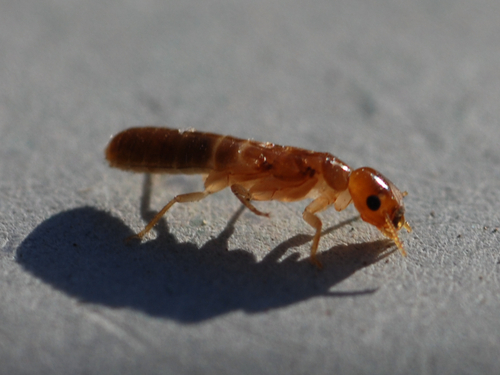
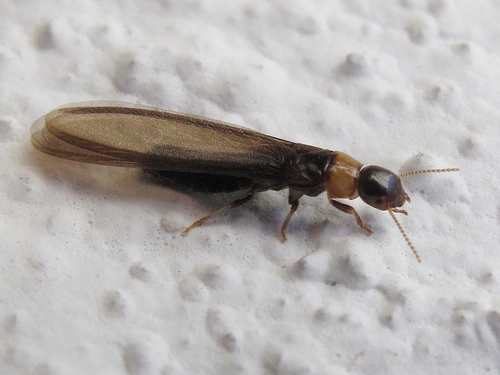
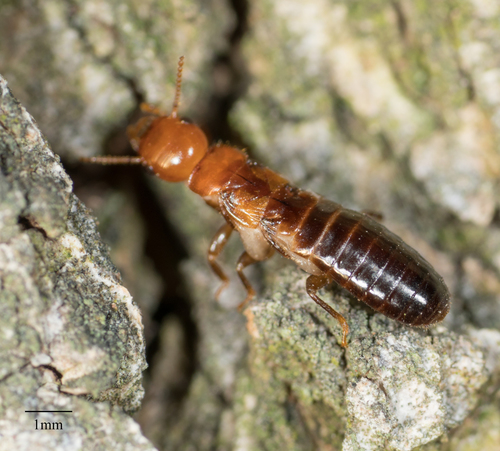
Incisitermes minor (Hagen, 1858), commonly called the western drywood termite, is a eusocial termite species with a caste system distinct from many other termites. A colony contains three recognized castes: alates (swarmers), soldiers, and non-typical reproductive worker caste members called pseudergates and nymphs. Alates have an orange-brown head and pronotum, with a dark brown 11–12.5 mm long abdomen; they are the only caste that leaves the colony to search for a mate, and successful mating pairs become the new kings and queens of founding colonies. Soldiers are large reddish-brown termites 8–12 mm long, weighing 20 to 25 mg, with two visible teeth on the left mandible and a notably enlarged third antennal segment. They average 0.4 inches in length, with a broad red head and black mandibles, and are larger than alates. Unlike many termite species, Incisitermes minor does not have a permanent sterile worker caste. Instead, it has pseudergates (false workers without wing pads) and nymphs (workers that have wing pads). Because neither group is sterile, nymphs can molt into soldiers or alates, and pseudergates can molt into male or female alates; all non-reproductive individuals retain the ability to develop into other castes, rather than being a fixed bottom worker class. Pseudergates are dark brown with an orange head. This species is native to western North America, where it is found in northern California, Oregon, and Washington in the United States, with most of its native California population in the Central Valley. It also occurs in central Arizona, and extends into Baja California and Sonora in Mexico. Isolated populations and infestations have been recorded outside this native range due to human transport: isolated groups are found in other U.S. states, particularly Florida, with confirmed infestations in Arkansas, Iowa, Maryland, New Jersey, New York, Oklahoma, Ohio, Georgia, South Carolina, Louisiana, China, and Japan. Its native range has a Mediterranean climate: relatively dry, with hot summers and low annual rainfall in many areas. It naturally occurs in California oak woodland and other local regional ecosystems, where it lives in trees. It builds nests in dead tissue of California bay laurel, willows, cottonwoods, oaks, and sycamores, as well as in stumps, fallen branches, and logs. Near human settlements, it also inhabits many native, introduced, and cultivated plant species, including roses, pyracantha, oleander, alder, ash, avocado, carob, citrus, elderberry, mulberry, walnut, and many species in the genus Prunus. It is able to survive in other climate types, as confirmed by its widespread isolated occurrences across North America (including many in Florida) and its established introduced population in Japan. It does not require living plants to survive, and can readily establish colonies in human-made wooden structures, making it a common household pest. It is most often introduced to new areas through shipments of wooden furniture and lumber, and has been observed colonizing outdoor wooden benches. In structures, it infests wood flooring, window frames, door frames, fascia boards, and soffits, and also occupies utility poles. In introduced Japanese populations, it is known to infest tatami. Reproduction occurs through swarming behavior, where large groups of alates gather to mate before dispersing to establish new colonies. In Southern California, alate swarming takes place from late September through November. Swarming occurs earlier in the day on warmer days, when temperatures fall between 26.7 and 37.8 °C (80.1 and 100.0 °F). Alates emerge from their natal wood nest and take flight once outside; they are poor fliers, so they rarely travel far from their emergence point. After landing, they shed their wings and crawl to search for a mate. When searching, females crawl forward with a male following behind; once a female accepts a male, the pair mates for life and becomes the new colony's king and queen. To start a new colony, the mated pair must find a piece of wood with an existing hole, enter it, and excavate a royal cell. This entire founding process takes three to four days. After excavating, the pair plugs the entrance hole with their gut contents, then enters a long period of inactivity that lasts approximately nine months. During this inactive period, the queen begins laying eggs. Eggs hatch after nine months, and the king and queen feed the first larvae until the young termites are able to excavate wood on their own. Once mature enough to feed independently, these first termites form the colony's wingless working group that forages and feeds subsequent generations, and they damage wood as they consume and digest it to support the nest. Over the first two years, as more eggs hatch, the colony grows to a small size that typically includes at least one soldier and around a dozen nymphs. Every individual goes through seven distinct developmental instars, and it takes approximately one year for an individual to develop from an egg to a mature adult. As the colony matures, the queen undergoes physogastry: her ovaries enlarge and her abdomen swells, while the king remains unchanged in size and form after shedding his wings. Mature working individuals can develop into either soldiers or new reproductive alates. These new alates leave the parent nest to swarm, mate, and found their own new colonies. Colonies of Incisitermes minor grow very slowly; visible feeding damage to wood does not appear until the colony is five to seven years old. Secondary reproductive pairs very rarely form, and multiple pairs only occur when two separate colonies merge. This termite feeds on wood and excavates wood similarly to other termites, but its feeding produces larger, more cavernous, irregular cavities inside the wood. It typically excavates toward the outer edge of a wood piece, but leaves a thin intact outer wood layer intact rather than breaking through the surface. This leaves the exterior of the wood appearing structurally sound, even as the inner wood is hollowed and weakened by feeding. It feeds on both dead tree branches and living tree tissue. There is a feeding hierarchy within the colony: an experiment using rubidium-marked filter paper found that not all colony members feed directly. Nymphs are the primary direct feeders (primary donors of food via trophallaxis), while larvae are the primary recipients of food that has already been consumed by other colony members. Alates may also require additional care from other colony members before they swarm. Feeding activity leaves few obvious external signs, aside from a small surface hole through which the termites eject their hard, evenly shaped fecal pellets. Fecal pellets are either accumulated in conical piles or scattered on horizontal wood surfaces. Each individual has unique cuticular hydrocarbons, and the species' fecal pellets carry the same signature hydrocarbons. Unlike many other termite species that host large bacterial and fungal communities within their colonies, Incisitermes minor prefers drier wood and maintains a very small bacterial and fungal microbial load. This species shows clear preferences for different wood types: it prefers wood that does not contain natural repellent chemicals, and is more likely to consume wood that its colony has already developed in. Douglas fir is the most preferred wood for feeding. Termites exposed to extracts of less preferred wood showed slightly higher mortality, confirming that wood type impacts individual survival. The least preferred wood tested was a commercial timber strain called Karamatsu wood, which experienced the lowest mass loss from feeding and is therefore the most resistant to infestation by this species.