About Incilius melanochlorus (Cope, 1877)
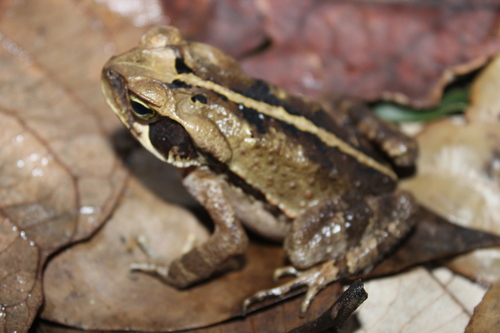
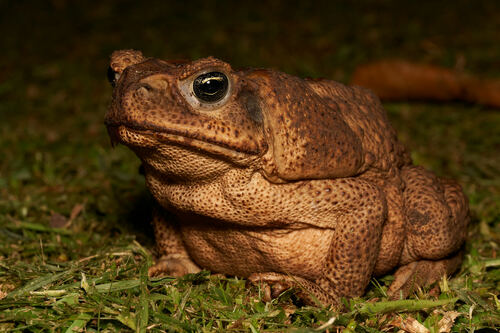
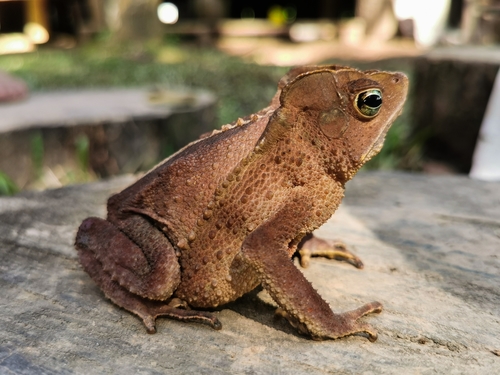
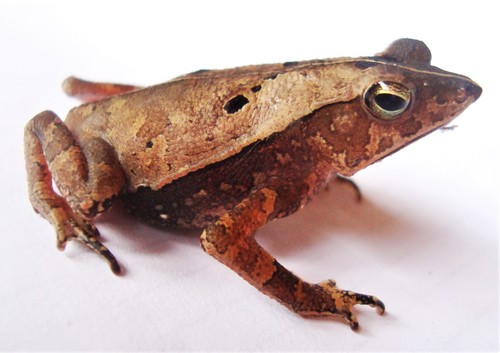
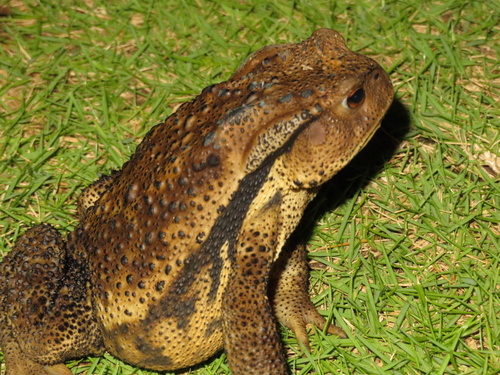
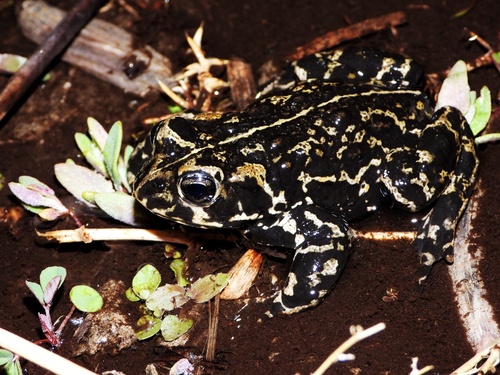
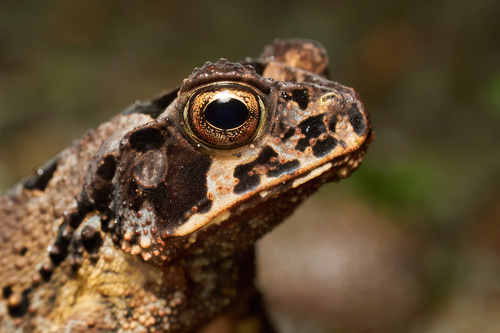
Incilius melanochlorus, first formally described by Cope in 1877, are moderately large toads that exhibit clear sexual dimorphism. Males reach a snout–vent length of 65 mm (2.6 in) to 74 mm (2.9 in), while females grow larger, between 103 mm (4.1 in) and 107 mm (4.2 in). In addition to greater size, females have more irregular dark dorsal colouration; males have longer heads and more robust forearms. The head of this species is wider than it is long, and bears well-developed, thin, high cranial crests, including canthal, supraorbital, postpreorbital, and parietal crests with transverse folds between them. These crests run from the nostril, behind the eye, to the back of the skull. The skin on the top of the head is hardened and adheres to the underlying skull. Males have a large, single-lobed, heavily pigmented vocal sac with a greenish tint that inflates fully to a round shape when calling; the small bilateral vocal slits that conceal the sac sit inside the throat. The eyes are large, with a coppery bronze iris divided into a lighter upper half and darker lower half by a thin dark line, and a black pupil. The tongue is long and thin. Paratoid glands are small (smaller than the upper eyelid) and triangular, and the tympanum is small. The hind limbs, tibia, and feet are all relatively short, but the toes are long and partially webbed. The first finger is longer than the second. Small tubercles sit underneath the fingers and toes; finger and toe tips may be either lighter in colour than the rest of the digit or the same colour. The tarsus (heel) has two differently shaped tubercles, one facing inward and one facing outward. The dorsum (back) is heavily warty, with generally smooth skin across most of the back except near the shoulders and hips, which bear small, low, rounded protrusions. The ventral surface is minutely roughened. A row of light-coloured, low to medium-sized, sharp but rounded spine-shaped warts runs along the upper edge of the lateral side, extending from the paratoid gland to the groin. The upper surface of the hind legs is covered in many large, pointed warts. The overall base colour is brown or grey, mottled with irregular splotches of dark grey or black. A light-coloured mid-dorsal stripe, which may be thin or thick, runs down the centre of the back. The dorsal base colour is light brown, often with lighter brown or pale grey bands along the sides of the back. Females and juveniles have darker brown mottling on the dorsum. The sides are dark, with a broad dark stripe positioned below the row of lateral warts. The ventral surface has a yellowish base, with black colouration on the throat and chest, and white spots along the edge of the lower jaw. A tan, square patch sits below each eye, extending to the lip, and a mottled dark brown area runs from the eye to the edge of the paratoid gland, forming a mask-like marking. The legs are mottled light and dark brown, with dark bars on the upper surface of the thighs. Juveniles are generally more brightly coloured than adults. The geographic range of Incilius melanochlorus has been revised repeatedly over time. In the 1960s, its range was thought to include Nicaragua, but in 1972 Villa determined all earlier Nicaraguan collections were misidentified Incilius luetkenii or I. valliceps, and the species was subsequently considered endemic to Costa Rica. In 2004, similar toads from the Pacific slopes of Costa Rica were reclassified as the new species I. aucoinae. As of 2008, it remained unclear whether I. melanochlorus still occurs on Costa Rica’s Pacific slopes, or if all records there are misidentified I. aucoinae. In 2005, McDiarmid and Savage documented the species in meadows on the Peninsula de Osa, extending its confirmed range to the Pacific slopes of far southwestern Costa Rica. Pounds et al. recorded in 1997 that I. melanochlorus disappeared from Monteverde, Costa Rica, in the late 1980s, then reappeared in the 1990s. The species was first correctly confirmed to occur in Nicaragua in 2004, when Gunther Köhler and his team found it in the Indio Maíz Biological Reserve; it was next recorded in Río San Juan during a 2009 Köhler-led expedition, and reported from the Pacific coast Rivas Department by a Nicaraguan team in 2014. In 2009, Jaramillo and Ibáñez extended the species’ confirmed distribution into Panama. The native habitats of Incilius melanochlorus are wet lowland rainforests and lower premontane wet forests, found at elevations up to around 1,080 m (3,540 ft) above sea level. The species favours areas near large streams and along forest edges. In northeastern Costa Rican rainforests, it occurs from sea level up to 2,000 m (6,600 ft) elevation, where only Eleutherodactylus frogs occur at higher altitudes. It is occasionally found in leaf litter on the forest floor. This is a nocturnal, insectivorous toad that becomes more active during light rain showers. Breeding occurs primarily during the dry season, with males calling from pools along rocky streams within 50 cm (20 in) of water between January and February, though males may occasionally call at other times of year. During the breeding season, males develop dark brown nuptial pads on their first and second fingers. While some sources state amplexus takes place in large streams, Savage (2002) notes breeding occurs in small, somewhat rocky-bottomed streams that are at seasonal low water during the dry season.