About Incilius alvarius (Girard, 1859)
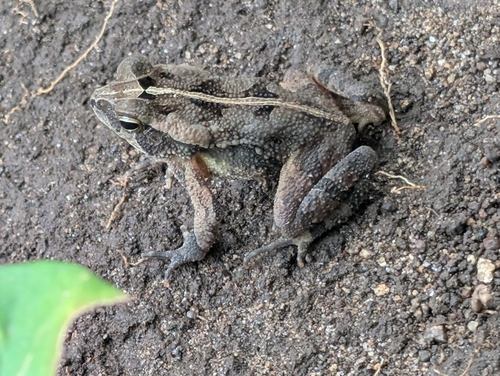
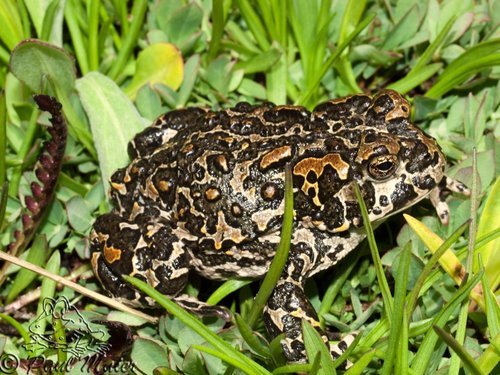
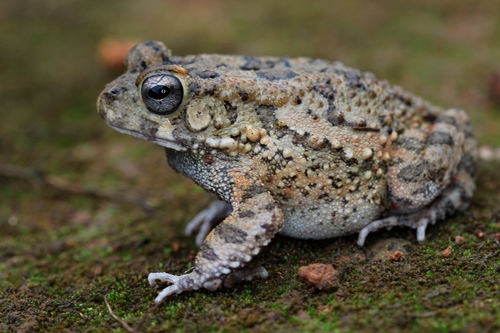
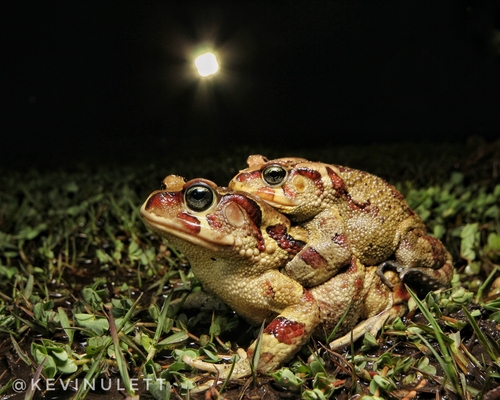
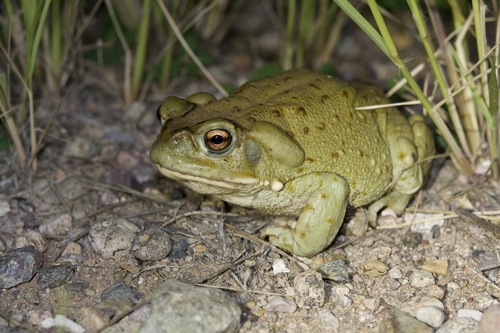
Incilius alvarius, commonly called the Colorado River toad, can grow to about 190 millimetres (7.5 in) long. It is the largest toad native to the United States, only outsized by the non-native cane toad (Rhinella marina). This toad has smooth, leathery skin that is olive green or mottled brown. Just behind its large golden eye with a horizontal pupil sits a bulging, kidney-shaped parotoid gland. Below this gland is a large circular pale green area that forms the tympanum, or ear drum. There is a white wart by the corner of the mouth, and white glands on the legs. All of these glands produce toxic secretions. Its call is described as "a weak, low-pitched toot, lasting less than a second." Dogs (Canis familiaris) that attack these toads can suffer paralysis or even death. Raccoons (Procyon lotor) have learned a feeding strategy to avoid the toad's poison glands: they pull the toad away from a pond by its back leg, flip it onto its back, and feed on its belly. Unlike most other vertebrates, this amphibian gets most of its water through osmotic absorption across its abdomen. Toads in the family Bufonidae have a specialized region of skin called the seat patch, which extends from the mid abdomen to the hind legs and is adapted for rapid rehydration. Most of the toad's rehydration happens by absorbing water from small pools or wet objects. In the United States, the Colorado River toad is found in the lower Colorado River and Gila River catchment areas, in extreme southwestern New Mexico and across most of southern Arizona. It is considered possibly extirpated from California. In Mexico, it occurs in the states of Sonora, Sinaloa, and Chihuahua. It lives in both desert and semi-arid areas across its range. It is semiaquatic, and is often found in streams, near springs, in canals and drainage ditches, and under water troughs. It is known to breed in artificial water bodies such as flood control impoundments and reservoirs, which may have recently altered its distribution and breeding habitat in south-central Arizona. It often lives in rodent burrows and is nocturnal. The toad's main defense system is glands that produce poison potent enough to kill a grown dog. Its parotoid glands also produce 5-methoxy-N,N-dimethyltryptamine (5-MeO-DMT) and bufotenin, which is named after the toad genus Bufo. Both of these chemicals are hallucinogenic tryptamines, and bufotenin can be toxic. When the poison is vaporized or smoked, a single deep inhalation produces strong psychoactive effects within 15 seconds that can last up to 20 minutes. After inhalation, users usually experience a warm sensation, euphoria, and strong visual and auditory hallucinations. This effect comes from 5-MeO-DMT's high affinity for the 5-HT2 and 5-HT1A serotonin receptor subtypes. Bufotenin occurs in the secretions and eggs of several toad species in the genus Bufo, but the Colorado River toad (Incilius alvarius) is the only toad species that has enough bufotenin to produce a psychoactive effect. Toad secretion extracts containing bufotenin and other bioactive compounds have been used in some traditional medicines, such as ch'an su, which is typically derived from Bufo gargarizans. Ch'an su has been used medicinally for centuries in China as a herbal remedy, and is often illegally imported to the USA, where it can be prepared as a tea. This toad has been recurrently depicted in Mesoamerican art. Some authors interpret this as evidence that the effects of ingesting Bufo secretions have been known in Mesoamerica for many years, but other scholars doubt this art provides sufficient ethnohistorical evidence to support the claim. In addition to bufotenin, Bufo secretions also contain digoxin-like cardiac glycosides, and ingesting this poison can be fatal. Ingestion of Bufo toad toxins and eggs by humans has led to several reported cases of poisoning, some of which have resulted in death. The first reported death linked to ingesting ch'an su was that of a young woman who consumed it as a Chinese herbal remedy prescribed by a Chinese herbalist, mixed into approximately 100ml of tea. Immediately after drinking the ch'an tea, the woman experienced vomiting, difficulty breathing, and gastric tenderness. Her husband took her to the emergency room, where she died two and a half hours after ingestion. Contemporary reports note that bufotenin-containing toad toxins have been used as a street drug: they are used as a supposed aphrodisiac when orally ingested in the form of ch'an su, and as a psychedelic when people smoke or orally ingest Bufo toad secretion or dried Bufo skins. The use of chan'su and love stone, a related toad toxin preparation used as an aphrodisiac in the West Indies, has caused several cases of poisoning and at least one death. The practice of orally ingesting toad secretions is referred to as "toad licking" in popular culture and scientific literature, and has drawn significant media attention. In 1984, Ken Nelson, writing under the pseudonym Albert Most with illustrations by Gail Patterson, published the booklet Bufo alvarius: The Psychedelic Toad of the Sonoran Desert, which explained how to extract and smoke the toad's secretions. Notable people who have spoken publicly about their experiences with the psychoactive compounds in the toad's poison include boxer Mike Tyson, comedian Chelsea Handler, podcaster Joe Rogan, television personality Christina Haack, and motivational speaker Anthony Robbins. On October 31, 2022, the United States National Park Service posted a humorous Facebook warning that people should not handle or lick the toad. While the warning received wide media coverage, the Park Service has no records of people licking or otherwise harassing these toads in national parks.