About Impatiens pallida Nutt.
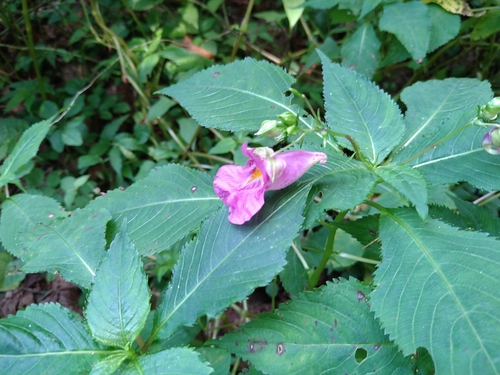
Impatiens pallida Nutt. can grow up to 2 metres (6 ft 7 in) tall. Its light green stems are smooth, slightly succulent, and branch frequently. Leaves are alternate, simple, hairless, and ovate with toothed margins, reaching up to 10 centimetres (4 in) long and 5 cm (2 in) across.
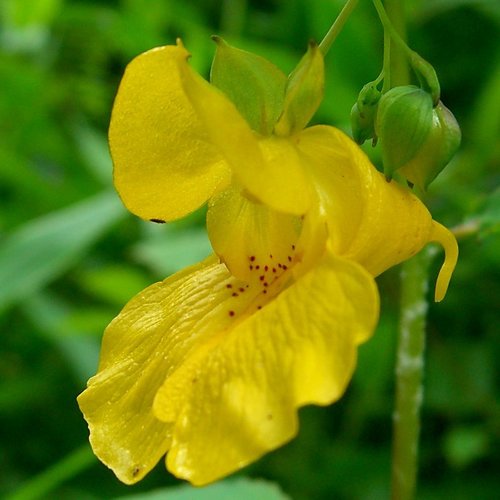
Its flowers are yellow with reddish spots on their faces, which distinguishes it from the similar species Impatiens capensis that has orange flowers. The flowers are tube or funnel shaped, 3–4 cm (1–1.5 in) long, and hold nectar in a narrow spur at the back of the bloom. Small clusters of flowers grow among the plant's upper leaves. After flowering, the plant produces a narrow seed pod up to 3 cm (1 in) long. When seeds are ripe, they explode out of the pod if touched, which gives the plant its common name of touch-me-not.
I. pallida is native to the United States, ranging east to Maine, north and west to North Dakota, and south to Georgia. In Canada, it is native to Ontario, Quebec, New Brunswick, Newfoundland, and Nova Scotia. It grows in wet, soggy soils, including areas along ponds and streams, in swamps, moist deciduous woodlands, and wet thickets.
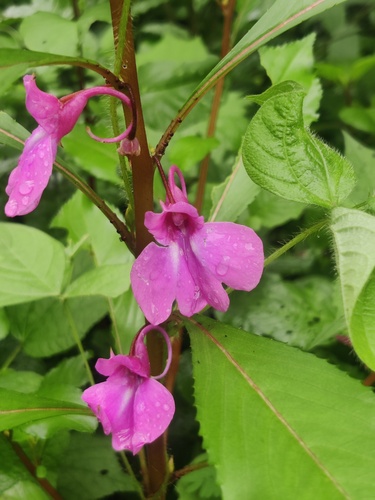
Nectar spurs are tubular elongations of flower petals and sepals that typically contain nectar. The nectar spurs of I. pallida are thought to have played a role in plant-pollinator coevolution. Most nectar spurs of this species are perpendicular, though some are curved. These flowers are partially or fully pollinated by insects, and the specific pollinator is determined by the curvature of the nectar spur. Because most I. pallida have perpendicular nectar spurs, bees are its main pollinators.
Like I. capensis, Impatiens pallida's young shoots can be boiled with two changes of water to be eaten as a potherb, and its seeds are also edible. Along with other jewelweed (touch-me-not) species, it is used as a traditional remedy for skin rashes.