About Impatiens glandulifera Royle
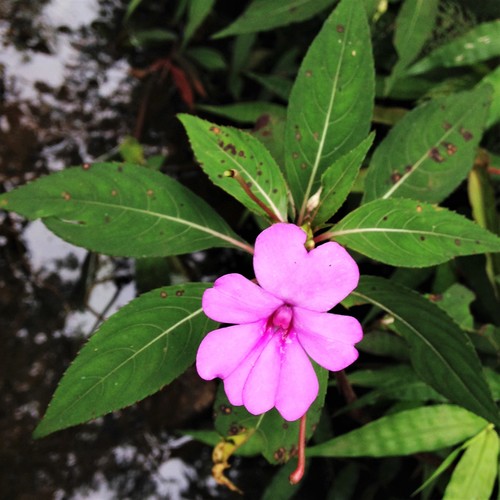
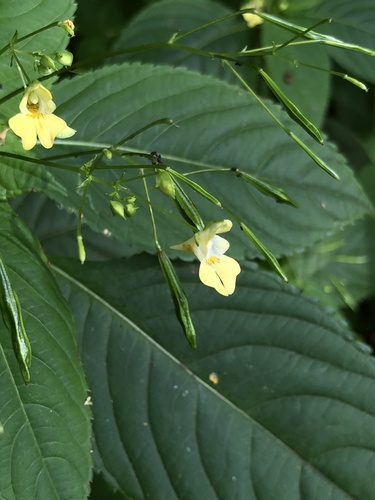
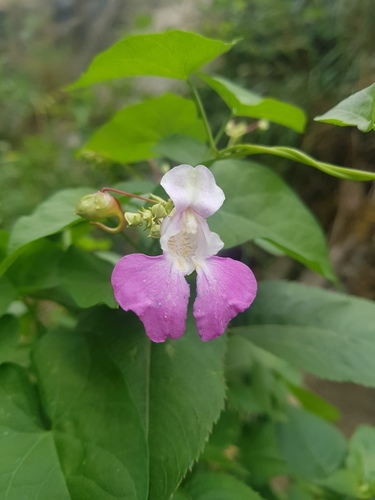
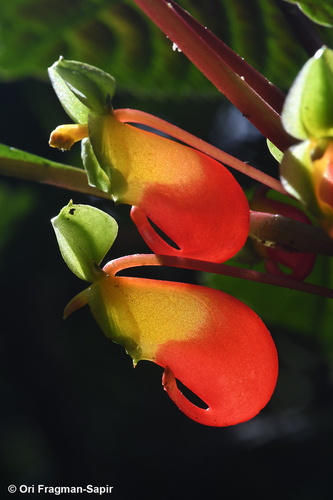
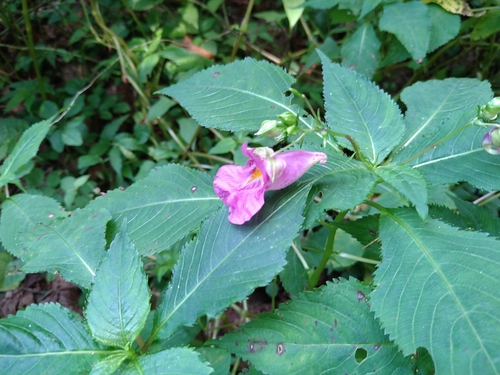
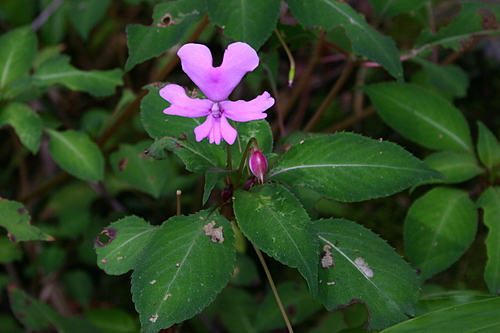
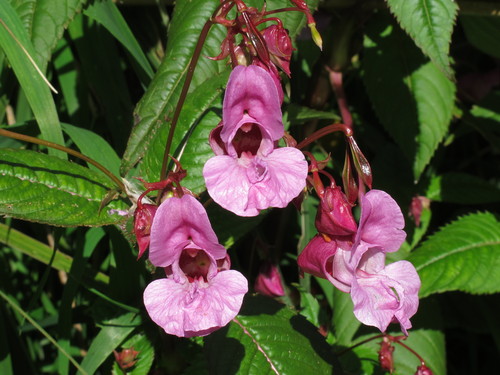
Impatiens glandulifera Royle, commonly called Himalayan balsam, typically grows 1 to 2 m (3.3 to 6.6 ft) high. It has a soft green or red-tinged stem, and lanceolate leaves that measure 5 to 23 cm (2.0 to 9.1 in) long. When crushed, its foliage gives off a strong musty smell. Glands located below the leaf stems produce a sticky, sweet-smelling, edible nectar. Its flowers are pink, hood-shaped, 3 to 4 cm (1+1⁄4 to 1+1⁄2 in) tall and 2 cm (3⁄4 in) broad; the flower shape is often compared to a policeman's helmet. Flowering occurs between June and October. After flowering, the plant develops seed pods that are 2 to 3 cm (3⁄4 to 1+1⁄4 in) long and 8 mm (1⁄4 in) broad. These pods explode when disturbed, scattering seeds up to 7 metres (23 feet) away. The green seed pods, seeds, young leaves, and shoots of Impatiens glandulifera are all edible, and its flowers can be used to make jam or parfait. In a UK plant survey conducted by the AgriLand project, which is supported by the UK Insect Pollinators Initiative, this species ranked first for daily nectar production per flower. However, when accounting for number of flowers per floral unit, flower abundance, and phenology, it dropped out of the top ten for most nectar per unit cover per year. This was also true for all other plants that placed in the top ten for daily per-flower nectar production, with the only exception being common comfrey (Symphytum officinale). Himalayan balsam is native to the Himalayas, specifically growing in areas between Kashmir and Uttarakhand. Within its native range, it usually occurs at altitudes between 2000 and 2500 m above sea level, though it has been recorded at up to 4000 m above sea level. It was first introduced to Europe in the United Kingdom by John Forbes Royle, who was a professor of medicine at King's College, London and later became Superintendent of the Botanic Gardens, Saharanpur, India. It is now naturalized and widespread across European riverbanks, and can currently be found almost everywhere across the continent. In North America, it has been recorded in the Canadian provinces of British Columbia, Manitoba, Ontario, Quebec, Nova Scotia, New Brunswick, Prince Edward Island, and Newfoundland. In the United States, it occurs on both the east and west coast, and appears to be restricted to northern latitudes. In New Zealand, it is sometimes found growing wild along riverbanks and in wetlands. While Himalayan balsam is edible, it should only be eaten in moderation because it contains oxalates.