About Impatiens capensis Meerb.
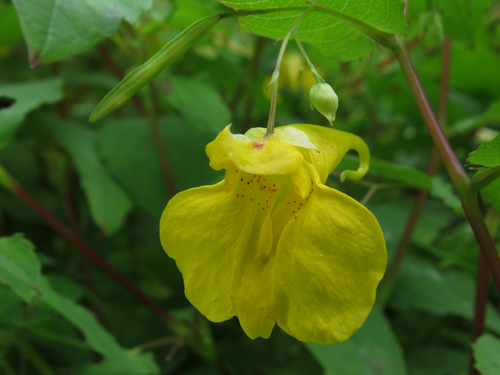
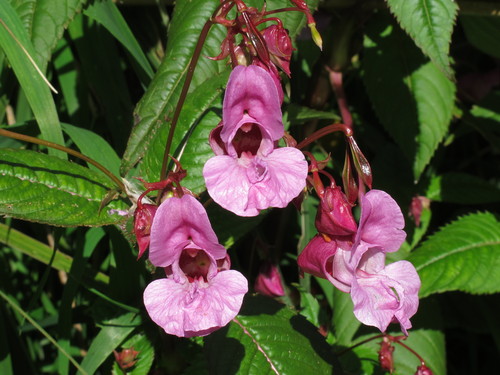
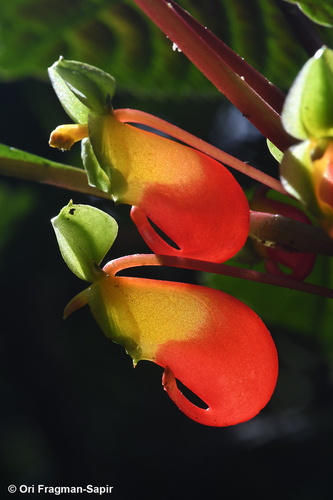
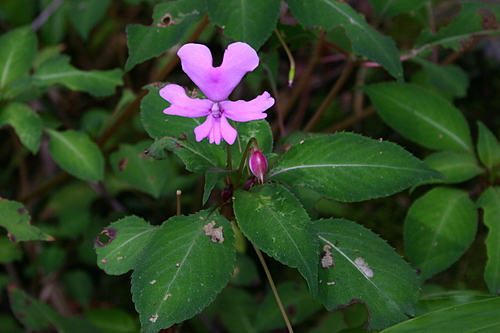
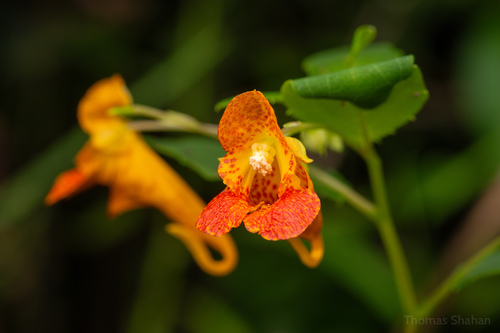
Impatiens capensis Meerb., commonly called jewelweed or touch-me-not, is a herbaceous plant that reaches 0.9–1.5 m (3–5 ft) in height, and often branches heavily. Its round stems are glabrous (smooth), succulent, semi-translucent, and some plants have swollen or darkened nodes at stem joints. Leaves grow up to 13 cm (5 in) long and 6 cm (2+1⁄2 in) across; they are arranged alternately on upper stems and oppositely on lower stems when lower stems are present. Leaves are simple, ovate to elliptic in shape, and have shallow, rounded teeth along their margins. Mature seed pods of this plant have five valves that coil back rapidly to eject seeds, a process called explosive dehiscence or ballistochory. This reaction, which can be easily triggered by a light touch to a mature pod, gives the species its common name 'touch-me-not'. The plant blooms from late spring to early fall. Its showy flowers are 2–3 cm (3⁄4–1+1⁄4 in) long, most often orange (sometimes darker blood orange, and rarely yellow), with a three-lobed corolla. One of the calyx lobes matches the corolla's color and forms a hooked conical spur at the back of the flower. Plants may also produce non-showy cleistogamous flowers that do not require cross-pollination. Impatiens capensis was transported from its original range to England, France, the Netherlands, Poland, Sweden, Finland, and potentially other areas of northern and central Europe during the 19th and 20th centuries. These introduced populations persist naturally without regular human cultivation. This species is very similar to Impatiens noli-tangere, an Impatiens native to Europe and Asia, as well as to other North American Impatiens. While the two species occupy very similar habitats, there is no documented evidence of natural hybrids between them. In the U.S. state of Washington, I. capensis is classified as a class-C noxious weed, because it spreads rapidly and tends to outcompete native jewelweed species. It has also formed a stable hybrid species with the native jewelweed Impatiens ecornuta. Nectar spurs are tubular elongated outgrowths of flower petals and sepals that typically hold nectar. The flowers of I. capensis have these nectar spurs, which are thought to have contributed to plant-pollinator coevolution. The curvature angle of I. capensis nectar spurs is highly variable, ranging from 0 degrees to 270 degrees. The spur angle strongly affects the pollination of the flower and which pollinator is most efficient for the species. Hummingbirds are the major pollinators of I. capensis; they remove more pollen per visit from flowers with curved nectar spurs than from flowers with perpendicular nectar spurs. Hummingbirds are not the only pollinators, however: bees, especially bumblebees, also play an important role in pollinating the plant. Thanks to visits from both hummingbirds and bees, I. capensis has very high pollination success. As a food source, the young shoots of I. capensis can be boiled with two changes of water and eaten as a potherb. Eating large amounts is not recommended, because the plant contains calcium oxalate crystals. Its seeds are also edible, and are best collected before the pods eject them. For medicinal use, the juice from the leaves and stems of I. capensis, along with other jewelweed species, is a traditional Native American remedy for skin rashes, including poison ivy rash. Peer-reviewed studies have supported that the juice is effective at preventing rash development after short-term exposure to poison ivy, and this effectiveness is likely due to saponins present in the plant. These same studies also found that some people have a sensitivity to jewelweed that can cause a more severe rash. The stem juice has also been used to treat athlete's foot, and its fungicidal properties have been scientifically verified.