About Imantodes cenchoa (Linnaeus, 1758)
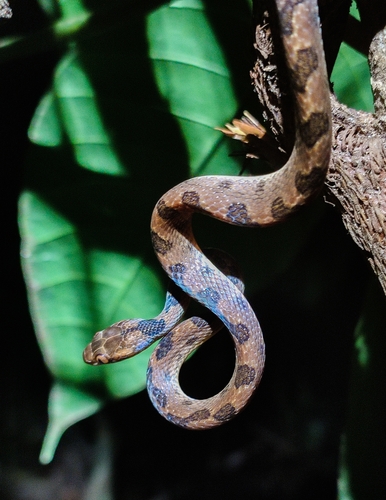
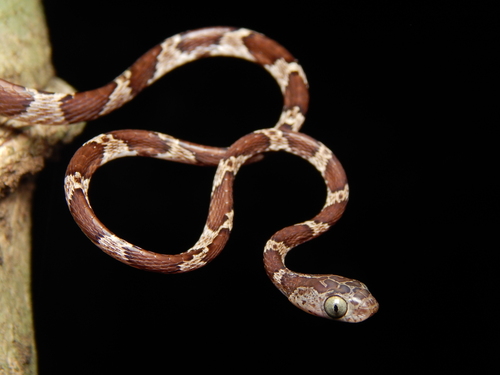
Imantodes cenchoa, commonly called the blunthead tree snake, averages about 800 mm (31 inches) in total length including the tail, with a maximum recorded total length of about 1.5 meters (4 feet 11 inches). This species is characterized by a long, very slender body and an unusually large head. Its eye pupil differs distinctly from those of most other snakes: while most snakes worldwide have poor vision and rely primarily on smell and vibrations to detect prey and predators, arboreal snake species generally have much better vision than other snakes. The blunthead tree snake has a vertical slit pupil that lets it look downward, giving this species an advantage over other snakes. Its large eyes make up approximately 26% of the total length of its head. The ventral (belly) surface of this snake is mostly white, while the dorsal (upper) surface is light or pale brown, with dark brown lateral patches that run from the head all the way down the body. Northern and southern populations of this species show differing patterns of sexual dimorphism, meaning the two sexes have different physical traits within the same species. For example, males from northern populations have slightly longer tails, while males from southern populations have shorter tails. In some regions, females typically have much larger heads than males of the species. The blunthead tree snake is an arboreal species, meaning it lives in trees and vegetation. It is most often found in low-growing vegetation such as coffee trees or bromeliads, and prefers cool, moist habitats including wet forests and rainforests. It occurs at altitudes ranging from sea level up to 1,700 meters (5,600 feet). This species is found in Mexico, most of Central America, and parts of South America as far south as the northernmost part of Argentina. Specifically, it has been recorded in eastern Mexico, Guatemala, Honduras, Belize, El Salvador, Nicaragua, Costa Rica, Panama, Colombia, Venezuela, Trinidad and Tobago, French Guiana, Brazil, Ecuador, Peru, Bolivia, Paraguay, and northern Argentina. The blunthead tree snake is a polygynandrous reptile. Its mating season varies based on the rainy season of its local habitat. Some populations mate year-round, while others have mating seasons synchronized to their local wet and rainy seasons. In areas with long rainy seasons, this species generally has a much longer mating season than populations in areas with shorter rainy seasons. The blunthead tree snake is oviparous, meaning it lays eggs and has little or no embryonic development within the mother’s body. Some populations have continuous year-round reproduction depending on their local environment, but in regions with seasonal rainfall, egg laying and hatching align with the rainy season. For example, in Guatemala and Mexico, females lay their eggs between June and July, and the eggs hatch around July and August, which matches these countries’ typical rainy seasons. In contrast, populations in Brazil have continuous reproduction; their eggs are laid from November to January and hatch from March through August. Both male and female blunthead tree snakes reach sexual maturity about two years after hatching, or at a snout-to-vent length of around 620 mm (24 in). Females lay a clutch of one to three eggs per breeding season, with clutch size varying based on the female’s size, feeding habits, and environmental factors. After laying eggs, females leave them and provide no parental care.