About Illicium anisatum L.
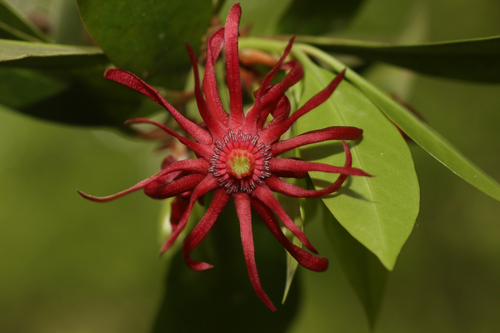
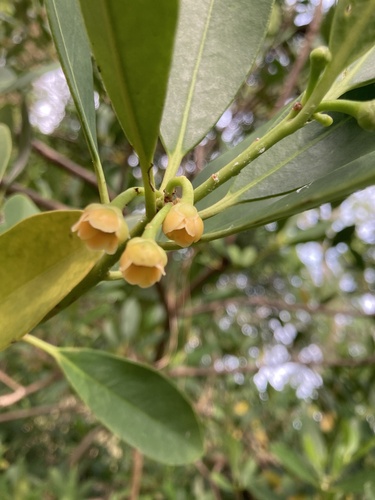
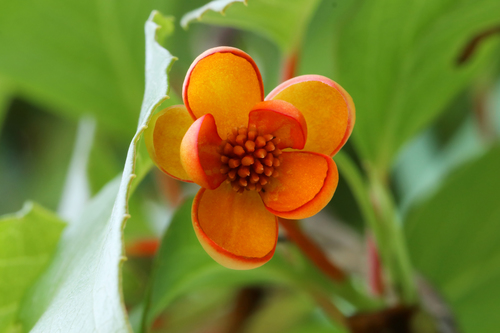
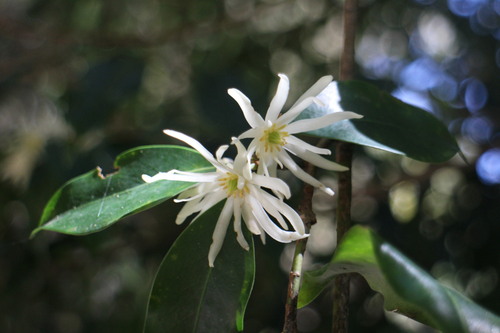
Illicium anisatum L., commonly called Japanese star anise, aniseed tree, and sacred anise tree, and known as shikimi in Japanese, is an evergreen shrub or small tree that is closely related to the edible Chinese star anise (Illicium verum). This plant is highly toxic, so its fruit is not edible. In Japan, dried and powdered leaves of Illicium anisatum are burned as incense. Japanese Buddhists consider its branches and evergreen leaves highly sacred, because insects avoid the plant and its foliage stays fresh after pruning. The sacred anise tree is native to parts of East Asia, including Japan, South Korea, and Taiwan. It typically reaches a height of 6 to 15 feet (1.8 to 4.6 m). Its leaves are simple, alternately arranged, oval-shaped, and 1 to 3 inches (2.5 to 7.6 cm) long. Its cream or white flowers have numerous petals and grow in clusters around leaf axils. Its fruit is a dry follicle that is similar in form to Chinese star anise, but is toxic, smaller, and has a weaker odor that is said to be more similar to cardamom than to anise. Because it is poisonous, its seeds have been used as a fish poison, a natural agricultural pesticide, and a repellent to keep animals from digging in Japanese graveyards. The seeds are also used topically as medicine to treat toothache and dermatitis, as the plant is not suitable for internal use. Japanese star anise contains anisatin, shikimin, and shikimitoxin, which cause severe inflammation of the kidneys, urinary tract, and digestive organs. Safrole and eugenol are additional compounds found in toxic Illicium species including this one; these compounds are not present in edible Chinese star anise, and can be used to confirm the toxicity of Illicium samples. Shikimic acid, a compound also found in Japanese star anise, is named after the plant's Japanese name. Because Japanese star anise and Chinese star anise are morphologically similar, they cannot be distinguished by appearance alone when dried or processed. Only botanical microscopy can identify them with certainty, and this testing must be done before the plants are dried and processed into tea. Product recalls have been reported when star anise-containing products were found to be contaminated with Japanese star anise. Hospitalizations of consumers with neurological symptoms have occurred after people ingested excessive doses of star anise, or smaller doses of products contaminated with Japanese star anise. In Europe, Chinese star anise tea is often used as a stress-relieving tea. Cases of illness have been recorded in France, Spain, and Switzerland after people consumed Chinese star anise tea contaminated with Japanese star anise. This contamination led to many hospitalizations, with patients experiencing epilepsy, hallucinations, and nausea, all caused by the toxin anisatin from Japanese star anise. In 2001, a large toxicity outbreak occurred in the Netherlands after a multi-ingredient tea blend containing more than six different plants was accidentally contaminated with Japanese star anise.