About Illex illecebrosus (Lesueur, 1821)
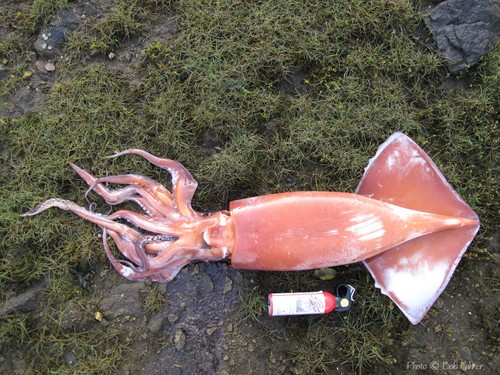
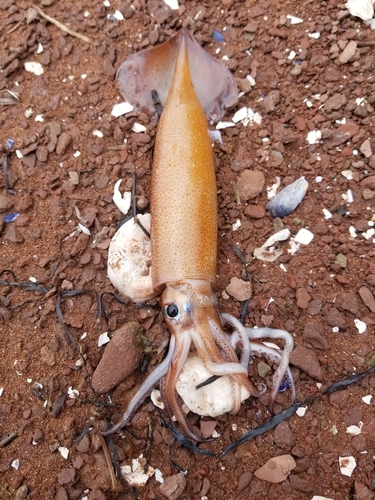
Illex illecebrosus, commonly known as the northern shortfin squid, is a moderately sized squid species. Females have a mantle length of 20 to 30 centimetres (7.9 to 11.8 inches), while males are generally smaller, with a mantle length ranging from 18 to 27 cm (7.1 to 10.6 inches). This species has short tentacles and a long, narrow head that connects to a long mantle. Its fins are shorter along the axis parallel to the mantle, and roughly twice as long along the axis perpendicular to the mantle. The squid’s coloration ranges from reddish brown to purple; the head and mantle have higher opacity, while the rest of the body carries a yellowish green tint. Northern shortfin squid are highly migratory, with seasonal distribution patterns. They migrate between boreal, temperate, and subtropical waters, traveling distances as far as 1,000 miles. Their overall range spans between 66°N and 29°N; they are distributed off central Florida, Newfoundland and Labrador, and spawn in waters from south of Cape Hatteras to central Florida. They inhabit both oceanic and neritic ocean zones, and are most abundant off the coasts of Newfoundland and New Jersey. Northern shortfin squid spawn year-round. Individuals spawned in winter have higher recruitment survival, as winter conditions are optimal for growth that supports their spawning migration. Hatching occurs from June to December, and is most common between July and November. Sex does not affect the growth rate of total body mass overall, but hatching month does affect growth rate: later hatching individuals grow faster. Across most of their range, females grow faster than males, and the species grows quickly with a linear growth rate measured by increasing mantle length. However, habitat conditions alter this trend: in the waters off Newfoundland and Nova Scotia, males grow faster than females. Juveniles have a mantle length of 34 to 66 mm (1.3 to 2.6 inches), while adults can reach a maximum mantle length of 35 cm (14 inches). Individuals living in warmer waters, particularly in the Mid-Atlantic region, grow more rapidly.