About Ilex paraguariensis A.St.-Hil.
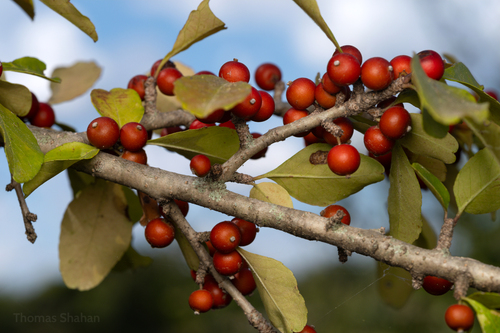
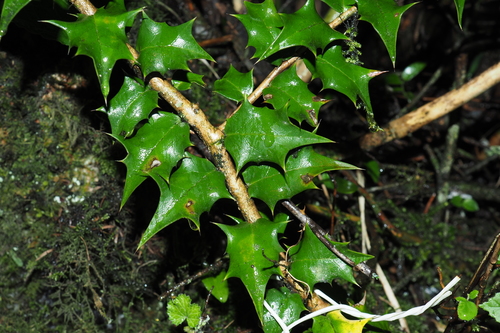
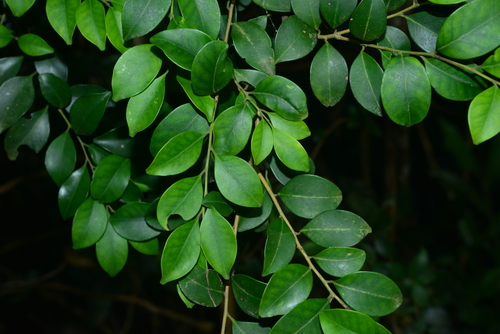
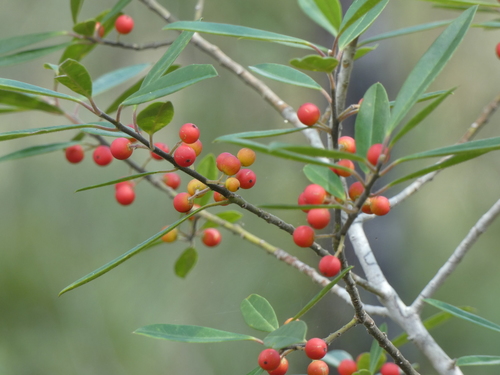
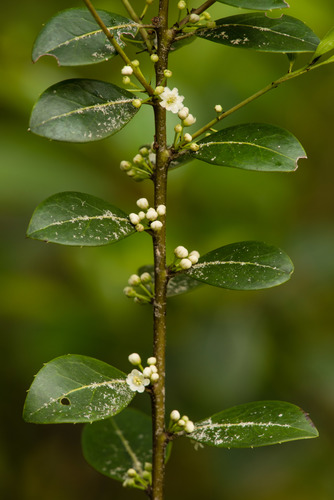
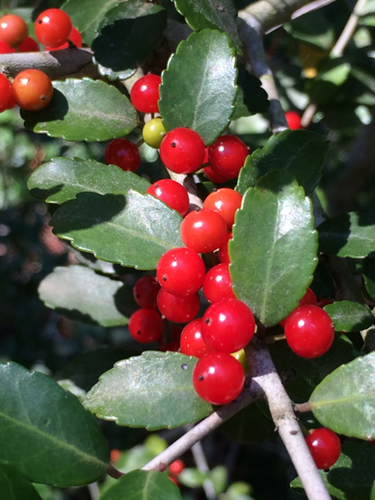
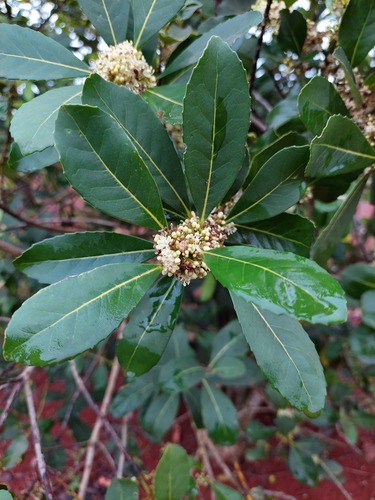
Ilex paraguariensis starts growing as a shrub and matures into a tree, reaching up to 15 meters (50 ft) in height. Its evergreen leaves are 7–110 millimeters (1⁄4–4+3⁄8 in) long and 30–55 millimeters (1+1⁄8–2+1⁄8 in) wide, with serrated margins. The leaves are called yerba in Spanish and erva in Portuguese, both words meaning "herb". They contain caffeine, which is referred to as mateine in some regions, along with related xanthine alkaloids, and are harvested commercially. The plant produces small, greenish-white flowers with four petals, and its fruit is a red drupe 4–6 millimeters (5⁄32–1⁄4 in) in diameter. A 2001 report by Junqueira noted the presence of extrafloral nectaries on the species' leaves.
The yerba mate plant is grown and processed in its native South American regions, specifically Paraguay, parts of northern Argentina (Misiones), Uruguay, and southern Brazil (Rio Grande do Sul, Santa Catarina, Paraná, and Mato Grosso do Sul). Cultivators of the plant are called yerbateros in Spanish and ervateiros in Brazilian Portuguese. Seeds for growing new plants are harvested after they turn dark purple, typically between January and April. After harvesting, seeds are submerged in water to remove floating non-viable seeds and detritus such as twigs and leaves. New plantings are started between March and May. Potted seedlings are transplanted from April through September, while bare-root plants are only transplanted in June and July.
Many natural enemies of yerba mate are hard to control in plantation settings. Insect pests include Gyropsylla spegazziniana, a true bug that lays eggs in branches; Hedyphates betulinus, a beetle that weakens the tree and makes it more vulnerable to mold and mildew; Perigonia lusca, a moth whose larvae feed on leaves; and multiple species of mites. Perigonia lusca can be controlled with a nuclear polyhedrosis virus used as a biopesticide, which was first applied for this purpose in 1992.
When I. paraguariensis is harvested, its branches are often dried over a wood fire, which gives the resulting product a smoky flavor. Flavor strength, caffeine content, and other nutrient levels vary between male and female plants. Female plants tend to have a milder flavor and lower caffeine content, and they are relatively scarce in cultivated yerba mate growing areas. According to 2012 data from the Food and Agriculture Organization, Brazil is the world's largest producer of mate, growing 513,256 tonnes (565,768 short tons), which accounts for 58% of global production. Argentina follows with 290,000 tonnes (320,000 short tons), 32% of global production, and Paraguay produces 85,490 tonnes (94,240 short tons), 10% of global production.
The infusion made from I. paraguariensis leaves is called mate in Spanish-speaking countries and chimarrão in Brazil. To prepare it, a container (traditionally a small hollowed-out gourd) is filled up to three-quarters full with dried leaves and twigs of the plant, then topped up with water heated to 70–80 °C (160–175 °F), which is hot but not boiling. Sugar may be added or omitted. The infusion can also be made with cold water, in which case it is called tereré.
Drinking mate is a common social practice among people of all ages in Paraguay, Uruguay, Argentina, Southern Brazil, and Southern Chile, and it is often a communal ritual that follows established customary rules. Friends and family share the same container, traditionally a hollow gourd (called guampa, porongo, or simply mate in Spanish, cabaça or cuia in Portuguese, and zucca in Italian), and drink through the same wooden or metal straw (called bombilla in Spanish and bomba in Portuguese). The brewer passes the gourd to each person in turn, usually moving in a circle. The recipient drinks the few mouthfuls in the container, then returns it to the brewer, who refills it and passes it to the next person clockwise. Recipients do not give thanks until they have finished drinking, and giving thanks early indicates they do not want any more servings. While traditional mate containers are made from hollowed calabash gourds, modern mate gourds are made from a range of materials including wood, glass, bull horns, ceramic, and silicone.
Similarly to how people gather for tea or coffee, friends often meet to drink mate (an activity called matear) in Paraguay, Argentina, Southern Brazil, Uruguay, and Southern Chile. In warm weather, hot water is sometimes replaced with lemonade. Paraguayans typically drink yerba mate with cold water on hot days and with hot water in the morning and during cooler weather. Yerba mate is most popular in Paraguay and Uruguay, where people often walk through public spaces carrying their mate and a thermal vacuum flask called a termo. Per capita annual consumption of yerba mate is 5 kg (11 lb) in Argentina; in Uruguay, which has the highest consumption rate, per capita annual consumption reaches 10 kg (22 lb). The large annual consumption by weight comes from the fact that much more herb is used to prepare mate than for tea or other beverages.
The flavor of brewed mate resembles an infusion of vegetables, herbs, and grass, and is similar to some varieties of green tea. Some people find the flavor very pleasant, but it is generally bitter when steeped in hot water. Sweetened and flavored mate products are also available, which blend mate leaves with other herbs such as peppermint or citrus rind.
In Paraguay, Brazil, and Argentina, a version of mate called mate cocido (or simply mate or cocido) in Paraguay and chá mate in Brazil is sold in teabags and as loose leaf. It is often served sweetened in specialist shops or on the street, served hot or iced, plain or mixed with fruit juice (especially lime, called limão in Brazil) or milk. In Paraguay, Argentina, and Southern Brazil, this version is commonly consumed for breakfast or at a café for afternoon tea, often paired with sweet pastries called facturas.
An iced, sweetened version of mate cocido is sold as an uncarbonated soft drink, with or without added fruit flavoring. In Brazil, this cold version of chá mate is especially popular in the south and southeast regions, and is widely available in retail stores in the same cooler as other soft drinks. Mate batido is a toasted version of yerba mate that has less bitter flavor and a stronger spicy fragrance. It becomes creamy when shaken, and is more popular in coastal cities of Brazil, in contrast to far southern Brazilian states where the traditional green preparation, consumed from a shared gourd with a silver straw, called chimarrão (cimarrón in Spanish, particularly Argentine Spanish), is more common.
In Paraguay, Southern Brazil (Mato Grosso do Sul, west of São Paulo and Paraná), and the Argentine littoral, a mate infusion called tereré in Spanish and Portuguese (sometimes tererê in Gaúcho, Caipira and Sulista Portuguese) is consumed as a cold or iced beverage, usually drunk from a horn cup called a guampa through a bombilla. The Guarani people drank the beverage in this cold format, but without ice, as they did not have technology to create or store ice. For this reason, tereré is recognized as the first and original way to consume mate. Tereré can be made with cold water, the most common preparation in Paraguay and Brazil, or with fruit juice, the most common preparation in Argentina. The water-based version is more bitter, and fruit juice acts as a sweetener; in Brazil, table sugar is usually added instead when making the water-based version. Medicinal or culinary herbs, called yuyos, may be crushed with a pestle and mortar and added to the water for flavor or for medicinal reasons.
Paraguayans have a tradition of mixing mate with crushed leaves, stems, and flowers of the plant known as flor de agosto (the flower of August, which refers to plants of the genus Senecio, particularly Senecio grisebachii). These plants contain pyrrolizidine alkaloids, so modifying mate in this way is potentially toxic. These alkaloids can cause veno-occlusive disease, a rare liver condition that leads to liver failure from progressive blockage of the liver's small venous channels.
Yerba mate has also become popular outside of South America. In the small hamlet of Groot Marico, North West Province, South Africa, mate was introduced to the local tourism office by returning descendants of Boers who emigrated to Argentine Patagonia in 1902 after losing the Second Boer War. It is also commonly consumed in Lebanon, Syria, and other parts of the Middle East, mainly by Druze and Alawite people. Most of its popularity outside South America comes from historical emigration to South America followed by return migration. It is consumed worldwide by expatriates from the Southern Cone. Materva is a sweet, carbonated soft drink based on yerba mate. It was developed in Cuba in 1920, and has been produced in Miami, Florida since the 1960s, where it is a staple of Cuban culture in Miami.