About Ilex opaca Aiton
Ilex opaca Aiton, commonly called American holly, is a medium-sized broadleaved evergreen tree. On average it grows 10–20 m (33–66 ft) wide, and can reach up to 30 m (98 ft) in height. Its trunk typically reaches 50 cm (20 in) in diameter, occasionally growing as large as 120 cm (47 in) across. The bark is light gray, roughened by small warty lumps. Young branchlets are stout, green, and covered in rust-colored down, maturing to become smooth and brown. Winter buds are brown, short, and can be either obtuse or acute. Its branches are short and slender, and its roots are thick and fleshy.
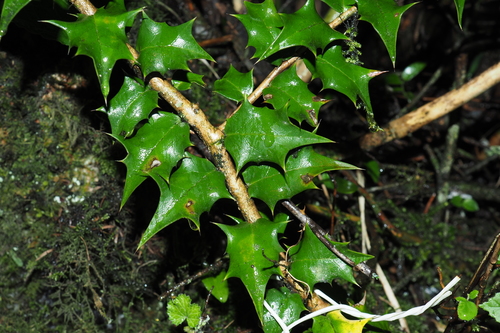
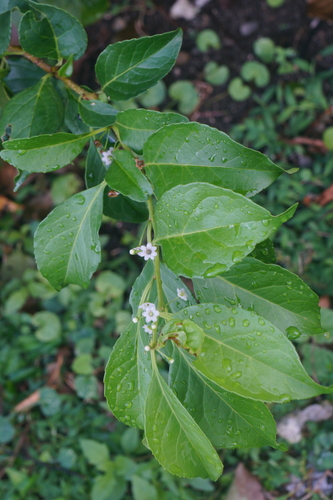
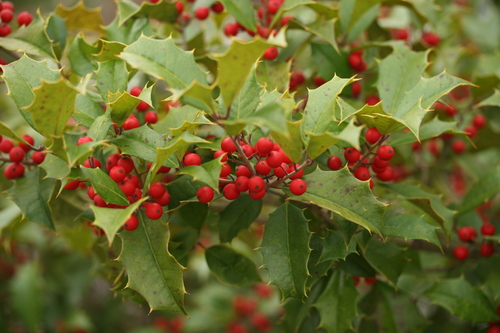
The leaves are arranged alternately along stems, and measure 5–7.5 cm (2.0–3.0 in) long by 2–4 cm (0.79–1.57 in) wide. They are stiff, with a dull matte to sub-shiny yellow-green upper surface that is noticeably less glossy than the similar European holly (Ilex aquifolium); the underside of the leaves is often pale yellow. Leaf edges curve inward and bear several sharp, spike-like points, and leaves have a wedge-shaped base and acute apex. The midrib is prominent and depressed, while primary veins are conspicuous. The petiole is short, stout, grooved, thickened at the base, and bears a pair of minute stipules. Leaves stay on branches for two to three years, and finally fall in spring when they are pushed off by new growing buds.
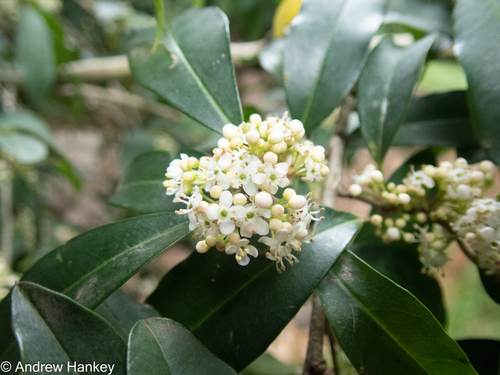
Flowers are small, greenish white, and are produced in late spring in short, stalked cymes. They grow from the axils of young leaves or scattered along the base of young branches. The small calyx is four-lobed, overlapping in the bud, with acute, ciliate margins, and is persistent. The corolla is white, with four petal-like lobes united at the base; lobes are obtuse, spreading, hypogynous, and overlapping in bud. The flower stalk is hairy and has a tiny bract at its base.
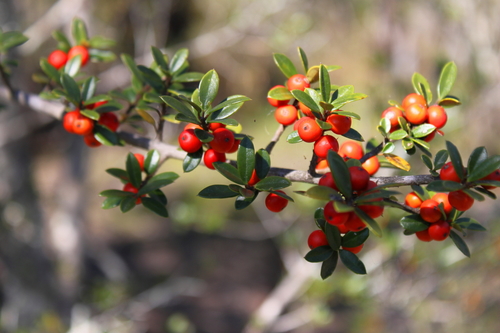
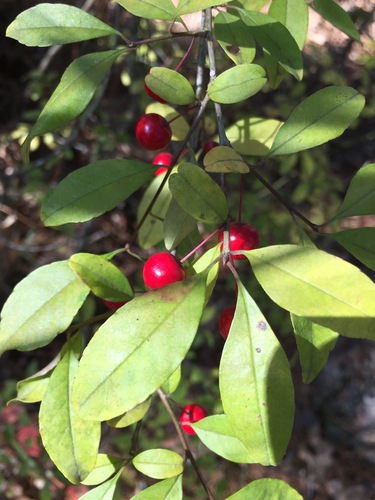
Like all hollies, Ilex opaca is dioecious: male and female flowers are borne on separate plants, and only female plants produce the characteristic red berries. The fruit (drupes) develop late in the growing season, and often remain on the tree until midwinter. These berries are poisonous to dogs, cats, and humans; ingestion often causes diarrhea, vomiting, dehydration, and drowsiness. Chickens can safely eat large quantities of the berries, which has led to the common local name "chicken apples" for the fruits. During their northward migration, cedar waxwings (Bombycilla cedrorum) will remove all fruit from the tree if it is not already bare. A single male plant can pollinate multiple female plants. For ideal fruit production, a ratio of three female plants to one male plant is recommended.
Male flowers have four stamens inserted at the base of the corolla, alternating with the corolla lobes. Filaments are awl-shaped, and anthers are attached at the back, oblong, introrse, and two-celled, with cells opening longitudinally. The pistil in female flowers has a superior four-celled ovary (which is rudimentary in male flowers); no style is present, the stigma is sessile and four-lobed, and there are one or two ovules per cell. The fruit is a small red drupe 6–12 mm in diameter containing four seeds, and often persists on the tree into winter. The current record holder for the largest American holly tree, recognized by the National Forests Champion Trees Official Register, is located in Rose Bud, White County, Arkansas, with a trunk circumference of 182 inches, a height of 64 feet, and a crown spread of 63 feet.
Due to its shade tolerance, Ilex opaca most commonly grows as an understory tree in moist forests of the east-central, southeastern, and south-central United States. It occurs in sparse numbers in the northern part of its range, extending from Cape Cod, Massachusetts, south to northern New Jersey, including southern Connecticut and southeastern New York (Long Island). It is abundant further south on the Gulf and Atlantic lowlands. It will grow in both dry and swampy soil, but grows slowly. Ilex opaca var. arenicola, called scrub holly, occurs as a shrub component in xeric scrub habitats of the Florida peninsula. The ideal average yearly precipitation for the species ranges from 102 cm to 165 cm.
Its flowers are pollinated by insects, including bees, wasps, ants, and night-flying moths. It is a larval host plant for Callophrys henrici. The tree forms a thick canopy that provides protection for birds from predators and storms. Songbirds including thrushes, mockingbirds, catbirds, bluebirds and thrashers, as well as some gamebirds and mammals, frequently feed on its berries.
The wood of Ilex opaca is very pale, tough, and close-grained, and takes a good polish. It is used for whip-handles, engraving blocks, and cabinet work. It can also be dyed and used as a substitute for ebony. Its density ranges from 0.58 to 0.64. The sap is watery and contains a bitter substance used as an herbal tonic. Leaves can be used to make a caffeine-free, tea-like beverage.