About Ilex decidua Walter
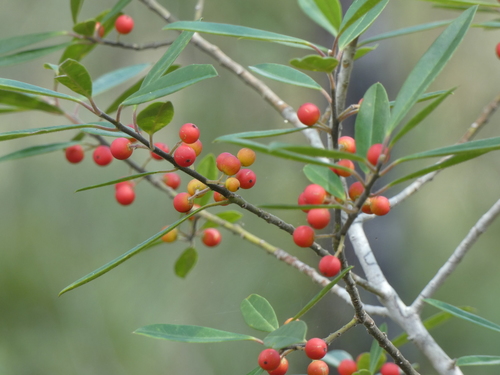
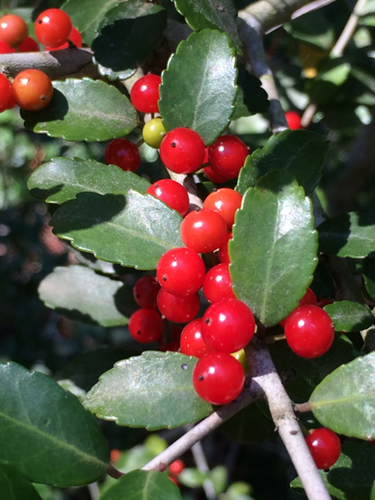
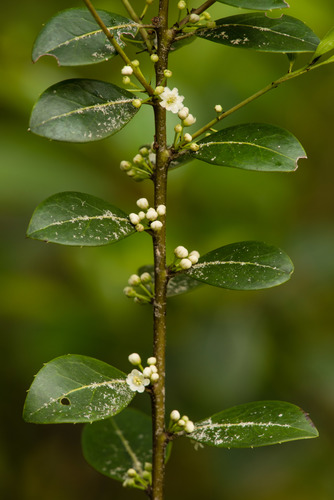
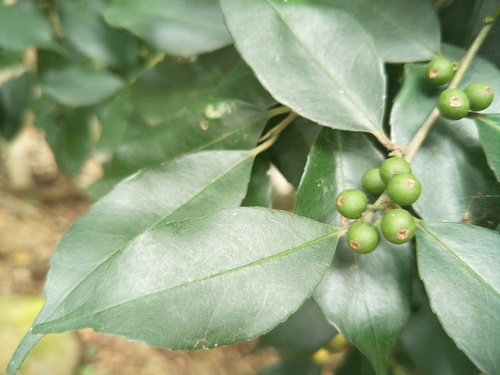
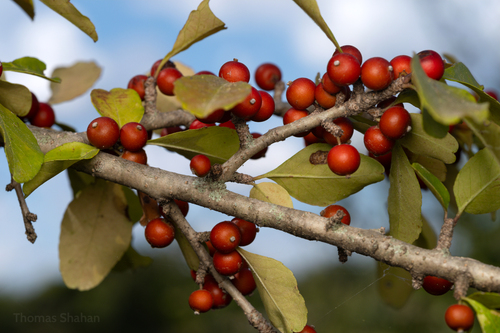
Ilex decidua Walter, commonly called possumhaw, is an upright deciduous shrub or small tree. At maturity, it typically reaches 10 to 15 feet tall, though it may grow larger when grown in partial shade. It grows multiple thin trunks and stems in a clumping pattern; if left unmanaged in the wild, it can develop into a large spreading mound of foliage up to 30 feet wide. Its bark is light brown to gray, and may be either smooth or warty and roughened. Slender twigs are glabrous and silvery gray, with numerous spur shoots, pointed lateral buds, and acuminate scales. Distinguishing features of this species are crenate leaf margins and fruiting pedicels that are 2–8 mm long. Its distinctive leaf shape is less variable than that of other holly species. Leaves are obovate, simple, and alternately arranged, growing 2.5 to 7.5 cm long. Though the plant is deciduous, its dark green leaves do not develop any noticeable fall color before dropping. From March to May, small white flowers bloom among the leaves; these produce small drupe fruits that ripen in early autumn. Fruits are red (or rarely yellow), shiny, and globose (nearly spherical), with a diameter of 4–8 mm. After leaves drop, fruits remain on the tree throughout winter, creating a striking display against bare branches. Fruits reach maturity by autumn, containing 3–5 seeds each, but the bitter fruits only become a favored food source for many birds and mammals in spring, after exposure to cycles of freezing and thawing. Ilex decidua is a common plant native to the United States, where it grows in Alabama, Arkansas, Washington, D.C., Florida, Georgia, Illinois, Indiana, Kansas, Kentucky, Louisiana, Maryland, Missouri, Mississippi, North Carolina, Oklahoma, South Carolina, Tennessee, Texas, and Virginia. It also grows in the northern Mexican states of Chihuahua and Coahuila. It prefers growing on floodplains and along the margins of swamps or lakes, at elevations up to about 360 m. It can often be found on limestone glades and bluffs, along streams in wet woods, and in lowland valleys, sloughs, and swamps. Plant species that commonly associate with possumhaw include water tupelo (Nyssa aquatica), overcup oak (Quercus lyrata), bald cypress (Taxodium distichum), sycamore (Platanus occidentalis), and hackberry (Celtis spp.). Fruits of Ilex decidua attract songbirds, small mammals, and bobwhite quail, while deer browse on its young twigs. The growth habit of Ilex decidua makes it suitable for various ornamental and functional uses in its native regions. Its dense arrangement of thick trunks and stems lets it work as an effective privacy screen when desired. Lower branches can be removed to form a neater small tree with a compact crown of foliage. It can be used ornamentally as a shrub or small tree for a range of landscape purposes, and is well suited to backyard gardens. Since possumhaw tolerates wet soil and often grows wild in wet woods, it is also an excellent choice for stabilizing stream beds or the banks of water retention ponds. Arborists may recommend this plant for parking lot buffer strips and islands, highway median strip plantings, or for planting near decks and patios. Thanks to its attractive persistent berries, it is often used as a winter ornamental plant, and its branches may be collected for use as Christmas decorations. The Audubon society specifically includes Ilex decidua among its recommendations for bird-safe outdoor holiday decorations. Possumhaw wood is not considered commercially useful because the tree typically remains small in size.