About Ilex cornuta Lindl. & Paxton
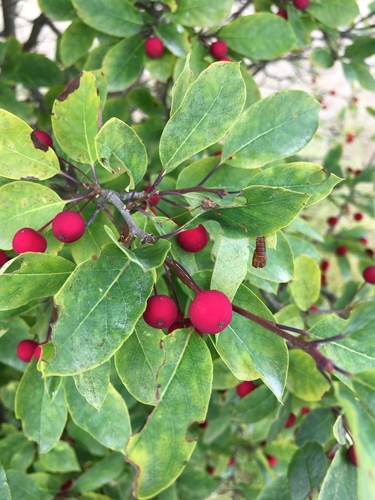
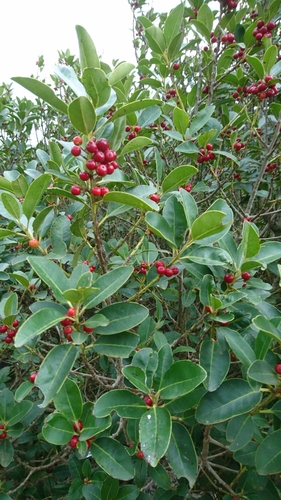
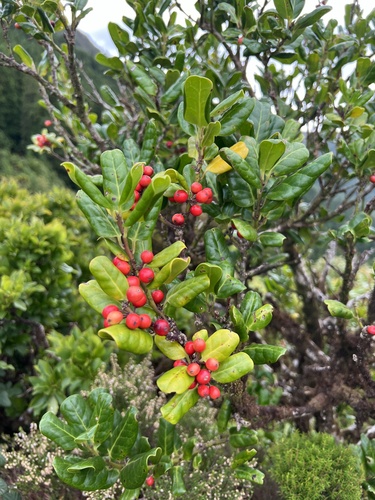
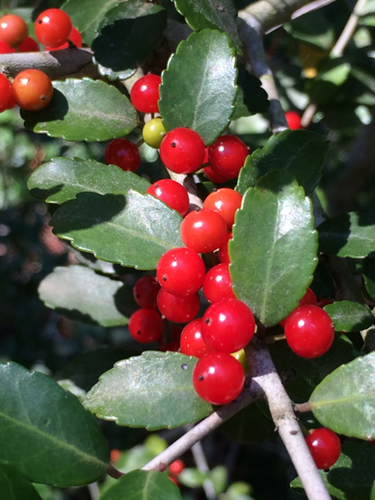
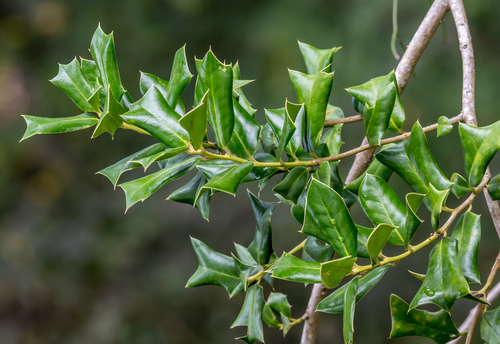
Ilex cornuta Lindl. & Paxton is a broadleaf evergreen shrub that typically reaches up to 2.5 meters (8 feet) tall, and has been recorded growing as tall as 7.6 meters (25 feet). Its leaves are rectangular, with 4 to 5 spines along the leaf margin. These leaves are glossy, leathery, simple, and arranged alternately along the stem. Flowers bloom in early spring, are dull white in color, and are fragrant. After flowering, the plant produces red berries that ripen in early fall. The bark is light gray and smooth when young, and develops a finely flaky texture as the plant matures. Stems are either green or red to burgundy, with color changing by season; green stems turn a slightly deeper red during the winter months. Ilex cornuta is dioecious: individual plants carry either only male or only female flowers, with both sexes not present on the same plant. This means the species is not self-fertile, and requires separate male and female plants to reproduce. Ilex cornuta is native to central and southeastern China, Hainan, and Korea. It was introduced to the United States, where it is currently considered invasive. It has naturalized across eastern United States, and is most prominent in North Carolina, Alabama, and Kentucky. This species tolerates most soil types except poorly drained soils. It can be grown in partial or full sun, and tolerates heat and humidity. In its native range, it grows at elevations between 150 and 600 meters, along fully sun-exposed mountain ridges. In landscaping, Ilex cornuta is used to add winter interest to drought-tolerant gardens, and grown as barriers, privacy plantings, and hedges. It attracts bees, specialized bees, other pollinators, and songbirds. The main issue this plant presents in landscape settings is its sharp leaf spines.