About Ilex canariensis Poir.
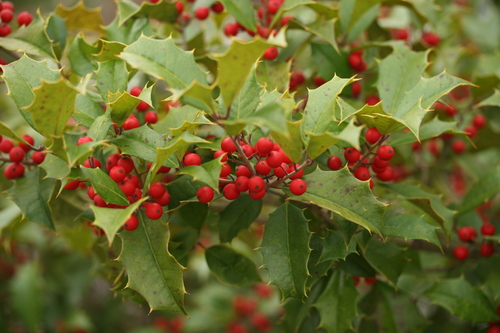
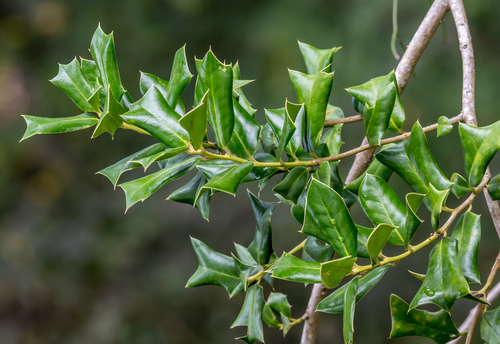
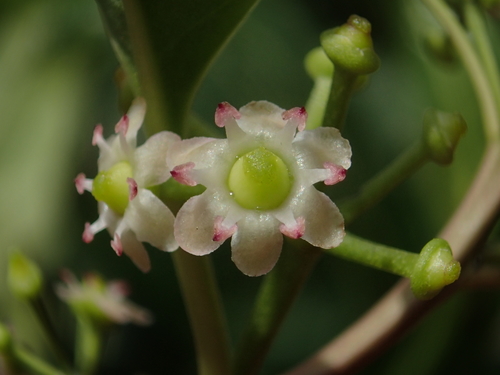
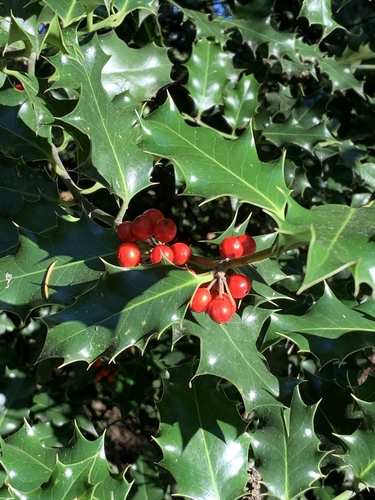
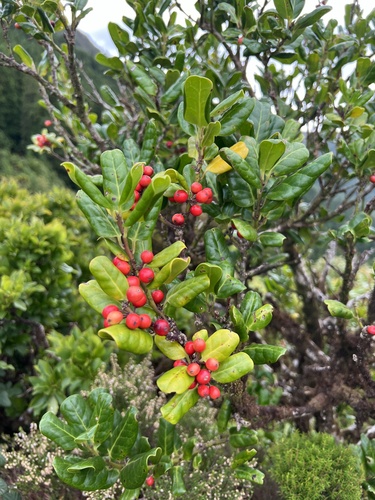
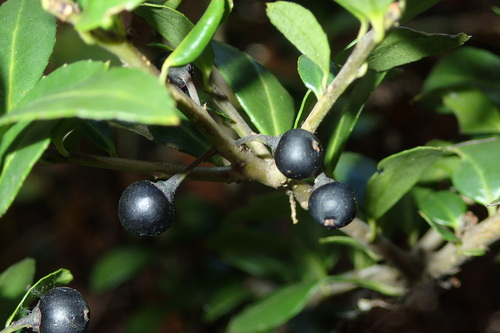
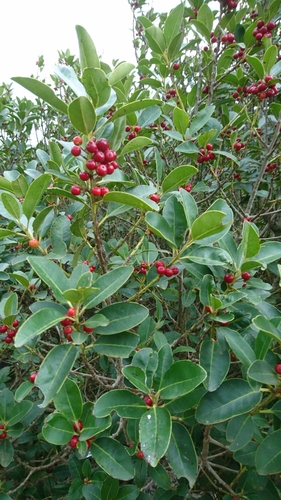
This species is called acebiño in Spanish and azevinho in Portuguese; these terms generically mean "holly" in other regions. It is an evergreen shrub or small tree, growing up to 6.5 meters tall, and occasionally reaching 10 meters in height, with a gray trunk. It bears glossy ovate leaves that are 5–7 cm long and 2.5–4 cm wide. Most leaves have entire, rounded margins with only a few small spines, and leaf tips are obtuse or rounded. Mature leaves range from ovate to ovate-lanceolate, are bright and entire-margined, while young leaves may be spiny. Small flowers grow in clusters in axillary inflorescences, located in subterminal leaf axils, with 4 to 6 white petals. It flowers from May to June. The fruits are globular, fleshy, red, about 1 cm wide, and borne on stems 3–8 mm long, matching the typical red spherical fruits of holly. Two subspecies are recognized: in Ilex canariensis ssp. azevinho (Sol. ex Lowe) Kunkel, the pedicels can grow up to 2 cm long. Ilex canariensis is a member of the family Aquifoliaceae, related to European holly, and is endemic to Madeira and the Canary Islands. Both subspecies have clear trunks marked with white and brown spots. The species reproduces via seeds and shoots. It requires high humidity and relatively stable, mild temperatures. It is currently threatened by habitat loss. It grows mainly at lower altitudes, in scrub and laurisilva forests where atmospheric moisture condenses, at the bottom of ravines, or near other wet areas. While laurisilva forest may be expanding in Madeira, the species faces pressures across most of its range, particularly from grazing by sheep and goats, and from wildfires. Unlike European holly, this endemic species has lost almost all leaf margin spines, which is thought to result from the lack of herbivore pressure on these islands before humans introduced livestock. Laurisilva is a subtropical forest type that occurs in areas with high humidity and relatively stable, mild temperatures. The Macaronesian laurissilva is an endemic ecoregion of Macaronesia, home to many endemic laurifolia trees, and Ilex canariensis is one of these endemics limited to Madeira and the Canary Islands.