About Ilex aquifolium L.
Ilex aquifolium L., commonly known as European holly, is an evergreen woody plant that only rarely reaches 24 m (79 ft) in height. More typically, it grows 3 to 15 m (10 to 49 ft) tall, and often remains a shrub instead of reaching full tree stature. Its woody stem is usually 40–80 cm (16–31 in) in diameter, and rarely reaches 100 cm (39 in) or more. The bark is smooth and silver-grey, developing small fissures as the plant ages. Its root system forms a fibrous mat near the soil surface, with only a few roots growing to greater depths. In dense stands, roots spread only about as wide as the plant’s branches. European holly only rarely produces suckers, but when it does, it can form a clump of multiple stems. Lower branches that become buried in dead leaves may also occasionally root. Botanist William Dallimore estimated the maximum lifespan of European holly at 250 to 300 years; the oldest reliably documented specimen was cut down in the New Forest in 1963.
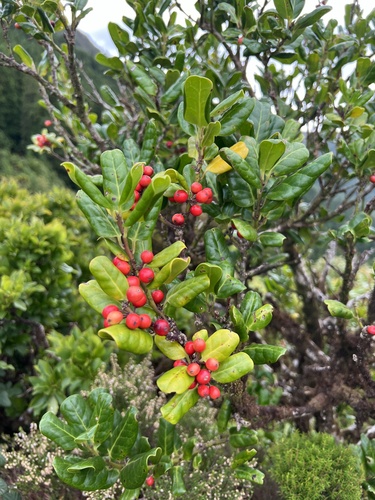
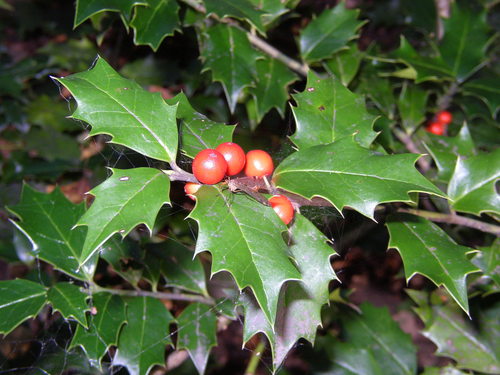
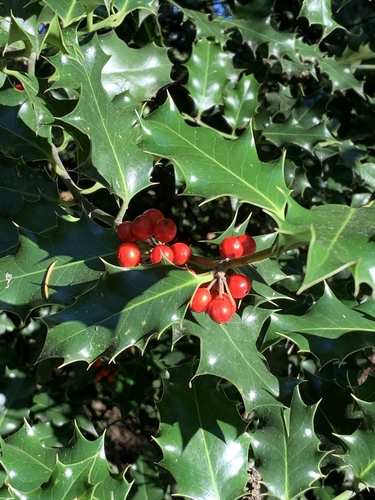
Its leaves are 5–12 cm long, with a width up to one-third of their length, and are evergreen. While leaves can last up to eight years, lifespans under five years are more typical. In the upper canopy of trees exposed to full sun, leaves fall after just one or two years. Most leaf shedding happens in mid-winter, though some leaves fall in all seasons, with the oldest leaves falling first unless drought causes disturbance. The upper leaf surface is dark and shiny green, while the underside is lighter. Leaves are shaped ovate to oblong-elliptic, broader at the base, ranging from egg-shaped to somewhat rectangular with curved sides. Leaf edges may be scalloped with a sharp spine at the tip of each tooth, or smooth with only a single spine at the leaf tip. Older trees and trees in shaded environments tend to have the most smooth-edged leaves, especially in the upper parts of the tree. In rare cases, a tree may have no spines even on its lower leaves. When spines are present, there can be as many as six to eight per side of the leaf.
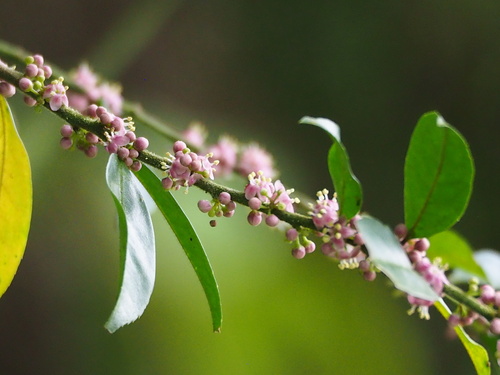
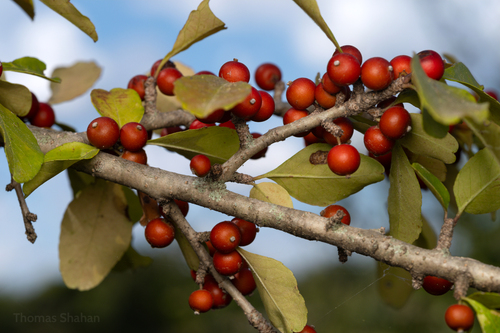
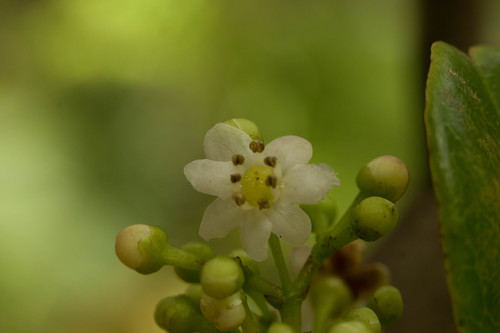
The flowers are white, sometimes with a faint red tint, and generally have four parts including petal lobes, though five-part flowers occur rarely. European holly is usually dioecious: pollen-producing and fruit-producing flowers grow on separate individual trees. Plants under 1.5 m (5 ft) tall rarely produce flowers or fruit, and most individuals taller than 3 m (10 ft) flower. While flowering most commonly occurs in spring, individual trees have been recorded blooming as late as January in winter. Fruit only grows on female plants, which require nearby male plants for fertilization. The fruit is a drupe (stone fruit) around 6–10 mm in diameter, colored bright red or bright yellow, and matures around October or November. At maturity, the fruit is very bitter due to ilicin content, so it is rarely eaten until late winter, when frost makes it softer and more palatable. It is eaten by rodents, birds, and larger herbivores. Each fruit contains 3 to 4 seeds, which typically germinate in the second or third spring after ripening.
European holly is native to most of the western half of Europe and northwestern Africa. Its native status in central and Eastern Europe is disputed. According to Plants of the World Online (POWO), it is not native and does not reproduce in Poland or Hungary, but it is native to Bulgaria and Romania. According to the International Union for Conservation of Nature (IUCN), its status in Romania is uncertain, and it is introduced and naturalized to some extent in Hungary; the IUCN agrees it does not occur in Poland or further east in northern Europe. In response to climate change, the species is shifting its range northwards in Norway, and towards the northeast in Denmark and Germany. By 2005, it had been found as far north as Kristiansund in Norway, where it is still limited to a fringe of the county immediately adjacent to the North Sea. Its status in Asia is also disputed: POWO lists it as an introduced species in Turkey and Syria, while the IUCN lists it as native to those areas, and also native to Iran and Lebanon.
European holly grows from sea level up to elevations of 600 m (2,000 ft). It is common and widespread across its native range, so the IUCN classifies it as a species of least concern. However, the population has declined in numbers of mature individuals and is severely fragmented, and local populations may face additional threats: in Sweden, only one wild individual tree remains. It mainly grows in the understory or at the edges of deciduous forests in oceanic or Mediterranean climates. In Mediterranean climate areas, it only grows at higher elevations in shade, and it can become the dominant species in cooler northern woodlands. In the northern part of its range, it is associated with oak forests dominated by European oak, durmast oak, and downy oak. Along the west coast of the United States and Canada, from California to British Columbia, non-native European holly has become highly invasive, spreading quickly into native forest habitat where it thrives in shade and crowds out native species. It is on the Washington State Noxious Weed Control Board’s monitor list, and is classified as a Class C invasive plant in Portland.
During the Cenozoic Era, the Mediterranean region, Europe, and northwest Africa had a wetter climate and were largely covered by laurel forests. European holly was a typical representative species of this biome, where many current species of the genus Ilex were present. As the Mediterranean Basin became drier during the Pliocene, laurel forests gradually retreated, replaced by more drought-tolerant sclerophyll plant communities. Modern Ilex aquifolium emerged from this change. Most of the last remaining Mediterranean laurel forests are believed to have died out approximately 10,000 years ago at the end of the Pleistocene.
European holly is a hardy pioneer species that prefers relatively moist areas, and tolerates frost as well as summer drought. Its spiny leaves allow it to form dense thickets that protect other woody species from herbivores, supporting forest regeneration. It is common in garrigue and maquis, and also found in deciduous forest and oak forest. Pure stands of European holly can grow into a labyrinth of enclosed spaces where thrushes and deer take shelter, while smaller birds are protected among the spiny leaves. After the season’s first frost, holly fruits soften and fall to the ground, serving as an important food source for winter birds in native regions when other resources are scarce. The flowers are a good nectar source for insects including bees, wasps, flies, and small butterflies. Pale patches commonly found on leaves are caused by the leaf-mining insect Phytomyza ilicis. It is an invasive species on the West Coast of Canada and the United States, as well as in Hawaii.
Holly berries contain alkaloids, theobromine, saponins, caffeic acid, and a yellow pigment called ilixanthin. The berries are generally regarded as toxic to humans.
Ilex aquifolium is widely grown in parks and gardens in temperate regions. Hollies are often used for hedges: their spiny leaves make them difficult to penetrate, and they respond well to pruning and shaping. European holly can grow in a wide variety of challenging soils including clay, acidic, and nutrient-poor soils, but it cannot tolerate poor drainage. In overly wet conditions, it commonly develops issues such as root rot, canker, or leaf blight.
From as early as the 1200s through the early 1700s, Ilex aquifolium was cultivated for use as winter fodder for many domestic animals. Sheep were most frequently fed holly, but it was also fed to horses and cattle, and branches were cut to feed red deer. This practice is best documented in southern areas of the Pennines near Sheffield, but may have been more widespread across Britain, with a few recorded instances in northwest France. In at least some cases, smooth leaves were specifically selected for cutting. Though the practice is now much rarer, branches are still cut for sheep or cattle in Dumfries, Derbyshire, Cumbria, and the New Forest. It was also practiced in Ireland until the mid-20th century.
Holly wood is hard and white with a faint grey or green tinge, and has no noticeable heartwood. It is fine-grained and quite heavy. It is difficult to dry, and is often cut into small pieces to avoid warping. It is used for wood inlay, small fancy carvings, and small turned pieces. It can be easily stained black, and is occasionally substituted for ebony. In the 1800s, holly was extensively used and considered the best material for making driving whips for horse-drawn carriages. Although popular stories claim holly and other local woods were used to make Great Highland bagpipes, evidence shows bagpipes were always made from imported woods in the lowlands. Like ash, holly makes desirable firewood because it burns well even when green. In the Pallars region of the mountains of northwestern Catalonia, leaves are rarely prepared as a tea in folk medicine for pain relief.