About Ileostylus micranthus (Hook.fil.) Tiegh.
Ileostylus micranthus (Hook.fil.) Tiegh. is a mistletoe species native to New Zealand and the Norfolk Islands. In New Zealand, it is also known by its Māori name Pirita.
All mistletoes are stem hemiparasites that grow on the limbs of host trees or shrubs, and draw water, water-transported nutrients, and organic solutes from their hosts. The two main groups of mistletoes are Loranthaceae and Viscaceae. Loranthaceae contains 50 to 80 genera, primarily distributed across the Southern Hemisphere. There are six endemic Loranthaceae species in New Zealand, and all of these species have declined in abundance since European settlement. This decline is caused by habitat loss and the introduction of herbivores, particularly the Australian brushtail possum.
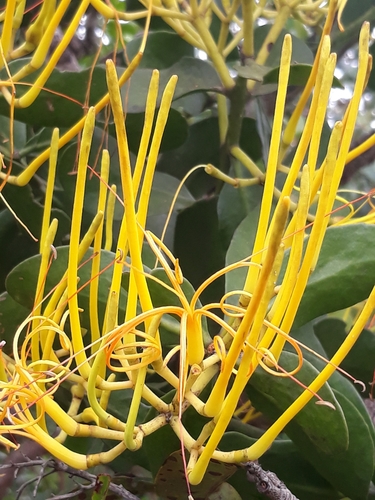
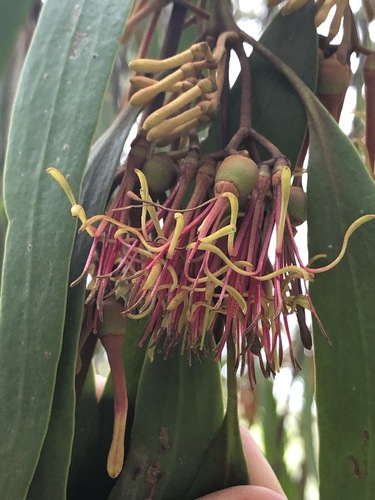
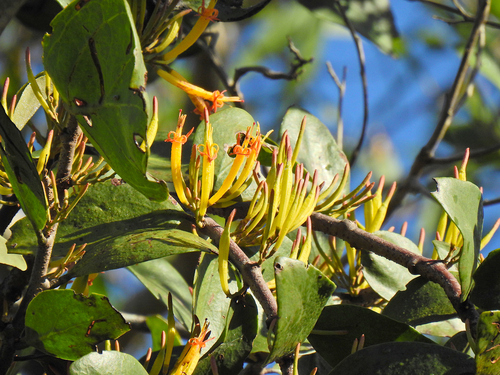
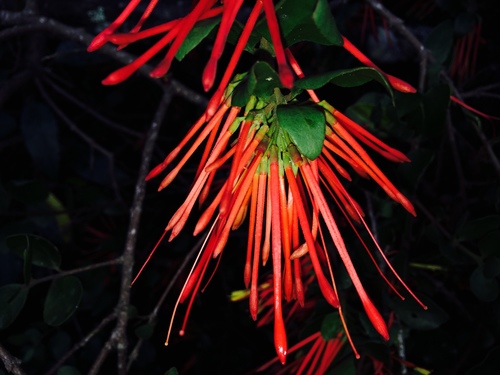
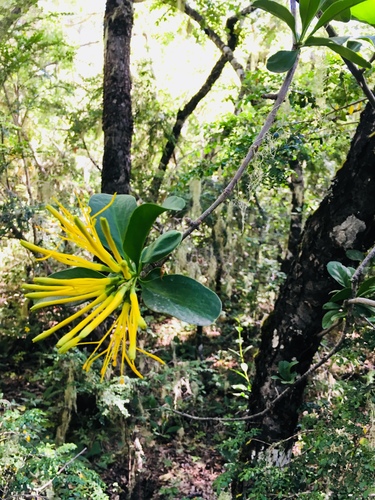
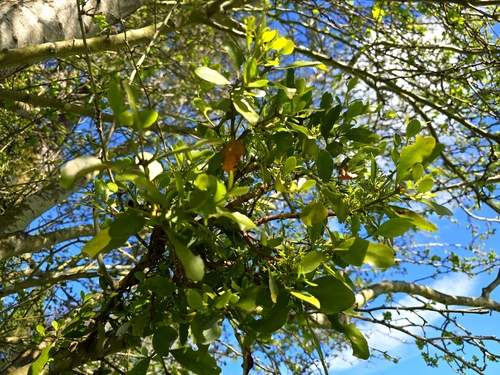
Ileostylus micranthus grows in clusters on its host plant, and mature clusters reach at least 2 m in diameter. It produces opposite pairs of thick, leathery leaves that range from 2 cm to 8 cm long and 1 cm to 3 cm wide. The leaves are rounded, have smooth edges, and show no visible veining. Young branchlets are curved and green. The flowers are very small, measuring 3–5 mm in diameter; they are greenish-yellow and lightly scented. Mature yellow fruit is rounded, around 6 mm in diameter, with green inner flesh and a single sticky seed.
On Norfolk Island, Ileostylus micranthus is classified as vulnerable under the Environment Protection and Biodiversity Conservation Act 1999. This species naturally dispersed to Norfolk Island from New Zealand, arriving there in the 1930s without human assistance. There are few records of the species on Norfolk Island, but it is much more abundant in New Zealand, where it occurs throughout the North Island, South Island, and Stewart Island.
In New Zealand, confirmed locations for Ileostylus micranthus include the Northland Podocarpus totara forests, regenerating scrub and forest in the Rotorua/Taupō area of the Taupō Volcanic Zone, and grey-scrub communities in Marlborough-Kaikōura, Banks Peninsula, Central Otago (the Lake District), and Dunedin. It is also commonly found in Cook Strait coastal forests, salt marshes, and parts of Nelson and Westland. The species occurs mostly in lowland districts across the North Island, South Island, and Stewart Island, and its distribution indicates it prefers lowland habitats. There is no clear nationwide association between this species and any specific host.
Compared to other parasitic mistletoes native to New Zealand, Ileostylus micranthus is a relatively recently established species. Variable spatial and temporal host availability since its arrival has favored the evolution of host generalization, a pattern consistent with host-switching as the primary mode of evolutionary adaptation for this parasite. Ileostylus micranthus shows no host specialization: it has been recorded parasitizing over 209 plant taxa, including 92 exotic species and three species endemic to Norfolk Island.
Ileostylus micranthus has unique physiological traits and morphological structures that help it form connections with host plants. Vascular connection points to the host allow easy transport of water, organic acids, ions, sugars, minerals, and amino acids. When a bird disperses an Ileostylus micranthus seed to a host branch, maternal seed reserves supply the nutrients needed for the parasite to attach and grow its first photosynthetic structures. The seed is covered in a thick sticky coating, an adaptation that helps it adhere to the host branch so the parasite can establish a connection with the host.
After establishment, the hypocotyl straightens and pulls the two cotyledons out of the endosperm. The small green cotyledons function as leaves, and the first pair of true leaves usually develops around four weeks after cotyledon emergence. Mature Ileostylus micranthus plants have high water and nutrient (nitrogen and phosphorus) use, wide stomata, and low stomatal density (the number of stomata per unit leaf area, a trait that influences growth characteristics).
Ileostylus micranthus makes host plant nutrients soluble to accumulate carbon, potassium, nitrogen, phosphorus, calcium, and magnesium from the host into its own tissues. This process draws on the host's non-structural carbohydrate reserves, which reduces the efficiency of the host's biological processes.
The most important bird species that disperse Ileostylus micranthus seeds are silvereyes, bellbirds, and tūī. Birds swallow the fruits whole, and excrete the seeds in a germinable condition. These birds typically only stay on individual host plants for 1–2 minutes, and eat just a few mistletoe fruits per visit. Seeds cannot germinate unless the outer fruit layer (the exocarp) is removed, either manually or by passing through a bird's gut. Hand removal of the exocarp can produce germination rates equal to or higher than bird removal, but bird gut passage is the only successful method of exocarp removal in the wild. If birds do not consume the fruit, it overripens, falls from its stalk, and rots, which prevents successful seed germination.
The flowers of Ileostylus micranthus are unspecialized, so they can be pollinated by both native and introduced insect species. Flowering occurs between September and December, and fruiting occurs between April and June.