About Iguana iguana (Linnaeus, 1758)
The green iguana, with the scientific name Iguana iguana (Linnaeus, 1758), is a large lizard, and is probably the largest species in the iguana family. A small number of species in the genus Cyclura may match or exceed it in weight. Adult green iguanas typically reach 1.2 to 1.7 m (3.9 to 5.6 ft) in total length from head to tail. Like all iguanas, the tail makes up most of this total length; most green iguanas have a snout-to-vent length of 30 to 42 cm (12 to 17 in). A typical adult male weighs around 4 kg (8.8 lb), while the smaller adult female typically weighs 1.2 to 3 kg (2.6 to 6.6 lb). A few large males can reach or exceed 8 kg (18 lb) in weight and 2 m (6.6 ft) in length, and some specimens have even been reported to weigh more than 8 kg (18 lb).
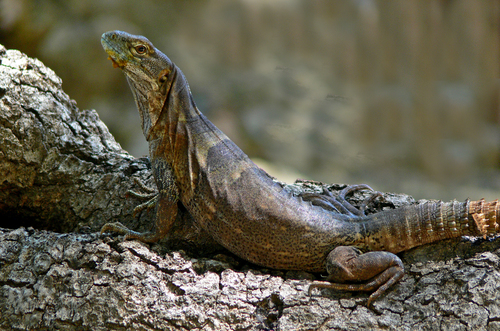
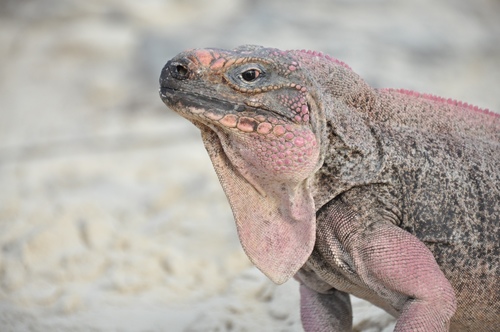
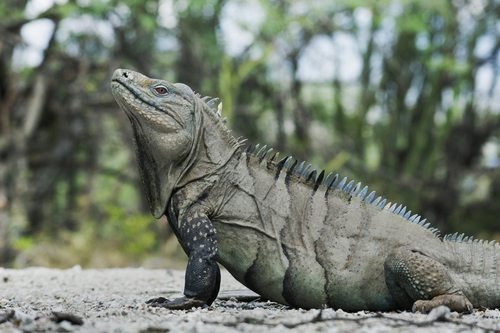
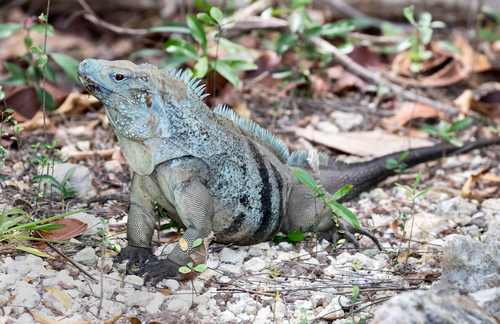
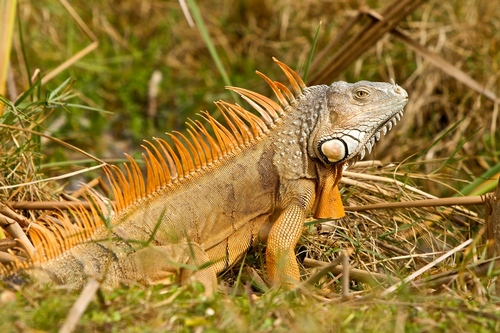
Green iguanas have a row of spines running along their backs and tails that helps protect them from predators. Their whip-like tails can deliver painful strikes. Like many other lizards, green iguanas can autotomize (detach) their tail if grabbed, allowing them to escape, and eventually regenerate a new tail. They also have a well-developed dewlap that helps regulate their body temperature, and this structure is also used during courtship and territorial displays.
Green iguanas have very sharp teeth that can shred leaves and even human skin. Their teeth are leaf-shaped, broad and flat with serrated edges. The similarity of these teeth to the teeth of one of the first discovered dinosaurs led to that dinosaur being named Iguanodon, meaning "iguana tooth", and led to the incorrect assumption that Iguanodon resembled a gigantic iguana. Green iguana teeth are positioned on the inner sides of the jawbones, so they are hard to see in smaller specimens.
Green iguanas are primarily herbivorous, which creates a special osmoregulation challenge. Plant matter contains higher amounts of potassium and has lower nutrient density, so green iguanas must eat more plant material to meet their metabolic needs. Green iguanas cannot produce liquid urine that is more concentrated than their bodily fluids, so like birds they excrete nitrogenous wastes as urate salts through a salt gland. As a result, they have evolved a lateral nasal gland that supplements renal salt secretion by expelling excess potassium and sodium chlorides.
The green iguana's native range extends from southern Mexico to central Brazil, Paraguay, and Bolivia, as well as the Caribbean, specifically the islands of Grenada, Aruba, Curaçao, Bonaire, Trinidad and Tobago, St. Lucia, St. Vincent, Montserrat, Saba and Útila. This species has been introduced to Grand Cayman, Puerto Rico, Hispaniola (on the Dominican Republic side), the island of Saint Martin, Guadeloupe, Martinique, Saint Vincent and the Grenadines, Singapore, Thailand, Taiwan, Texas, Florida, Hawaii, and the U.S. Virgin Islands.
In 1995, green iguanas colonized the island of Anguilla after being washed ashore following a hurricane; this event provided direct evidence that oceanic dispersal allows species to colonize new areas they did not previously occupy. Though green iguanas are not native to Martinique, a small wild colony of released or escaped individuals persists at historic Fort Saint Louis. Green iguanas were introduced to Puerto Rico from South America, and are now very common across the island, where they are considered an invasive species. In the United States, feral populations live in South Florida (including the Florida Keys), Hawaii, the U.S. Virgin Islands and the Rio Grande Valley of Texas.
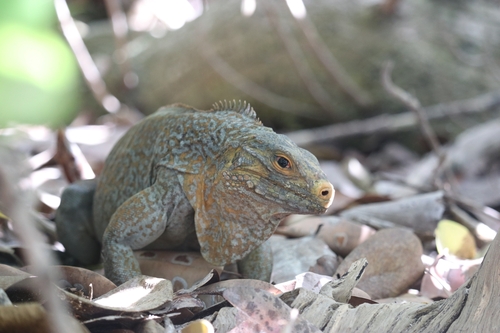
Despite their common name, green iguanas occur in a range of different colors and forms. In the southern countries of their range, such as Peru, green iguanas appear bluish with bold blue markings. On Caribbean islands including Bonaire, Curaçao, Aruba, and Grenada, a green iguana's color can range from green to lavender, black, and even reddish brown. Green iguanas from the western region of Costa Rica are red, while individuals from the northern parts of the range, such as Mexico, appear orange. Juvenile green iguanas from El Salvador are often bright blue, but lose this coloration as they age. In southeastern Florida, yellow green iguanas are seen occasionally, and orange individuals are even rarer.
Adult green iguanas found across most of St. Lucia, mainly on the northeastern coast at Louvette and Grand Anse, differ in many traits from other green iguana populations. They are light green with prominent black stripes, and unlike the typical orange dewlap of common green iguanas, these St. Lucia individuals have a black dewlap. Females of this population lay roughly half the number of eggs common green iguanas lay, producing around 25 eggs instead of 50. The scales behind their head, near the jawbone, are smaller than those of other populations. Their irises are white or cream, while other green iguanas have yellow irises.
Green iguanas from Guatemala and southern Mexico (which may belong to the distinct species I. rhinolopha) mostly have small horns on their snouts between their eyes and their nostrils, while other green iguanas do not have this feature.