About Iguana delicatissima Laurenti, 1768
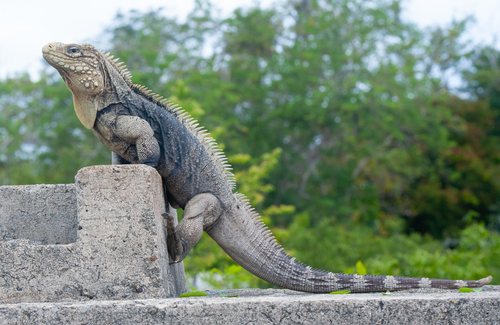
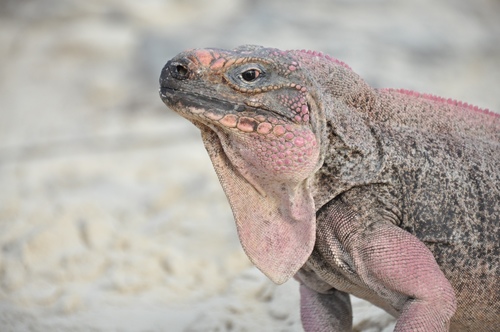
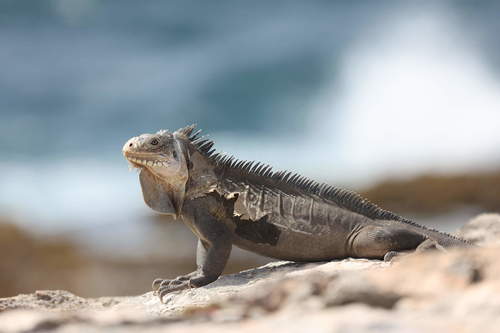
Anatomy and morphology: Compared to green iguanas, the Lesser Antillean iguana has a more blocky, shorter face, and does not have the distinctive tail stripe pattern found on green iguanas. The two easiest traits to tell the two species apart are the large round scale below each ear and the striped tail; both are present in green iguanas, but absent in the Lesser Antillean iguana. A recent assessment comparing morphometric and scale traits between green iguanas and Lesser Antillean iguanas found 13 additional differing characters between the two species, with green iguanas having relatively longer tails. The base body color of the Lesser Antillean iguana is generally gray, with green blotches on the underside, though color varies between populations on different islands. They have large, pale, ivory-colored scales on their heads. Male individuals have pink jowls and blue scales around the eyes. Males also have femoral pores along each inner thigh that secrete pheromones during the breeding season. Males are larger than females: fully grown males can reach a body length of 43.4 cm (17 in), with a tail length of 80 cm (31.5 in). Females grow to around 38.5 cm (15 in) and can lay up to 30 eggs. Habitat and distribution: The Lesser Antillean iguana inhabits scrub woodlands, rainforests, and mangroves across the Lesser Antilles, and can be found on Saint Barth, Anguilla, St. Eustatius, Guadeloupe, Dominica, and Martinique. Since European settlement, the species has gone locally extinct on Sint Maarten, Saint Kitts, Nevis, Barbuda, Antigua, Marie Galante, and Îles des Saintes; the exact causes of these local extinctions vary between islands. Ecology: Lesser Antillean iguanas are primarily herbivorous, feeding on leaves, flowers, seeds, fruit, and new growth shoots from over 100 different plant species. They are known to eat manchineel (Hippomane mancinella), a tree that produces chemicals toxic to mammals and birds. From August to December, which is the wet season, they eat leaves from various plants and fruit from multiple plant species, including Barbados cherry (Malpighia emarginata) and manchineel. From January to May, the dry season, Lesser Antillean iguanas tend to eat more foliage than fruit. They commonly eat fruit from chink bush (Bourreria succulenta). A study of nests on St. Eustatius found that inquilines use the nest tunnels and chambers dug by female Lesser Antillean iguanas, indicating this species acts as an ecosystem engineer.