About Idaea seriata (Schrank, 1802)
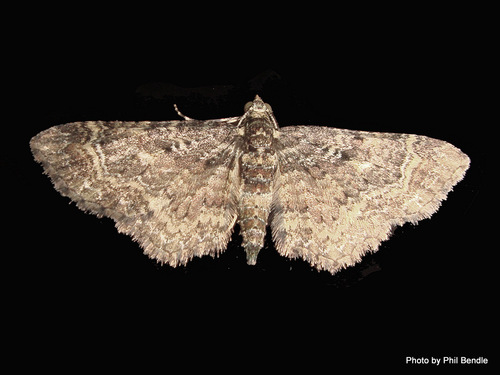
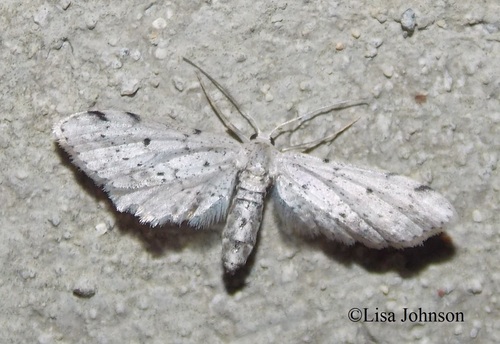
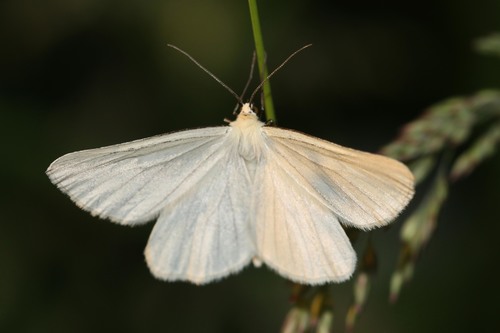
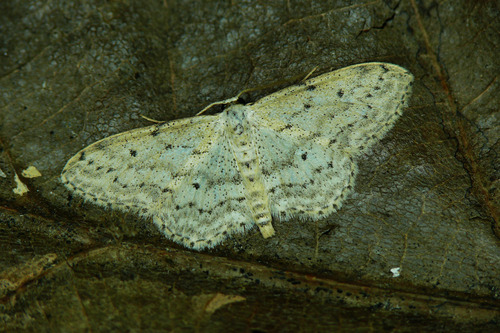
This is an extremely variable species, ranging from almost pure white forms with no markings or with well-defined lines to solid black-grey forms. In all forms, the vertex of the head remains whitish, while the collar is dark. When present, the lines do not originate from enlarged costal spots, though the costal end of the lines is not infrequently a little blacker than the rest of the line. The first line of the forewing is angled on the subcostal vein, or at least strongly bent, and is thickened with dark marks on the veins. The median shade is thicker, and is often quite strongly developed; however, it is also often completely absent even in forms where the other lines are sharply marked. On the forewing, it usually touches the cell-spot, and on the hindwing it is always positioned proximal to the cell-spot. The postmedian line is fine and grey, and not conspicuous on its own, but is marked with strong, coarse black spots on the veins. It lies fairly close to the distal margin, is incurved between the radials, then curves outwards; the shape of this line is best shown on the right forewing in the original figure, and can be compared to the more developed version of this shape seen in calunetaria. The pale subterminal line is slightly more strongly bent (or angled) inwards between the radials. It is often almost impossible to distinguish because it lacks accompanying dark shading, but this dark shading can also be moderate or even very strong; sometimes it almost fills the distal area and forms a dark border to the wings. This dark shading almost never has a tendency to break up into spots, which marks a clear difference from species such as Idaea incisaria, Idaea camparia, and Idaea sodaliaria. The distal marginal line is made up of a series of black dashes of variable thickness, and is sometimes almost obsolete. The fringe has more or less prominent dark dots at its base, opposite the vein ends. The underside of the forewing is more or less suffused, often dark smoke-colour, but the postmedian line and the cell-spot are usually clearly visible. The underside of the hindwing is white or whitish, and its marking (or lack of marking) closely matches that of the upper surface of the specific form. The typical seriata found in Central and Northern Europe is more or less strongly dusted, giving it a grey appearance, but it includes a wide range of minor variation. This variation affects the intensity of the dusting, as well as the definition of the lines, median shade, or dark bordering, either individually or in combination. This species produces either one or two generations per year, and can be seen in flight from June to September in the British Isles; it flies at night and sometimes comes to light. The flight season note refers specifically to the British Isles, and may differ in other parts of the species' range. The larva feeds on ivy, and the species overwinters in the larval stage.