About Idaea fuscovenosa (Goeze, 1781)
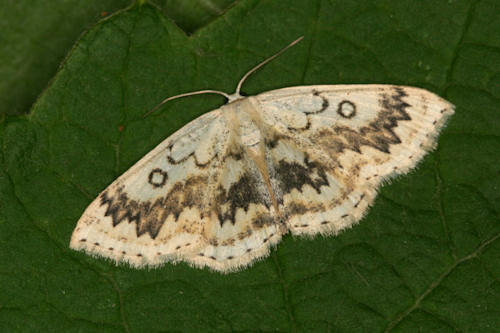
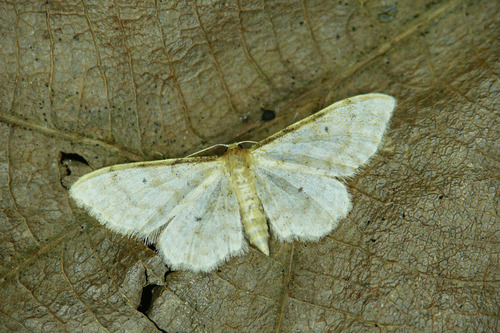
Idaea fuscovenosa (Goeze, 1781) has a wingspan of 19–22 mm, with forewings measuring 9–11 mm in length. Its forewings are relatively wide, and the rear edge of the hindwing is slightly concave between the median veins. The base body and wing color ranges from whitish to light brown. The basal half of the costa is often greyish brown. Well-developed wavy crosslines end at the costa as black spots, and two additional wavy lines are present in the marginal field. Black discal marks are almost always present on both forewings and hindwings. The somewhat stumpy caterpillar is dull smoky brown, marbled and variegated with ochreous; darker coloration is most prominent on the front portion, while ochreous color is more visible on the rear. An ochreous line runs along the middle of the dorsum, and another runs along the spiracle region, with white spots present on segments 5–7. This species is widespread in central and southern Europe. To the north, its range extends to England, Ireland, Denmark, southern Sweden, and the southern Baltic Sea region. It occurs in western Iberian Peninsula, and eastward it reaches Asia Minor, Ukraine, European Russia, and the Caucasus. It is also found on the large Mediterranean islands of Corsica, Sardinia, and Sicily; the Corsican population is referred to as corsula Schawerda, 1929. Earlier records of this species from North Africa are now classified as Idaea bigladiata. In northern parts of its range, it occurs from sea level up to around 500 meters above sea level. In the Southern Alps, it can be found up to 1000 meters above sea level, and on Corsica it occurs up to 2000 meters above sea level.