About Idaea dimidiata (Hufnagel, 1767)
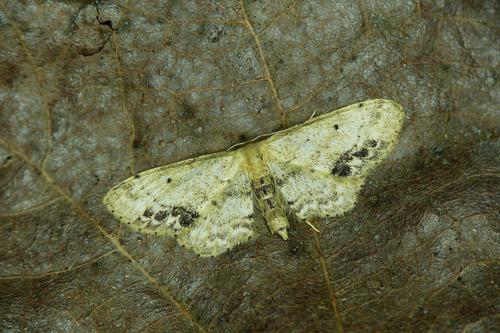
Idaea dimidiata (Hufnagel, 1767) has a wingspan ranging from 13 to 18 mm. The base ground colour of its wings runs from brownish yellow, brownish white to slightly reddish white. Pattern elements on the wings are dark grey to dark brown. The median band and the two crosslines may be incomplete or interrupted, and are marked by so-called costal stains on the front wing at the costa. There is a light wavy line, which is limited mainly to the inside edge and marked on both sides by dark stains in the marginal field. Both forewings and hindwings have black discal flecks, which occasionally are significantly weaker on the forewings. Marginal stains are connected by a thin line. The larva of the species is long and thin, grey-brown, and has a V-shaped dark spot on each body segment. This species occurs in both the Western Palearctic and the Nearctic. It is widespread across West, South and Central Europe. To the North, its range extends to South Scandinavia, and to the East it reaches as far as the Urals. Idaea dimidiata is found on almost all islands of the Mediterranean. Outside of Europe, it can be found in Morocco, Northwestern Turkey, the Caucasus and Transcaucasia, and its range extends from North Iran through to Afghanistan and Central Asia. In Cyprus, Turkey and the Levant to the South, the subspecies dimidiata antitaurica replaces the nominate subspecies dimidiata dimidiata. The nominate subspecies also occurs in Canada and the most northern regions of the United States of America.