About Ictonyx striatus (Perry, 1810)
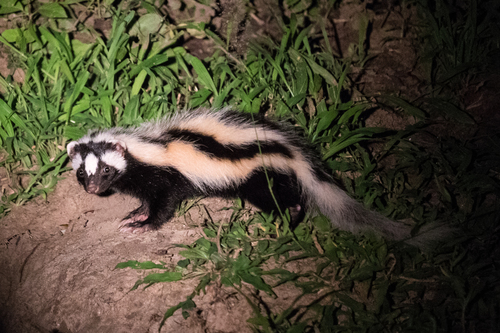
Ictonyx striatus (Perry, 1810), commonly called the striped polecat, has a head-and-body length of 30–38 cm (12–15 in), with an additional tail length of 22–30 cm (8.7–11.8 in). Adults weigh between 0.7 and 1.4 kg (1.5 to 3.1 lb). This species shows sexual size dimorphism, with males larger than females and averaging around 50% heavier than females. Exact colouring varies by location, but striped polecats are generally primarily black, with a wide white band at the back of the head that splits into four white stripes running down the back and toward the tail. The underside and all limbs are entirely black. The tail has both black and white colouration, and while the base is usually black, the proportion of each colour varies between individuals. The head is mostly black, with two large white cheek patches that extend from below the ears to the back of the eyes, a white spot on the forehead, and white fringes on the ears; the exact size and extent of these facial markings is highly variable. The cheek patches and forehead spot are usually distinctly separate, but may merge into a single white band in some individuals from West Africa. Like many other mustelids, the striped polecat has glands near its anus that can expel a noxious fluid when the animal feels threatened, and its distinct black-and-white patterns are an example of aposematic colouration that acts as a warning to potential predators. Fur on the back is long and silky, measuring 50–60 mm (2.0–2.4 in) in length, while fur on the head is shorter, at only 6–7 mm (0.24–0.28 in). Tail fur is particularly long, reaching 70–80 mm (2.8–3.1 in), which gives the tail a bushy look. When walking, all of the striped polecat's claws and digits touch the ground, and all of these structures leave impressions in its footprints. Each of the four limbs has five digits, and every digit bears a claw. Claws on the front limbs are longer and more curved than claws on the hind limbs; front claws grow to around 18 mm (0.71 in), while hind claws typically only measure 10 mm (0.39 in). Front paws are larger than hind paws, and the soles of all four paws are hairless. Each paw is narrow, and most digits are spread widely apart, though the third and fourth digits of each hind paw sit close together. Every digit has an oval-shaped pad, and each paw has a four-lobed pad that forms a shape with a notch at the back; each front paw also has two additional carpal pads on the wrist area. All of these pads have coarse grooves. The striped polecat's skull is heavily built, with a braincase that is wide at the back and narrows toward the front, and a short, blunt snout. The palate is wide at its rear portion, and narrows past the location of the molar teeth. The eyes sit near the front of the head: the distance between the front edges of the eye sockets and the tip of the maxilla is only a quarter of the full length of the skull. This species does not have a sagittal crest, but two low ridges that act as attachment points for the temporalis muscles are visible, running from the supraoccipital crests at the back of the skull to the postorbital processes behind the eye sockets. The auditory bullae, the bony structures that hold the middle and inner ears, are wide and flat, and the zygomatic arches, arch-like bones in the cheeks, are wider at their bases than at their centers. The striped polecat's dentition follows a dental formula of 3.1.3.1 / 3.1.3.2: each half of the upper and lower jaw has three incisors, one canine, and three premolars; each half of the upper jaw has one molar, while each half of the lower jaw has two molars, for a total of 34 teeth. The canines are short and robust, and the lower canines curve backwards at their tips. The outer incisors of the upper jaw are longer than the inner incisors, and are used alongside the canines to subdue prey. The molars have broad grinding surfaces that let the animal crush food, especially insects. The striped polecat is endemic to Africa, where it is a highly adaptable, very widespread species across the continent. It lives across most of Sub-Saharan Africa, ranging from Mauritania across to southeastern Egypt in the north, and extending south to South Africa. It is not found in the dense rainforests of West Africa and the Congo Basin, nor in the dry areas of northeast Somalia and Ethiopia. Despite these absences, the species tolerates many different habitat types, and occurs in grasslands, forests, rocky areas, and deserts. It can live in dry areas if scrub cover is present, and has been recorded in the hummocks and sand dunes of the Namib Desert, but also occurs in regions with high rainfall. It appears to prefer open environments; this may be because exposure makes other small carnivores vulnerable to predation, especially from birds of prey, while the striped polecat can defend itself with its noxious spray, which reduces competition for preferred open habitat. It is most often found in habitats with large ungulate populations, because grazers create areas with lower shrub cover. The striped polecat occurs across a wide range of elevations, from sea level up to 4,180 m (13,710 ft) above sea level, as confirmed by sightings on Mount Kenya. It is not restricted to natural environments, and will even enter areas developed for human activity such as plantations and gardens. The breeding season of the striped polecat is long, but the exact time of year varies between different populations. In KwaZulu-Natal, breeding occurs from spring to the end of summer; male testes remain large from September to April (spring to early autumn) and shrink for the rest of the year. In other parts of South Africa, juveniles and pregnant females have been recorded in April and from September to December. In the area around Lake Chad, young individuals have been observed from September to November, indicating the local population breeds during the rainy season. In East Africa, juvenile sightings are reported in February, June, September and October. Striped polecats kept in zoos (specifically the National Zoological Park, Toronto Zoo and Wilhelma) have given birth throughout the year, suggesting there is no restricted breeding period for captive individuals. Though females are usually hostile toward males, they are more tolerant when receptive, and will crouch in front of males to let them smell her vulva, sometimes taking a submissive stance with an extended neck, open mouth, and head turned to the side. The male then pulls the female to a covered area by the back of her neck. This process may repeat several times before copulation, during which the male mounts the female, occasionally biting the back of her neck, while his forelimbs clasp around her lumbar area as she stays crouched. Copulation can last between 25 and 106 minutes; during this time the male thrusts his pelvis with pauses between thrusts, while the female makes loud yapping and shrieking sounds. After conception, the gestation period for the striped polecat is around 36 days. Females generally produce one litter per year, with two to three young per litter, but may breed again if a litter is lost early in development. When giving birth, the mother lies on her side, regularly licks her genital area, and keeps one hind leg raised. She licks and sniffs each newborn immediately after birth, and ignores already born young while she continues delivering the rest. The mother protects her young until they are able to survive independently. Newborn striped polecats are altricial and completely vulnerable: they are born blind, deaf, and almost hairless. At birth, they measure only 110–115 mm (4.3–4.5 in) long and weigh around 15 g (0.53 oz). While eye slits and external ear flaps are visible, both are closed at birth. Newborns appear mostly pink because their skin is visible, though dark stripes are already present at this age. The mother carries her newborns in her mouth by their shoulders or back; when the young reach three weeks old, she instead lifts them by the scruff of the neck. At ten days old, white hair grows to cover the young, and they begin crawling short distances. The species' distinctive black and white stripes become visible between 19 and 21 days after birth, and the young start walking at 39 days old. The eyes begin to open when the young are 35 days old, and are fully open one week later. Lower milk canines erupt at 32 days old; at this point the young start eating the soft parts of prey killed by their mother, and permanent canines grow in before all the milk canines are shed. Young that have started eating solid food nurse less often, and are weaned by eight weeks of age.