About Icterus spurius (Linnaeus, 1766)
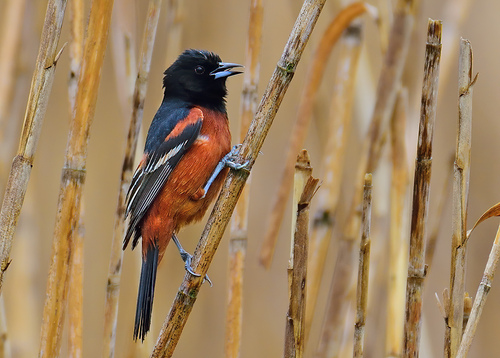
Description and measurements: This bird measures 5.9–7.1 inches (15–18 cm) in length, weighs 0.6–1.0 ounces (16–28 g), and has a wingspan of 9.8 inches (25 cm). Its bill is pointed and black, with blue-gray coloring at the base of the lower mandible. All adult individuals have pointed bills and white wing bars, and orchard orioles are considered adults after their second year. For the nominate subspecies, adult males have chestnut coloring on the underparts, shoulder, and rump, with all other plumage black. In the subspecies I. s. fuertesi, the chestnut coloring found in the nominate subspecies is replaced with ochre. Adult females and juveniles of both subspecies have olive-green upper parts and yellowish breast and belly. One-year-old males are yellow-greenish with black lores and a black bib. Habitat and range: The breeding habitat of Icterus spurius is semi-open areas with deciduous trees. These birds prefer to live in shaded trees within parks along lakes and streams. Their nest is a tightly woven pouch attached to a fork on a horizontal branch, and their nests are typically placed close together. The nominate subspecies I. s. spurius breeds in spring across eastern North America, ranging from near the Canada–United States border south to central Mexico. A 2009 study found that I. s. spurius also breeds in the thorn forest of Baja California Sur and the coast of Sinaloa during the summer monsoon; this region had previously been thought to be only a migratory stopover. The subspecies I. s. fuertesi breeds from southern Tamaulipas to Veracruz, and there is a recorded specimen of I. s. fuertesi from Cameron County, Texas. The winter range of the nominate subspecies extends from the coastal lowlands of central Sinaloa and southern Veracruz south to northern Colombia and northwestern Venezuela (Scharf and Kren 1996). The ochre I. s. fuertesi subspecies has been observed in winter on the Pacific slope of Mexico. Nominate orchard orioles depart from their winter habitats in March and April, and arrive in their breeding habitats from late April to late May. They usually leave their breeding territories in late July and early August, and arrive on their winter territories in mid August. These birds are nocturnal migrants.