About Icterus prosthemelas (Strickland, 1850)
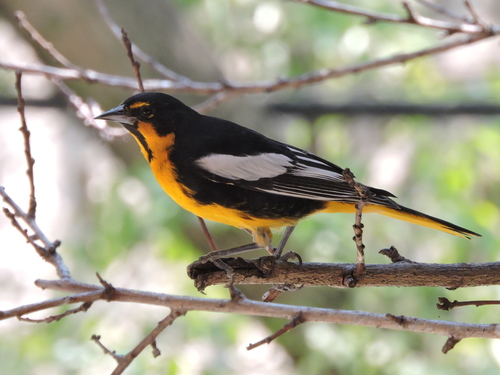
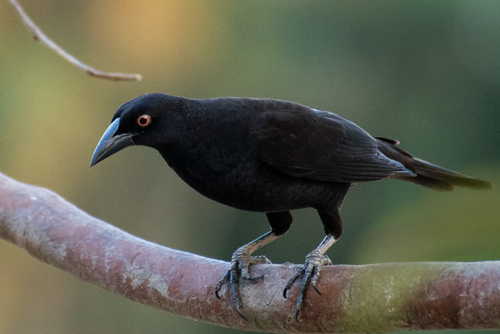
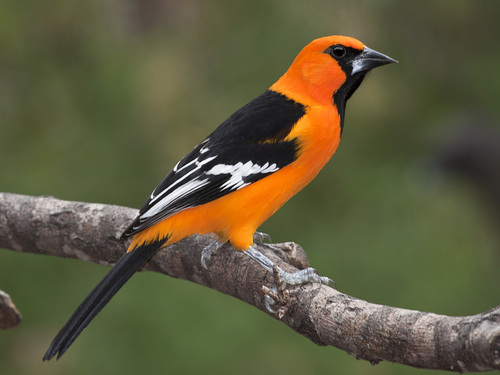
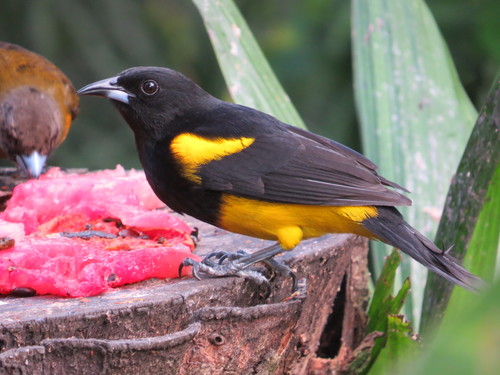
The black-cowled oriole, with the scientific name Icterus prosthemelas (Strickland, 1850), is a medium-sized passerine bird. It measures 18.5 to 21 cm (7.3 to 8.3 in) in length, and shows sexual size dimorphism: males average 32.5 g (1.15 oz), which is larger and heavier than females, who average 27.5 g (0.97 oz). Across its range, sexual plumage dimorphism varies: northern populations are sexually dimorphic, while southern populations have similar plumage in both sexes. For both sexes, the bill is slender, slightly decurved, and black, with a silvery base on the lower mandible. Both sexes also have blue-gray legs and feet, and brown eyes. Adult males have mostly black plumage, with bright yellow patches on the shoulder, rump, and uppertail coverts. The wing lining, lower breast, thighs, and crissum are fully yellow, with a narrow chestnut wash between the black and yellow on the breast. Where female plumage differs from males, females have a black face, throat, and upper breast, with an olive-yellow crown and olive-yellow upperparts. Some females, especially those further south in the species' range, have a mix of black and yellow feathers on the head and back; others have entirely black heads, and some fully resemble males. The immature of the subspecies I. p. praecox is dull yellow-olive on the upperparts and dull yellow on the underparts. Back feathers have black bases, which are sometimes visible. The immature's face, forehead, and throat are matte black, and its wings and tail are also matte black. Immature birds retain this plumage for a year, though individual heavily worn feathers may be replaced. The black-cowled oriole is distributed across much of eastern Central America, ranging from southern Mexico through western Panama. It inhabits Caribbean lowlands and foothills, occurring from sea level up to 1,300 m (4,300 ft) in elevation, though it is found primarily below 500 m (1,600 ft). It is fairly common throughout its native range. In the early 21st century, the species expanded its range to the Pacific slope of Costa Rica, with scattered sightings reported in the central and southern lowlands of the country. It occurs in humid and semihumid forest, including forest clearings and forest edges, as well as more open areas with scattered bushes and trees. In forested areas, it is generally found along waterways. It favors open woodland and plantations, especially banana plantations, and is regularly associated with palms. In the southern portion of its range, it prefers more open habitats, including gardens, forest edges, and second growth. The black-cowled oriole is a non-migratory resident species, and has not been reliably recorded as a vagrant anywhere. It typically moves in pairs or small groups, and often joins mixed-species foraging flocks. It regularly mixes with other oriole species. It roosts in loose groups in tall grass, and juvenile birds sometimes travel together in flocks.