About Icterus portoricensis H.Bryant, 1866
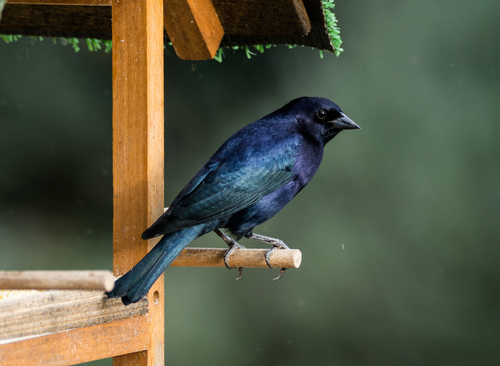
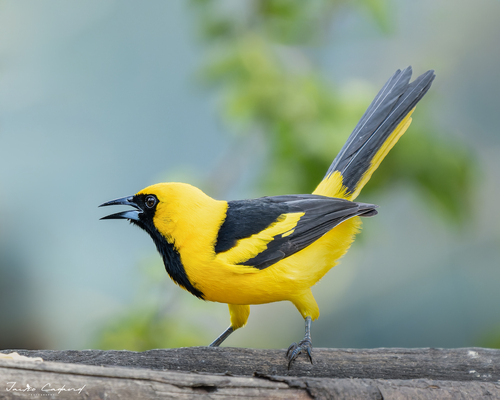
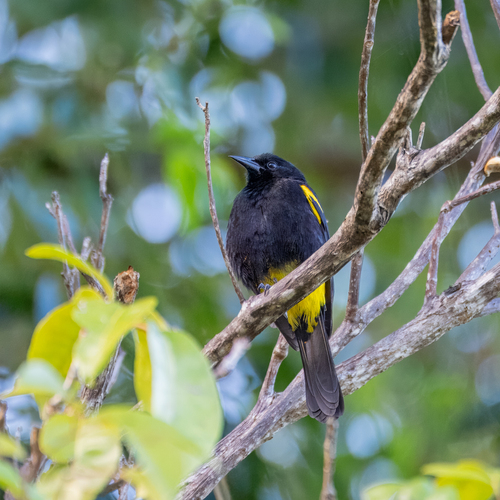
Male and female Puerto Rican orioles (Icterus portoricensis) are similar in both size and color. Males weigh approximately 41.0 grams, while females weigh around 36.6 grams. The average wingspan is 96.9 mm for males and 92.1 mm for females. A 2008 study by Hofmann, Cronin, and Omland found that there is very little difference in feather color between males and females of many tropical oriole species, including the Puerto Rican oriole. As a result, both males and females have distinct elaborate coloration. This differs from many temperate zone bird species, where males are brightly colored and females are dull colored. Adult Puerto Rican orioles are primarily black, with yellow coloring on the lower belly and shoulder. Compared to this species, the closely related Hispaniolan oriole (Icterus dominicensis) and Bahama oriole (Icterus northropi) have more yellow on their bodies, while the Cuban oriole (Icterus melanopsis) has more black. Juvenile Puerto Rican orioles are tawny colored, with an olive tint on the rump. Puerto Rican orioles develop their bright coloration as they mature. The tawny juvenile plumage provides a selective advantage for young birds by helping them camouflage in dense forest. This tawny juvenile coloration is likely the ancestral trait for the genus Icterus. The Puerto Rican oriole is endemic to Puerto Rico. Its natural habitats are tropical forests, mangrove forests, and plantations. The species also has a natural preference for nesting in palm trees. Most members of the genus Icterus are thought to be monogamous, forming lifelong pair bonds between males and females. The Puerto Rican oriole breeds primarily from February through July. It lays around three eggs per clutch. The eggs are white with a bluish hue, marked with light lavender-gray-brown speckles and spots. Nests are basket-shaped structures woven from palm fibers, and are typically suspended from two points on the underside of a palm leaf. One threat to Puerto Rican oriole nesting is parasitism by the shiny cowbird, which is especially common in coastal habitats.