About Icterus mesomelas (Wagler, 1829)
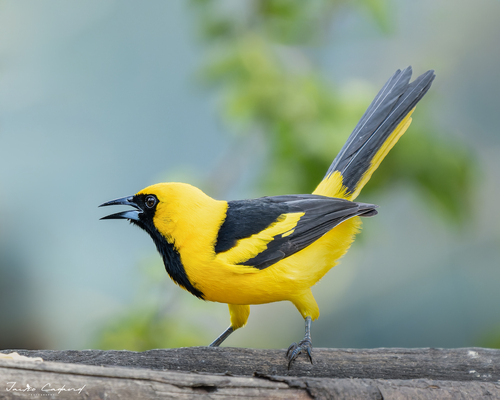
The yellow-tailed oriole, with the scientific name Icterus mesomelas, is a passerine bird belonging to the New World family Icteridae. It breeds across a range from southern Mexico to western Peru and northwestern Venezuela, and in Peru it also occupies a river valley corridor outside its main breeding range. This species measures 22–23 cm (8.7–9.1 in) in length and weighs an average of 70 g (2.5 oz). Its plumage is mostly yellow, with black markings on the back, lower face, and upper breast. The wings are black with yellow epaulets. When viewed from above, the tail is black with yellow margins; from below, the tail appears almost entirely yellow. This is the only oriole species with prominent yellow coloration on its tail, which gives the species its common name. Adult sexes have similar plumage, but young birds have olive-green in place of the black markings found on the backs and tails of adults. Four subspecies of yellow-tailed oriole are recognized: The nominate subspecies I. m. mesomelas, first described by Wagler in 1829, occurs from Mexico to Honduras and has yellow fringes on its tertials. I. m. salvinii, described by Cassin in 1867, is found in the Caribbean lowlands of Nicaragua and Costa Rica; it lacks yellow fringes on the tertials and is more orange in overall color than the nominate subspecies. I. m. carrikeri, described by Todd in 1917, occurs in Panama, Colombia, and northwestern Venezuela; it resembles I. m. salvinii, but is less orange and has a smaller bill. I. m. taczanowskiis, described by Ridgway in 1901, is found in Pacific South America from Ecuador to western Peru, and has white fringes on the tertials. The common calls of this species include a chick note and a weechaw note. Its song consists of melodic repetitions of rich whistles, transcribed as chuck, chuck-yeeaow. The song is often performed as a duet, where the female's response follows or overlaps the male's longer phrases. This large oriole lives in dense thickets, often grown through with vines, Heliconias, and other similar dense vegetation, located in swampy lowlands. The birds forage in pairs or small groups in denser vegetation than most other orioles. They feed mainly on insects, but will also take nectar and certain fruits including gumbo-limbo (Bursera simaruba). The species builds a deep but thin cup nest 2 m (6.6 ft) high in thorny scrub next to a stream. It lays three white eggs marked with dark blotches. Eggs hatch after 13 days of incubation, and young birds fledge 14 days after hatching. The yellow-tailed oriole is fairly common across most of its range, except in Peru and Venezuela. Populations in parts of the species' range are declining due to capture for the cage-bird trade, as this species is valued for both its attractive plumage and its beautiful song.