About Icterus icterus croconotus (Wagler, 1829)
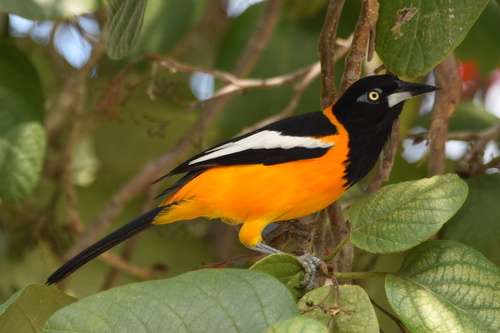
Venezuelan troupials (Icterus icterus croconotus) are fairly large birds, with a long tail and a bulky bill. They have a black head and upper breast. The feathers on the front of the neck and upper breast stick outward, creating an uneven boundary between the black plumage and the orange lower breast and underside. Orange coloration also appears on the upper and lower back, separated by the black shoulders. The wings are mostly black, apart from a white streak that runs the full length of the wing when the wing is closed. Their eyes are yellow, and each eye is surrounded by a patch of bright, blue, naked skin. Venezuelan troupials inhabit dry areas including woodlands, gallery forest, dry scrub, plains, and open savanna. In these habitats, they mainly forage for fruits of the giant cactus, which make up their entire diet when the cactus fruits are in season. They also consume other fruits, such as mangoes, sapodillas, papaya, soursop, dates, and malpighia cherries. They are also known to eat juvenile birds and unhatched eggs from the nests they attack.