About Icterus graduacauda Lesson, 1839
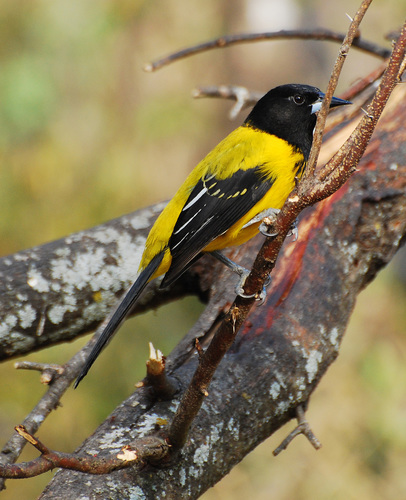
Icterus graduacauda Lesson, 1839, commonly called Audubon's oriole, has distinct physical characteristics that differ by sex and age. Males have a black hood, lower mandible, throat, tail, and wings. Their flight feathers (remiges and rectrices) have white fringes, and their secondary coverts form yellow epaulets. The back and vent are yellow with an olive wash, and the underside is almost uniformly yellow. Females have a slightly more olive nape and back than males. Adult female plumage is similar to juvenile plumage, but unlike adult males, adult females have dull brown wings instead of black. Immature individuals generally have the hood, wingbars, remiges, and epaulets of adult specimens, though first-basic plumage retains the darker, greener coloration of juvenile plumage. Molting most often occurs in early autumn, though some individuals have been recorded molting as early as June. For reproduction, the Audubon's oriole nest is similar in size and construction to nests of the hooded oriole and orchard oriole. It measures approximately three inches in both diameter and depth, shaped like a hanging pouch or basket that is less deep than the nests of other oriole species. The nest rim is firmly woven to supporting twigs, and the entrance is somewhat narrow. Nests are usually built from long grass stems that are woven while still green, and lined with finer grass. A mated pair usually raises two broods per year, with between three and five eggs per brood. Chicks from the second, later brood usually cannot survive the winter. Audubon's oriole nests are often parasitized by brown-headed cowbirds.