About Icterus galbula (Linnaeus, 1758)
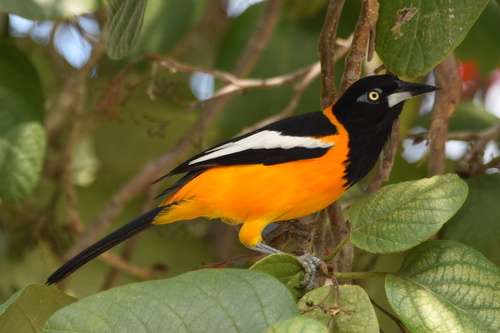
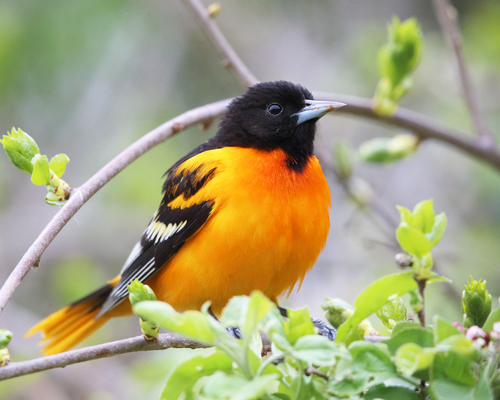
This medium-sized passerine, Icterus galbula, measures 17–22 cm (6.7–8.7 in) in total length, with a wingspan of 23–32 cm (9.1–12.6 in). It has the characteristic build of icterids: a sturdy body, a moderately long tail, fairly long legs, and a thick, pointed bill. Body weight averages 33.8 g (1.19 oz), ranging from 22.3 to 42 g (0.79 to 1.48 oz). Males are slightly larger than females, and this size dimorphism is small compared to what is typical for other icterid species. All adult Baltimore orioles have white bars on their wings. Adult males have orange underparts, shoulder patches, and rumps; individual males can range in color from deep, bright flaming orange to yellowish-orange, and all other parts of their plumage are solid black. Adult females have yellow-brown upperparts, darker wings, and dull orange-yellow breasts and bellies. Juvenile Baltimore orioles look very similar to adult females, and young males do not grow their full adult plumage until the fall of their second year. During the summer breeding season, Baltimore orioles live in the Nearctic. Their breeding range extends from the Canadian Prairies and eastern Montana in the northwest, eastward through southern Ontario, southern Quebec, and New Brunswick, and south through the eastern United States to central Mississippi, central Alabama, and northern Georgia. This species is migratory, and most individuals travel to the Neotropics to overwinter; while some reach as far north as Mexico, and a small number stay as far north as the southern coast of the United States, the majority overwinter in Central America and northern South America. Baltimore orioles may remain year-round in parts of the southern United States if suitable bird feeders are available there. The range of Baltimore oriole overlaps with the range of the closely related similar species Bullock's oriole in the American Midwest. The two species were once classified as a single species called the northern oriole, because they can produce fertile hybrids where their ranges meet. Baltimore orioles are rare accidental vagrants to Western Europe. Baltimore orioles are most often found high in the canopies of large, leafy deciduous trees, and they do not typically live in dense deep forests. During the summer breeding season and migration, they occur in open woodland, forest edges, partially wooded wetlands, and groups of trees growing along riverbanks. They are highly adaptable and can successfully breed in a wide range of secondary habitats. In recent decades, they have commonly been found in orchards, farmland, urban parks, and suburban areas, as long as these locations still contain stands of trees. During the winter in Mexico, they live in flowering canopy trees, most often over shade coffee plantations. Between 1966 and 2015, the Baltimore oriole population declined by more than 1.5% per year across the northern and eastern sections of its breeding range. One major contributing factor to this decline is that Dutch elm disease destroyed a large number of elm trees, which are this species' preferred nesting locations.