About Icterus dominicensis melanopsis (Wagler, 1829)
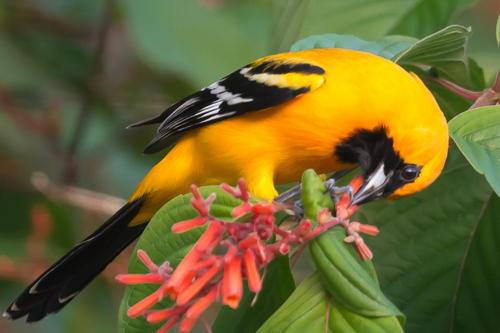
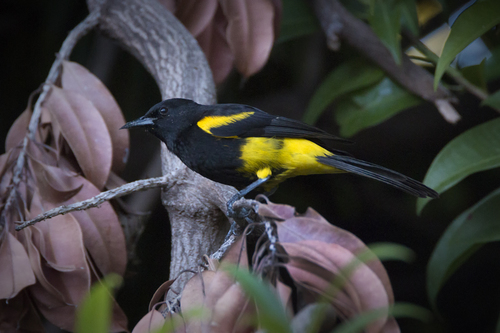
The Hispaniolan oriole (Icterus dominicensis melanopsis) is a slender-billed black and yellow oriole with no white wing markings. It has more yellow plumage than most Caribbean orioles, with the exception of the Bahama oriole (Icterus northropi). Adult males and females are mostly black overall, with distinct yellow patches on the shoulders, rump, and undertail coverts that extend to the lower breast. Like most tropical oriole species, female Hispaniolan orioles have coloring that is similar or identical to that of males. Juvenile Hispaniolan orioles have mainly olive upperparts and dull yellow underparts. Their wings are black, and their throat is sometimes an indistinctly bordered black or reddish-brown. The Hispaniolan oriole averages 20–22 cm in total length; males weigh 35–38 g, while females weigh 33–40 g. The yellow-shouldered blackbird (Agelaius xanthomus) is a similar-sized species often mistaken for the Hispaniolan oriole, but it only has yellow patches on its shoulders. The Hispaniolan oriole is a year-round endemic resident of the island of Hispaniola, which spans both the Dominican Republic and Haiti, as well as the nearby islands of Gonâve, Saona, and Tortuga. It lives in tropical and subtropical forests, forest edges, woodlands, and gardens, ranging from the coast up to mid-elevation mountain areas. It is less common at higher elevations. It is frequently found in areas where palm fronds are available for nesting, and also occurs on the many shaded coffee plantations across Hispaniola. The Hispaniolan oriole appears to be rare in the Hispaniolan pine (Pinus occidentalis) forests of the Dominican Republic's highlands, though other oriole species such as the Bahama oriole have been recorded nesting in pine forests. Because no formal population assessment has been published, it remains possible that the Hispaniolan oriole does nest in pine forests.