About Icterus cucullatus Swainson, 1827
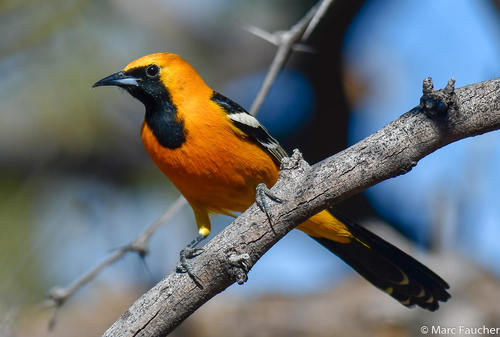
Adults of Icterus cucullatus have a completely black curved bill and white wing bars. Adult males have a deep yellowish-orange head with black markings on the face and throat; their back, wings and tail are black, and their underparts are orange. Adult females have olive-green upper parts and yellowish breast and belly. Their calls include whistles and wheets, and their song is a mixture of these two sounds. Their breeding habitat is open tree-dotted areas, particularly areas with palms, across the Southwestern United States and northern Mexico. They build a tightly woven pouch nest, which is attached to the underside of a leaf or tree branch. Brown-headed cowbirds, a brood parasite species that lays its eggs in other birds' nests for the hosts to raise, sometimes deposit cowbird eggs in the nests of this species. Most populations of these birds migrate south in flocks to the southwestern coast of Mexico. They are permanent residents in Baja California Sur, the Mexican east coast, and Belize. Some individuals may overwinter near bird feeders. They can also occur in Southern California neighborhoods, but they are rare there during the winter. They forage in trees and shrubs, and also feed from flowers. They act as nectar robbers: they pierce the base of a flower to feed on nectar, and do not assist in pollination. Their diet consists mainly of insects, nectar and fruit, and they will also visit hummingbird feeders and general bird feeders to eat seeds. This species shows geographic variation, with five subspecies split into two groups. Subspecies found east of the Big Bend in Texas are generally more orange, while subspecies found in New Mexico and further south are yellower. The five described subspecies are listed below. I. c. cucullatus is found in the Rio Grande Valley of Texas, and ranges south through Mexico to Oaxaca and Veracruz; this subspecies is very orange in color. I. c. sennetti occurs from the lower Rio Grande Valley of Texas south along the coastal plain into Tamaulipas; it is similar in color to I. c. cucullatus, but is notably paler and more yellow. I. c. igneus occurs in southern Mexico, from East Tabasco and the Yucatán Peninsula south into Belize; it is the brightest, most orange subspecies, and females of this subspecies have been reported to often display a more greyish throat patch. I. c. nelsoni is the western subspecies of the species, found from California south to North Baja California, and east into Arizona and New Mexico; this subspecies is noticeably more yellow than the other subspecies, and also has a much more slender bill, longer wings and a shorter tail. I. c. trochiloides is found in Baja California and Mexico; this subspecies has a yellowish-orange coloration, and has a much longer and thinner bill.