About Icterus chrysater (Lesson, 1844)
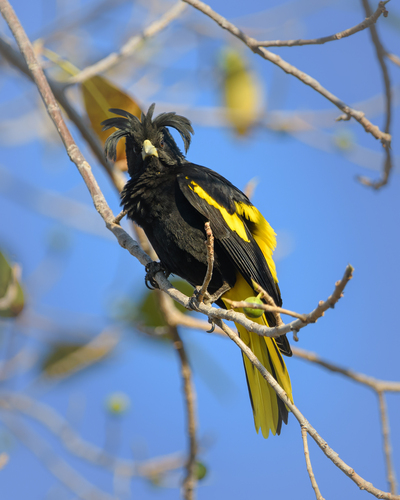
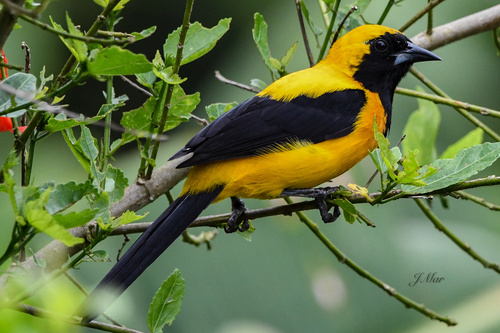
Description: Yellow-backed orioles (Icterus chrysater) are a sexually monomorphic species with yellow bodies. They average 21.5 cm (8.5 in) in total length from beak to tail, making them a relatively medium-sized oriole species. Their exposed skin and claws are bluish-black. In adults, the bill is black, with the base of the mandible turning bluish-grey. Adult males have strongly contrasting yellow and black plumage: their wings, tail, shoulders, throat, and face are all black, while their back and underparts are an extremely bright yellow. Adult females closely resemble males, but their yellow-colored regions appear slightly greenish. Despite the small plumage color difference between sexes, this species is extremely difficult to tell apart by sex when observed in the field. Immature yellow-backed orioles share the overall pattern of adult females, but are greener overall. Additionally, their flight feathers are dark brown, while adult females have black flight feathers. Immature yellow-backed orioles can be easily distinguished from adult females by their olive eye-line. A similar species to the yellow-backed oriole is the South American yellow oriole (Icterus nigrogularis).
Distribution and habitat: Yellow-backed orioles are found across Central America and northern South America. The species is split into three allopatric populations. One population, the subspecies I. c. giraudii, is endemic to southern Central America, including Nicaragua, Panama, and Colombia. The northernmost populations belong to the subspecies I. c. chrysater and I. c. mayanensis, which occur in northern Central America and southern Mexico. The species has been recorded in Belize, Colombia, El Salvador, Guatemala, Honduras, Mexico, Nicaragua, Panama, and Venezuela. Yellow-backed orioles can tolerate a wide range of habitats, but they prefer open mixed pine-oak woodlands and dry scrub forest. They have also been sighted in banana plantations, and occasionally colonize lowland deciduous forest. They are usually found in regions below 900 m (3,000 ft) in altitude, but populations in Central and South America are often seen living at elevations above 1,000 m (3,300 ft). The highest altitude limit recorded for wild populations of this species is approximately 3,000 m (9,800 ft).
Reproduction: Yellow-backed orioles are monogamous. Like many species in the genus Icterus, they breed once a year with a single mate. Their nests are shallow, hanging basket-shaped structures, usually hung from the edge of a tree limb. Members of this species prefer to attach nests to the tips of palm fronds. Nests are typically woven from fine grasses, which gives them a springy texture (Wetmore et al. 1984). Nests are normally hung in the canopy of mature trees that are at least 7 m (23 ft) tall. The eggs of this species are whitish, with purple scrawls concentrated near the broad end of the egg. The eggs also commonly have evenly distributed brown lines.