About Icterus bullockii (Swainson, 1827)
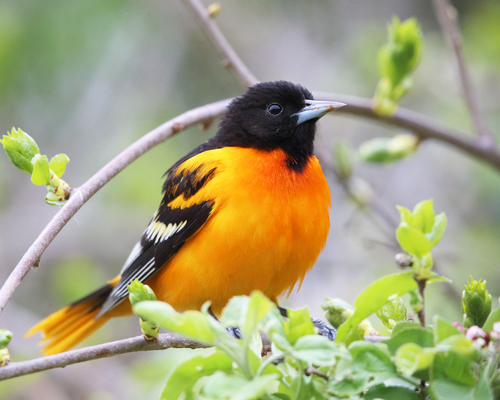
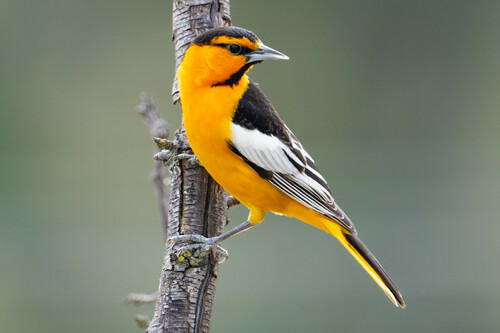
Bullock's oriole (Icterus bullockii) is a sexually dimorphic species: adult males are more brightly colored, and slightly larger and heavier, than adult females. Standard measurements for the species are 17–19 cm (6.7–7.5 inches) in length, 28–43 g (1.0–1.5 ounces) in weight, and 31 cm (12.2 inches) in wingspan. All adults have a pointed bill with a straight culmen. For adult males, the tail is long, square, and solid jet black; all exposed skin, claws, and bill are black, though the base of the lower mandible lightens to bluish-gray. Adult males have strongly contrasting orange and black plumage, a black throat patch, and a white wing bar. Their underparts, breast, and face are orange or yellow, while their back, wings, and tail are black. A black line runs from each eye to the black crown, and the wing coverts (feathers not used directly for flight) are fringed white, forming a distinct wing patch. While the tail is mostly black, the outermost three or four rectrices (flight tail feathers) are tipped orange, forming a "T" shape. In contrast, adult females have gray-brown upperparts, duller yellow on the breast and underparts, and an olive crown. Some females may have a dark throat patch similar to but less extensive than that of adult males, but all females lack the black eye line found in adult males; females with dark throat patches are thought to be older individuals. Following the common pattern among icterids, immature male Bullock's orioles have a plumage pattern that closely resembles that of adult females. Juveniles also resemble adult females, but have darker wings, fresh wing coverts, and a pink or whitish bill, and sexual dimorphism is not obvious in juveniles. Bullock's orioles are native to western North America, and are sometimes found as vagrants in the eastern half of the continent. During the breeding season, their range extends as far west as the eastern foothills of the Cascade Range, and stretches east to the Dakotas, Kansas, and northern Central Texas. The breeding range reaches as far north as British Columbia, Canada, and as far south as Sonora or Durango, Mexico. The species is common throughout most of its range, but is absent from parts of Arizona and Idaho, where a combination of extreme elevation and arid climate creates unsuitable habitat. During winter, the species migrates to Mexico and northern Central America, with its winter range extending south and east from Sinaloa to Oaxaca. Like other members of the Icteridae family, Bullock's orioles prefer habitat edges, and especially favor riparian corridors, open deciduous woodland, and scrub forest. Breeding season observations show the species prefers areas with abundant cottonwood, pecan, and willow when near water. In dry areas, the species favors salt cedar and mesquite. In California, eucalyptus trees are a major source of nectar for the species. Bullock's orioles are seasonally monogamous, with a breeding season that typically runs from May to July. The exact start of breeding varies geographically, generally beginning later in the northernmost and westernmost parts of the species' range. Mated pairs cooperate to weave deep, hanging basket nests to hold between three and six eggs, though females do most of the weaving work. Nests are woven from plant fibers, primarily bark and fine grass, and animal hair is also commonly used; nests are lined with down, hair, and moss. Both males and females feed the young and defend the nest from predators and nest parasites. Where their ranges overlap in the Midwest, Bullock's orioles and Baltimore orioles commonly hybridize.