About Ictalurus punctatus (Rafinesque, 1818)
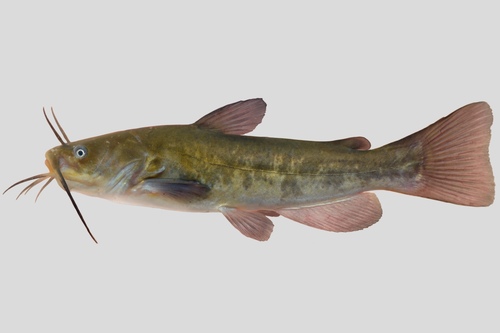
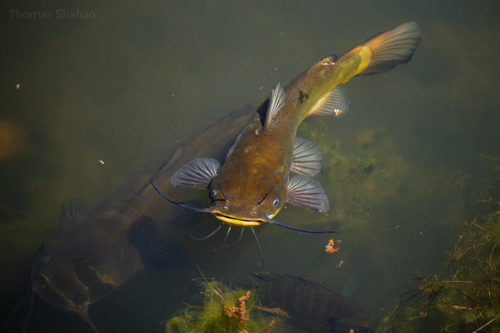
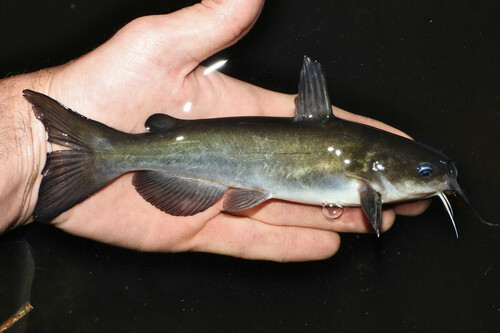
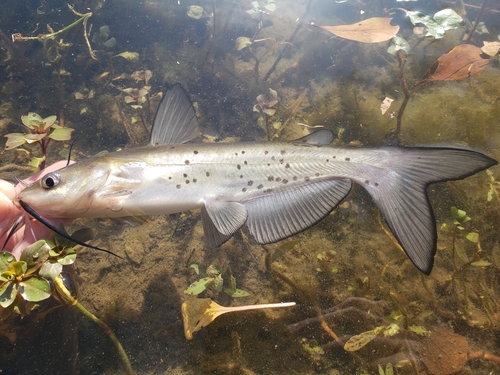
Channel catfish (Ictalurus punctatus) have a well-developed sense of smell and taste. Their nostril pits, called nares, hold sense organs with high concentrations of olfactory receptors. In channel catfish, these organs are sensitive enough to detect several amino acids at a concentration of about one part per 100 million in water. Channel catfish also have taste buds distributed across the entire surface of their body. These taste buds are especially concentrated on the four pairs of barbels, or whiskers, that surround the mouth, with about 25 buds per square millimeter. This combination of strong senses of taste and smell lets channel catfish find food relatively easily in dark, stained, or muddy water. They also have a Weberian apparatus that amplifies sound waves that would otherwise be undetectable. A common misconception claims that channel catfish barbels sting on contact, but the barbels do not have this capability and cannot sting. However, channel catfish do have spines on their pectoral and dorsal fins that can inject venom and cause injury if the fish is handled improperly. Channel catfish are native to the Nearctic realm, and are widely distributed across southern Canada, the eastern and northern United States, and parts of northern Mexico. Their extensive native range covers almost all of the United States west of the Appalachian Mountains and east of the Rocky Mountains, roughly following the Mississippi River Basin. They are also native to peninsular Florida. They have been widely introduced to Atlantic-draining rivers east of the Appalachians and Pacific-draining rivers west of the Rockies, giving them a range that spans the North American continent. Although they are officially classified as introduced to this Atlantic-draining region, it has been suggested that they may also be native to Atlantic-draining rivers from the Susquehanna River south to the Neuse River. Their range in southern Canada includes the Great Lakes, excluding Lake Superior, and parts of the provinces of Quebec, Ontario, and Manitoba. They have also been introduced into some waters of the Czech Republic and Romania, as well as parts of Malaysia and Indonesia. This species thrives in rivers, reservoirs, lakes, and ponds. Channel catfish are cavity nesters, meaning they lay their eggs in crevices, hollows, or debris to protect the eggs from swift currents.