About Ichthyosaura alpestris (Laurenti, 1768)
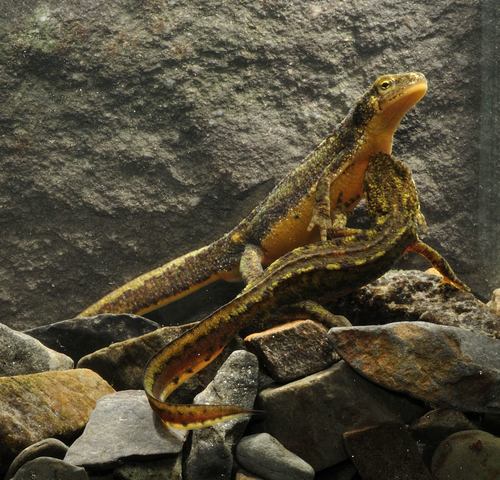
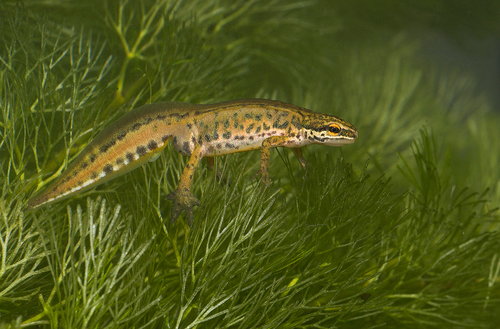
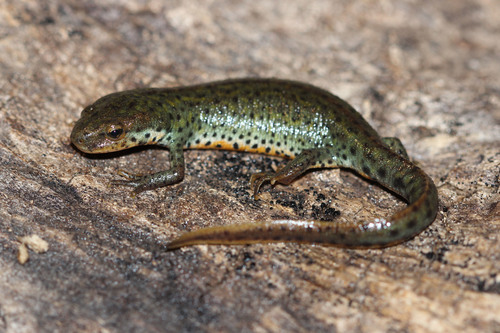
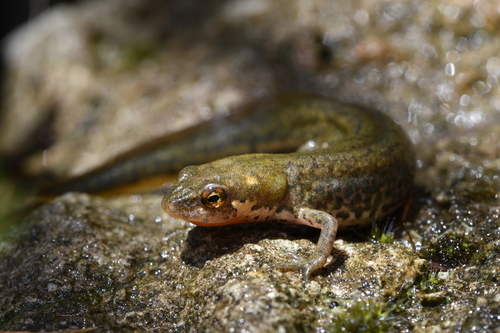
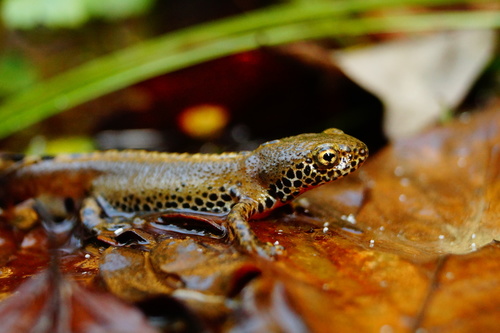
Ichthyosaura alpestris, commonly known as the alpine newt, is a medium-sized, stocky species. Adults reach a total length of 7–12 cm (2.8–4.7 in), with females typically 1–2 cm (0.39–0.79 in) longer than males, and have a body weight between 1.4 and 6.4 g. Their tail is laterally compressed, and is half the total body length or slightly shorter than the rest of the body. While living in water, both sexes develop a tail fin; males additionally grow a low (up to 2.5 mm), smooth-edged crest along their back, and the male cloaca swells during the breeding season. The skin is smooth during breeding season and granular outside this period, and has a velvety texture during the newt's land-dwelling phase. The characteristic dark grey to bright blue colouring of the back and sides is most intense during breeding season. This base colour can vary to a greenish shade, and is typically duller and more mottled in females. The belly and throat are orange, with dark spots only occurring occasionally. Males have a white band marked with black spots and a pale blue sheen that runs along the flanks from the cheeks to the tail. During breeding season, their crest is white with regular dark spots. Juvenile efts, just after metamorphosis, look like adult terrestrial females, but sometimes have a red or yellow line along the back. Leucistic individuals have very rarely been observed. These descriptions apply to the widespread nominate subspecies I. a. alpestris; other recognized subspecies show minor differences. I. a. apuana often has dark spots on the throat, and sometimes on the belly. I. a. cyreni has a slightly rounder and larger skull than the nominate subspecies, but is otherwise very similar. For I. a. veluchiensis, females have a more greenish base colour, spots on the belly, sparse dark spots on the lower edge of the tail, and a narrower snout, but these differences between subspecies are not consistent. When newly hatched, larvae are 7–11 mm long, and grow to 3–5 cm (1.2–2.0 in) just before metamorphosis. Newly hatched larvae only have two small filaments called balancers, located between the eyes and gills on each side of the head. These balancers later disappear as the forelegs, and then the hindlegs, develop. Larvae are light brown to yellow, and initially have dark longitudinal stripes that later break up into darker pigmentation that is more intense towards the tail. The tail is pointed, and sometimes ends in a short filament. Alpine newt larvae are more robust and have wider heads than the larvae of smooth newts and palmate newts. The alpine newt is native to continental Europe. It is relatively common across a large, mostly continuous range extending from northwestern France to the Carpathians in Romania, and from southern Denmark in the north to the Alps and northern France just above the Mediterranean in the south. It is absent from the Pannonian basin. Isolated populations in Spain, Italy and Greece correspond to distinct subspecies. Alpine newts have been intentionally introduced to parts of continental Europe, including within the city limits of Bremen and Berlin. Other introduced populations exist in Great Britain—mostly in England, but also in Scotland—and on the Coromandel Peninsula in New Zealand. A thriving introduced population was discovered in 2014 in the Catalonian Pre-Pyrenees at Santa Maria de Besora, Barcelona; it was likely established from released captive individuals, and this population was found to carry ranavirus. The alpine newt can occur at high elevations, and has been recorded up to 2,370 m (7,780 ft) above sea level in the Alps. It also occurs in lowlands down to sea level. In the southern part of its native range, most populations are found above 1,000 m (3,300 ft).