About Ichneutica sulcana
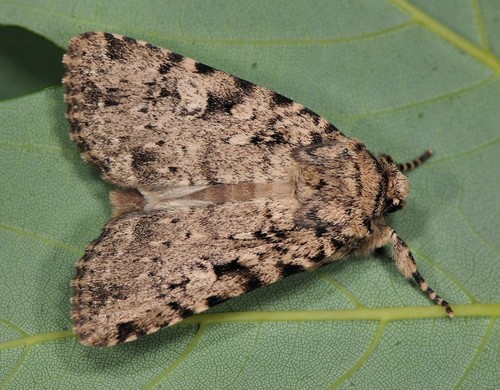
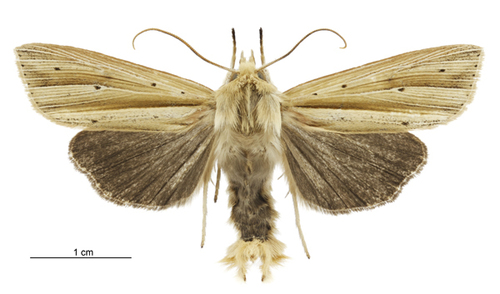
This is a description of the moth species Ichneutica sulcana. Eggs of this species are hemispherical, green, and have a honeycomb pattern on their surface. George Hudson provided a description of the full-grown larva, which is approximately 1 and 3/4 inches long, much narrowed towards its posterior end, and is pale reddish-ochreous with numerous fine wavy darker lines. The larva’s subdorsal and lateral lines are straight and far more conspicuous; its spiracles are black, and there is a dark olive-green line running down its midback. Hudson also described the adult moths of I. sulcana: the wing expansion ranges from 1 and 1/2 inches to 1 and 3/4 inches. The forewings are light ochreous with white veins; there are shaded, brownish longitudinal streaks: one near the apex, a second from the end of the cell to the termen, a stronger streak from the wing base to near the tornus, and another along the dorsum. There is a minute black dot near the base above the middle, a slightly larger dot at about one-third of the wing length, a conspicuous dot between the origins of veins 3 and 4, and a very minute dot on vein 6. The hindwings are dark blackish-grey, with paler cilia. The adult male wingspan is between 35 and 46 mm, while the adult female wingspan is between 42 and 48 mm. Specimens from the northern North Island may be smaller and have more pronounced shading on the forewing. I. sulcana is extremely similar in appearance to I. supersulcana, with no reliable consistent visible differences between the two having been found. However, I. supersulcana tends to be larger and paler, with less well-defined longitudinal dark streaks on its forewings. The two species have distinct differences in the male abdomen and genitalia. As of 2019, the two species have not been found to share overlapping ranges, as I. supersulcana appears to be restricted to the higher altitudes of the Tararua Range and Tongariro National Park. I. sulcana may also be confused with I. semivittata, but I. sulcana is larger, has a much darker abdomen and hindwing, and only has 1 to 3 dots on its forewing postmedian line. When resting among grass, this species is well camouflaged. I. sulcana is endemic to New Zealand. It is fairly common, and is found throughout the North Island, South Island, and Stewart Island, across a range of altitudes from lowlands to the alpine zone. It is reported to be more common in the North Island. This species prefers habitats including native grassland, shrubland, wetlands, and native forest. The egg hatches after about a week into a bright green larva. After feeding, the larva hibernates during winter, and reaches full growth in spring. The larva pupates in a space just beneath the soil surface. The pupa is brown, and the adult moth emerges after a few weeks.