About Ichneutica semivittata
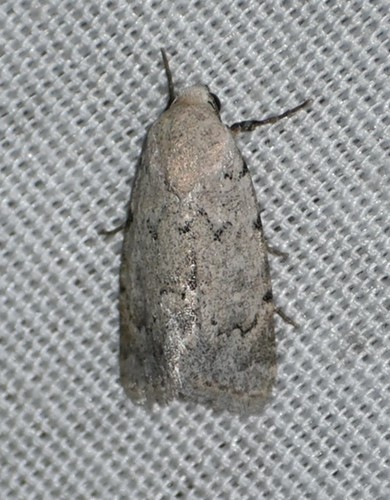
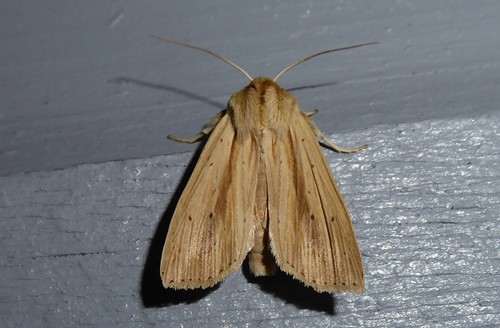
George Hudson described the larvae of Ichneutica semivittata as follows: The larva, which feeds on native grasses, is about 1+1⁄4 inches in length, subcylindrical, and slightly tapering at each end. It is dull green, very finely streaked with reddish-brown; the dorsal and subdorsal lines are marked by fine double reddish lines. There is a series of white dots, one on each segment except for the second and last segments. The lateral line is very distinct, dark reddish-brown, and shaded with cream colour below; the spiracles are blackish; the underside of the larva and the entire second segment are a paler, clearer green than the rest of the body. Walker described the adults of this species as follows: Male specimens are very pale fawn-colour. Palpi hardly ascend, and are as long as the breadth of the head; the second joint is fringed beneath, and the third joint is lanceolate, less than half the length of the second. Antennae are setose. The abdomen extends somewhat beyond the hind wings. All wings have black marginal points. Fore wings are acute, with a short black basal line; this black line is accompanied by an ochraceous line that extends irregularly along the hind side of a brownish streak in the wing disk. This streak is crossed by a curved line of black points; veins towards the exterior border are brownish, with brownish lines between them; the underside of the fore wing has a brownish patch in the disk beyond the middle. Hind wings are brownish on the upper surface, except along the interior border. The length of the body is 9 lines; the length of the wings is 22 lines. The wingspan of an adult male of this species ranges between 30 and 42 mm, while for adult females it ranges between 31 and 40 mm. This species is distinctive and can be told apart from other related species by the reddish ochreous streak on its forewing. The similar species Ichneutica sulcana can be distinguished from I. semivittata because I. sulcana is much larger, has a darker hindwing and darker abdomen, and only has one to three spots behind the middle of the forewing, compared to the 8 or 9 spots found in that location on I. semivittata. This species is endemic to New Zealand. It can be found from the Three Kings Islands down to and including Stewart Island. This species lives in a variety of habitats, from open grasslands to forest clearings, and occurs at a range of altitudes from sea level up to the alpine zone. It is relatively rare in the tussock grasslands of MacKenzie country and in Canterbury.