About Ichneutica blenheimensis
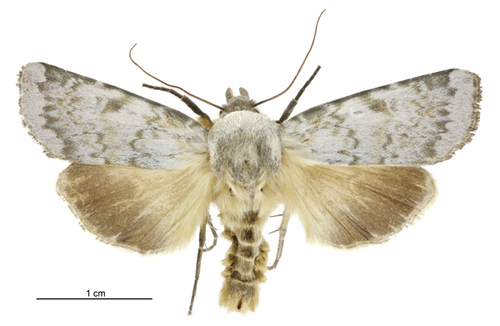
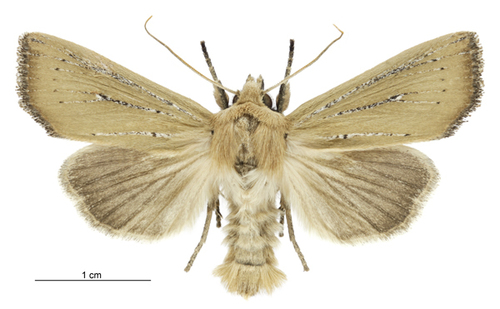
Ichneutica blenheimensis is a moth species with the following documented descriptions. A. V. Chappell described its egg as pale cream, becoming light brownish with a brown ring and a central spot on the top, changing to dark brown then pale blackish, with fine sculpturing. Chappell also described the larva: it is pale dusky yellow and transparent, has numerous stout black hairs that grow singly from black spots, and a large, pale amber head speckled with black. G. V. Hudson described the adults: the wing expansion is about 1+1⁄2 inches. The fore-wings are cream-coloured with darker veins; there are three faint black dots at about one-third of the wing length, a curved series of black dots near the termen, the termen itself is strongly shaded with dark greyish-brown, and the cilia are dark greyish-brown. The hind-wings are grey, paler towards the base, and the cilia are also grey. The wingspan of adult males is 37 mm, while the wingspan of adult females is between 40 and 41 mm. Blackish forewing fringes are a diagnostic feature of this species. Worn specimens of Ichneutica arotis can be confused with worn specimens of I. blenheimensis, but I. arotis can be distinguished by its scale-tuft on the thorax and dark longitudinal stripes on the tegula. This species is endemic to New Zealand, and is found throughout the North Island, South Island, and Stewart Island. Its range covers the Hawkes Bay, Marlborough, Dunedin, Otago Lakes, Southland, and Stewart Island regions. Along with the type locality of Meanee, specimens have also been collected at Denniston Plateau, Blenheim, Dunedin, Lake Wakatipu, and Routeburn. The likely host plant for the larvae of this species is golden sand sedge pīngao, which is now absent from the moth's type locality. Chappell notes that very young larvae eat grass species, while more developed larvae consume Phormium tenax. Based on collection records, this species appears to prefer drier eastern localities, and is rarely collected in forested areas of the western North Island. It also does not appear to be frequently collected in dry inland tussock grassland habitats.