About Ichneutica agorastis
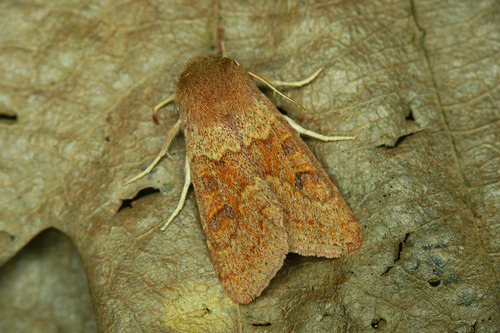
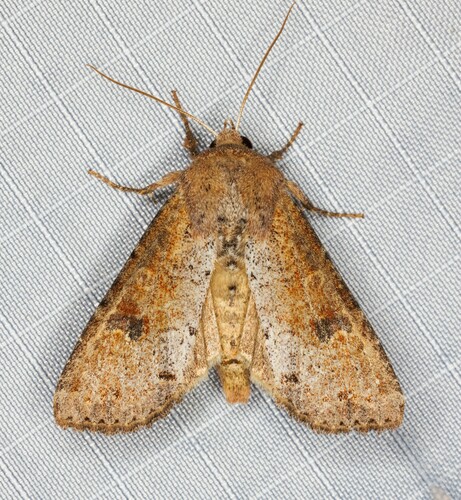
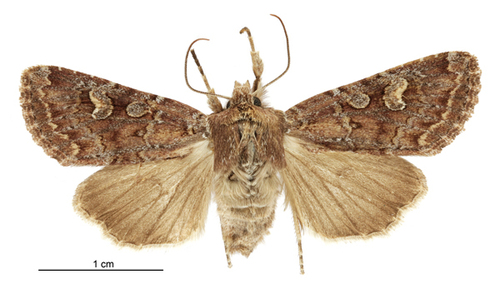
When Edward Meyrick first described Ichneutica agorastis, he noted that both male and female individuals have a wingspan of 35 mm, following his original measurements. The head, palpi, and thorax are reddish-fuscous; the thorax has small anterior and median crests. The antennae are fuscous; in males, the antennae have rather short, strongly ciliated pectinations. The abdomen is grey, and the anal tuft is light reddish. The legs are reddish-fuscous, speckled with ochreous whitish. The forewings are moderately dilated, with an almost straight costa, obtuse apex, and a waved, obliquely rounded hindmargin. The forewings are a rather dark reddish-fuscous, with greyish-tinged lines edged in dark reddish-fuscous that are fairly well defined. The claviform mark is small, obscure, and greyish. The orbicular and reniform markings are dark grey, bordered first with white then with dark reddish-fuscous; the orbicular is round, and the reniform is oblong. There is a fairly distinct median shade. The subterminal line is whitish-ochreous, obscure, and waved. A series of black lunules runs along the hindmargin, and the cilia are reddish-fuscous. The hindwings are fuscous, and the cilia are whitish with a fuscous line. I. agorastis is very similar in appearance to I. hartii, and has also been confused with I. alopa. It can be distinguished from I. hartii because I. agorastis normally has a larger wingspan, and has a more reddish tinge to its forewings, while I. hartii forewings tend to be purplish. It can be distinguished from I. alopa because I. agorastis has more distinctive and paler crosslines on its forewings. The overall wingspan of I. agorastis ranges from 32 to 39 mm. This species is endemic to New Zealand. It has been recorded in the South Island and Stewart Island, and its presence in the North Island has not yet been confirmed. It inhabits subalpine open habitats such as tussock grasslands, but has also been found at sea level in locations in Southland. Specimens have also been collected in string mires.