About Ichneumia albicauda (G.Cuvier, 1829)
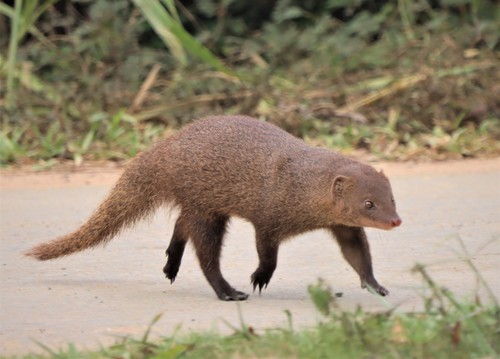
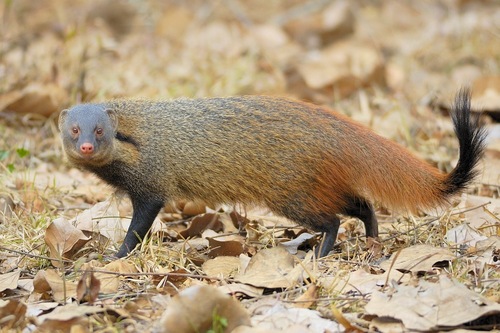
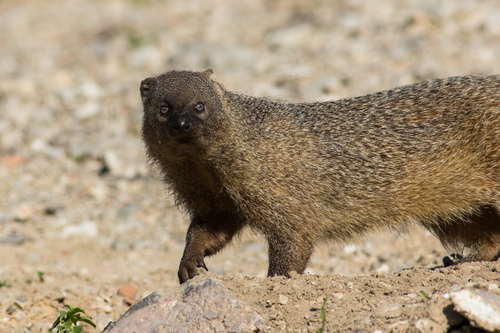
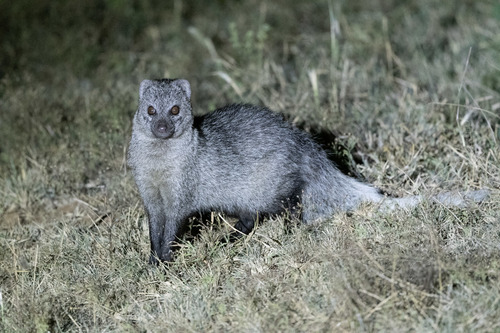
Ichneumia albicauda, commonly called the white-tailed mongoose, has a weight range of 1.8 to 5.2 kg (4.0 to 11.5 lb), with an average weight of approximately 3.38 kg (7.5 lb). Its head-and-body length measures 53 to 71 cm (21 to 28 in), and its tail length ranges from 40 to 47 cm (16 to 19 in). On average, it appears to be the longest and heaviest living mongoose species, though its body length and body mass ranges broadly overlap with other large mongoose species. In particular, the marsh mongoose most closely rivals the white-tailed mongoose in reported body mass range, and may possibly match that range even if it does not match the white-tailed mongoose's average weight. It has relatively long legs for a mongoose, with a long, narrow head and large, rounded ears set low on the sides of the head. Its body has a yellow to tan base coloration, covered with long black guard hairs that create an overall grizzled grey appearance. All portions of the legs distal to the tibiofemoral joint are black. The base of its large, bushy tail is brownish yellow, while its distal half is white, which is the feature that gives the species its common name. The tail can make up as much as 40% of the animal's total body length. This species has no hair on its upper lip or on its forepaws. Females have four teats.
The white-tailed mongoose is found across most of Africa south of the Sahara, as well as in the southern portion of the Arabian Peninsula. It occupies a wide range of habitats, from semi-desert to savanna woodland, but avoids moist regions such as the Congo River basin and extremely arid areas. It favors areas with thick cover, including forest edges and brushy stream banks. It was recorded in the transboundary Dinder–Alatash protected area complex of the East Sudanian Savanna during surveys conducted between 2015 and 2018, and it is also frequent in the Degua Tembien massif further to the northeast.
This mongoose is primarily nocturnal and terrestrial. During the day, it rests in abandoned burrows, termite mounds, or cavities under tree roots. The average home range size is 0.97 km² (0.37 sq mi) for males, and 0.64 km² (0.25 sq mi) for females. Male home ranges do not overlap, but the ranges of males and females overlap significantly. Females either live alone with their own offspring, or in a small group with other females and their offspring, though the females do not form social associations with one another. Even when sharing a home range, females forage separately. The species is mostly solitary, with males and females only coming together to mate. Observed groups are always either a breeding pair or a mother with her offspring. White-tailed mongooses only migrate to establish their own territory separate from their mother's range.
This species is very vocal, and produces an unusual barking sound linked to sexual behavior. When frightened, it secretes a noxious substance from its anal glands. Unlike other mongooses, it does not stand on its hind legs for extended periods of time.
Current knowledge about the reproduction of the white-tailed mongoose is incomplete. Litters are most commonly observed from February to May, and no young are seen at all during the dry season from August to November. This seasonal pattern suggests the species only breeds once per year. Young white-tailed mongooses are fully weaned at nine months of age, and disperse around this time. It has been speculated that sexual maturity is reached before two years of age, and that the gestation period is approximately 60 days.