About Icerya purchasi Maskell, 1879
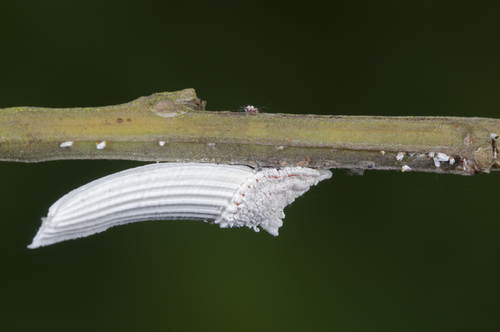
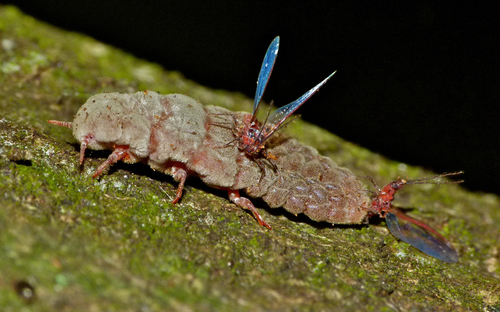
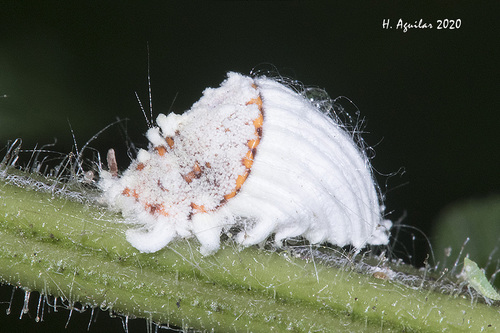
Icerya purchasi, commonly called the cottony cushion scale, is a species of scale insect that feeds on woody plants from more than 80 different families, with Citrus and Pittosporum being the most common host plants. This insect originates from Australia. It was originally described in 1878 from specimens collected as pests of kangaroo acacia in New Zealand, and was named by W.M. Maskell after the Rev. Dr. Purchas, who Maskell believed first found the species. Today it is found in all regions of the world where citrus crops are grown. Cottony cushion scales infest the twigs and branches of their host plants. Mature hermaphrodite individuals are oval-shaped, reddish-brown with black hairs, and reach 5 mm in length. Once mature, the insect stays stationary, attaches itself to its host plant using waxy secretions, and produces a white egg sac by extrusion from grooves in its body. This egg sac holds hundreds of red eggs, and grows to two to three times the length of the insect’s body. Newly hatched nymphs are the primary dispersal life stage; nymphs disperse via wind and by crawling. Early-stage nymphs feed from the midrib veins of leaves and small twigs, and cause most of the damage to host plants. After each molt, nymphs leave their old skin and waxy secretions at their former feeding point; these waxy secretions give the insect its common name. Unlike many other scale insects, cottony cushion scales retain legs and limited mobility through all their life stages. Older nymphs move to larger twigs, and eventually move to branches and the trunk once they become adults. Their life cycle is highly dependent on temperature: each life stage lasts longer in cold temperatures than in warm temperatures. In addition to direct damage from sucking sap, these insects secrete honeydew, which often encourages the growth of sooty mold that causes further damage to the host plant. Some ant species will also consume this secreted honeydew. Icerya purchasi is a hermaphroditic species, and males are very rare. In this species, males are haploid while female (hermaphrodite) individuals are diploid. Hermaphrodite individuals have an ovitestis that can produce both sperm and oocytes, which fertilize internally to produce diploid female (hermaphrodite) offspring through this form of hermaphroditism. The cells of the ovitestis are haploid, and come from excess sperm produced during matings with males. This tissue has been called 'parasitic tissue', and theoretical studies have examined it as a form of sexual conflict, exploring the possible fates and fitness consequences, since females can produce daughters either by mating with males or by using their parasitic male cell lines. Females that do not have ovitestes may preferentially produce sons, while females with parasitic tissue should prefer to pass their genetic material on through daughters. True males are overall uncommon to rare, and are often not even present in many infestations. Pure female individuals of this species have never been documented. Self-fertilization by a hermaphrodite produces only hermaphrodite offspring. Matings between a male and a hermaphrodite produce both males and hermaphrodites.