About Ibycter americanus (Boddaert, 1783)
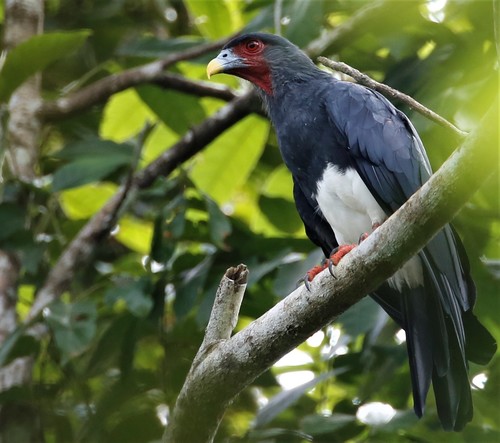
Ibycter americanus (Boddaert, 1783), commonly called the red-throated caracara, shows size differences between sexes: males average 20.1 inches (51 cm) in total length, while females average 22.1 inches (56 cm). Compared to the black caracara, this species is larger, and its plumage is mostly black, with white belly, tail feathers, and undertail feathers. Both sexes have bare skin on the face and throat, with a small number of scattered black feathers on the throat; the exposed bare skin is red. Male and female red-throated caracaras are otherwise similar in appearance. Detailed body measurements for males are: 35.55 cm wing length, 24.96 cm tail length, 2.5 cm bill length, and 5.41 cm tarsus length. For females, the measurements are: 35.93 cm wing length, 25.31 cm tail length, 2.58 cm bill length, and 5.62 cm tarsus length. This species lives in humid lowland forests across Brazil, Bolivia, Colombia, Costa Rica, El Salvador, Ecuador, French Guiana, Guatemala, Guyana, Honduras, Mexico, Nicaragua, Panama, Peru, and Venezuela. The red-throated caracara has slow flight, which is well suited for moving through the forest understory where vegetation is relatively sparse. This sparse vegetation gives the bird better visibility to spot both food and predators. Known predators of the red-throated caracara include the ornate hawk-eagle and the black-and-white hawk-eagle. Red-throated caracaras hunt in both the canopy and understory of lowland jungle, and forage mainly for insect nests. Most hunt silently, but they will occasionally make soft caws, and sometimes hunt in groups. When hunting in groups, one or two individuals scout for predators in the canopy, while the rest of the flock hunts in the understory. This species is highly territorial, and social groups contain between four and eight individuals. Its diet is made up mostly of wasp and bee larvae, though it also eats mature insects, and forages for fruits and berries across the humid subtropical, tropical lowland, and mountainous parts of its range in Central and South America. Forest biodiversity and old-growth forest are critical for this bird's specialized diet, because wasps and bees typically build their nests in hollows or on the branches of mature trees found in undisturbed old-growth forest. Deforestation and intensive agricultural practices have severely harmed red-throated caracara populations, which likely explains why the species is rarely seen today. After the 1950s, the species' population and range declined rapidly in Costa Rica, Honduras, Panama, Ecuador, and French Guiana, leading to it being placed on the World Wildlife endangered list. Before 2013, very little was known about the red-throated caracara's feeding behavior. That changed after a team of Canadian biologists from Simon Fraser University conducted months of research on the birds using camera surveillance at the Nouragues Field Station in French Guiana. The recorded scientific footage showed the birds use a rapid "fly-by" aerial diving attack strategy to knock wasp and bee nests down to the forest floor, while skillfully avoiding most stings. The birds act with coordinated group precision, repeatedly diving then pulling upward, to drive off and confuse swarms of defending wasps around the hive. Researchers observed that neotropical defender wasps eventually abandon their damaged hives and retreat, alongside smaller worker wasps, to build a new nest at a different location. Biologist Sean McCann observed that these intelligent birds have this highly specialized predation trait that evolved in response to wasps' typical behavior to cut losses and rebuild elsewhere. The impact of this predation on prey population numbers has not been determined. Additionally, it remains unclear how much the availability of the red-throated caracara's primary food source, wasp larvae, limits the species' ability to survive, since its complex predation strategy is closely linked to the behavior of neotropical wasps. Whether the birds have any chemical resistance to wasp stings is also unknown. Chemical traces found on the birds' feet are similar to chemicals secreted by Azteca ants, which the birds likely encounter while moving along tree branches and visiting shared nest sites both species use.