About Iberolacerta monticola (Boulenger, 1905)
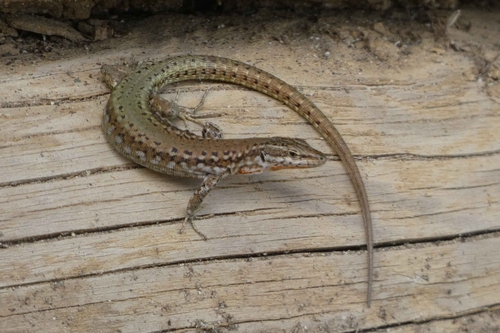
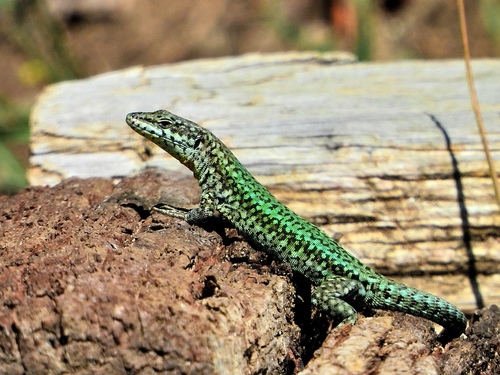
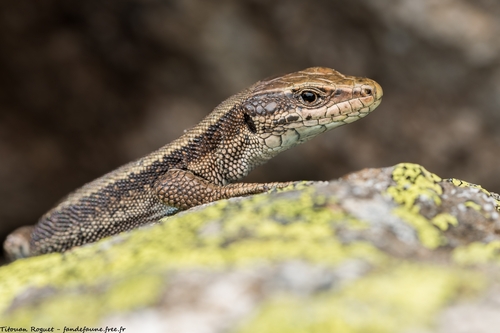
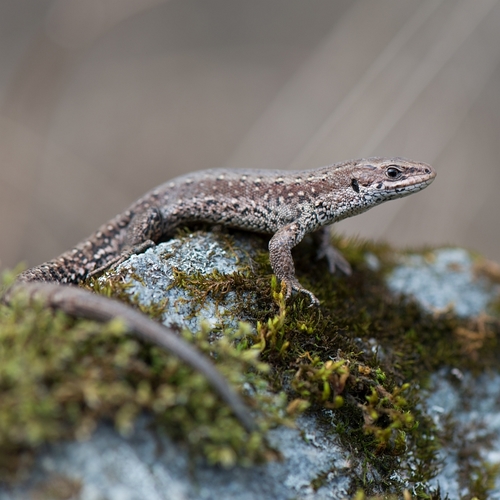
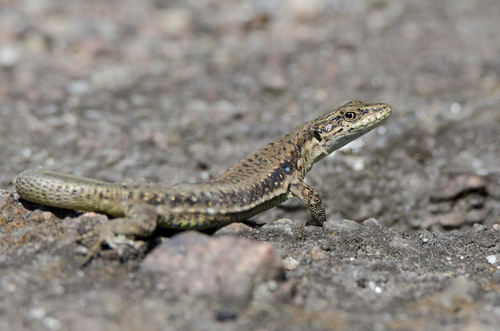
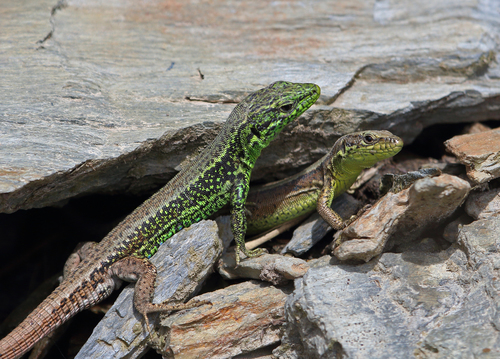
The Iberian rock lizard, Iberolacerta monticola, measures about 8 cm (3 in) from snout to vent, with a long, slender tail twice the length of its body. It has a somewhat flattened build, with finely boned, short limbs. Its body color varies across its range. The general base color is light brown or green, patterned with either longitudinal color bands or longitudinal rows of dots and small patches. Unlike some other wall lizard species, the stripe along its spine is less dark than its other bands. Most, but not all, individuals have a distinctive green belly, and juvenile lizards may have blue tails. A 2008 field study recorded that the underparts of Iberian rock lizards turn green as they reach maturity, and the upperparts gradually turn green as the lizard ages further. This lizard is distributed in the Cantabrian Mountains and Galicia in northwest Spain, the Sierra de Gredos in central Spain, and Serra da Estrela in central Portugal. It can be found at sea level in Galicia, but elsewhere it is rarely found below 1,000 m (3,281 ft) altitude, and occurs up to 2,000 m (6,562 ft) above sea level in mountain areas. It prefers damp locations among boulders in scrubby areas, and in Galicia it also inhabits low-level woodlands. It is a cold-resistant species, and is often found above the tree line in areas with long winters and wet or misty summers. Where its range overlaps with the common wall lizard (Podarcis muralis), the Iberian rock lizard occurs at higher altitudes and climbs higher on cliffs. During the breeding season, male Iberian rock lizards are often territorial. Sexually mature females lay their eggs under stones or in other concealed locations; eggs are approximately 10 to 15 mm (0.39 to 0.59 in) long. Young lizards hatch after about six to eight weeks, and reach sexual maturity in around two years. A 2008 field study found that females preferentially mate with males that have more green coloration on their bodies.