About Iberis sempervirens L.
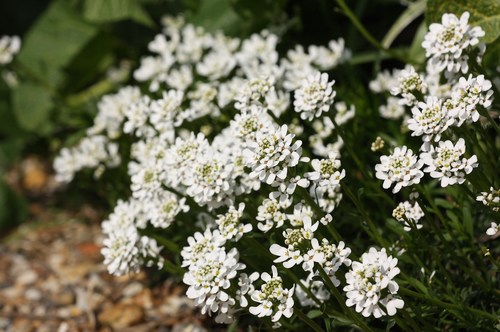
Iberis sempervirens L. is a spreading subshrub that grows 30 cm (12 inches) high and 40 cm (16 inches) wide. As a popular spring-blooming ornamental plant, it is often used to cascade over rocks and walls, or as groundcover. Its glossy evergreen foliage forms a billowing mound, and it produces many fragrant, pure white flowers in tight clusters for several weeks during spring and early summer. Its leaf blades are leathery, generally 25–75 mm (1–3 inches) long, and rarely reach 125 mm (5 inches) long. Leaf blades are 2 to 5 millimetres wide, shaped oblong spatulate to lanceolate, and are obtuse with a pointed base. The fruits of this plant are roundish to broadly ovate, 6 to 8 millimetres long and 5 to 6 millimetres wide. The seeds are narrowly winged and 2 to 3 millimetres long.
Its natural range covers Europe, where it occurs in Spain, France, Italy, Romania, and the Balkan Peninsula. In Africa, it is found in Morocco and Algeria. In Asia, it is present in Syria and Turkey. It has become naturalised in the British Isles, Assam, and North America. It grows in steppes and dry forests in locations that range from sunny to lightly shady. It prefers moderately dry to fresh, slightly acidic to alkaline, sandy-loamy to loamy, nutrient-rich soils. This species is heat-loving and frost-hardy.
When cultivated in gardens, it may need light pruning immediately after blooming. Aside from this pruning, plants do not require additional care in fall and early spring. It is drought-tolerant once it is fully established. It prefers a well-drained site, so heavy clay soils that remain wet through winter should be avoided. It is not easily propagated by division. Iberis sempervirens survives in USDA hardiness zones 3–9, which correspond to mean annual minimum temperatures of −23 to −21 °C (−10 to −5 °F). It is hardy across most parts of the UK, surviving temperatures as low as −15 °C (5 °F). A period of cold weather called vernalization is required to initiate flowering. At least 8–10 weeks at an average temperature of 5 °C (40 °F) are needed for this process. The cultivar 'Snowflake' has received the Royal Horticultural Society's Award of Garden Merit.