About Iambrix salsala (Moore, 1865)
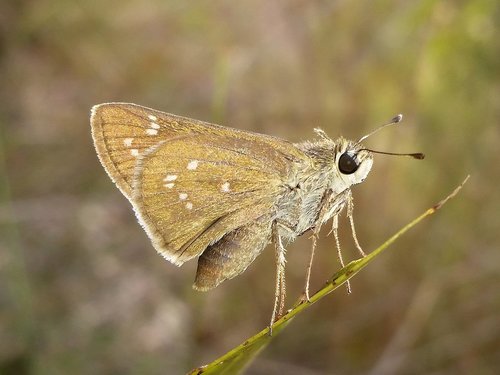
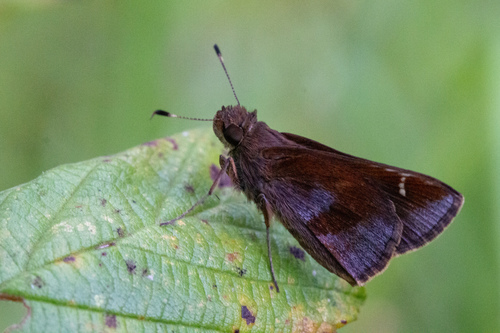
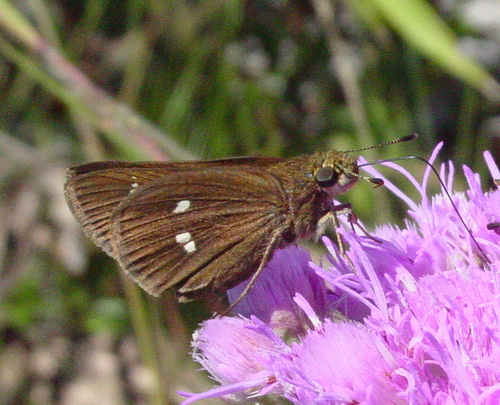
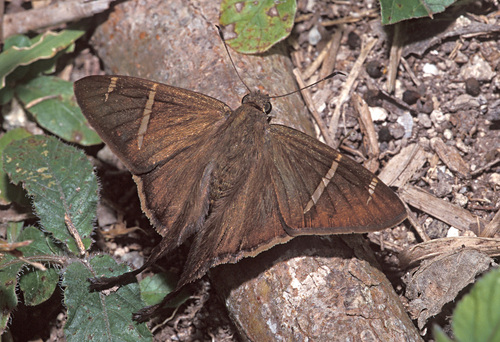
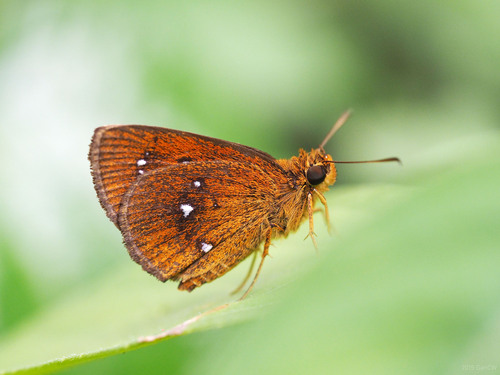
This species is Iambrix salsala, originally described in detail by Watson in 1891. The description from Watson (1891) is as follows: Both males and females are dark brown with an olive-brown gloss. On the upperside of the male forewing, there are two or three ill-defined yellowish spots that run obliquely upward from beyond the middle of the posterior margin. On the upperside of the female forewing, there is an oblique series of small semi-transparent white spots curving across the disc (these spots are more or less distinct), ending below in an ill-defined yellowish spot. The underside is chestnut-brown, suffused with black on the disc; the forewing has minute white spots: one at the end of the cell, and two or three placed obliquely beyond it; the hindwing has a series of three spots arranged in a curve across the disc; the cilia are greyish-brown. The palpi, body, and legs are yellowish on the underside. Mr. de Niceville stated that he considers A. salsala to be identical to A. stellifer, though Mr. Moore informed him that the female of A. salsala has a curved discal row of seven white spots and two lower ochraceous discal spots, and is a larger species than A. stellifer Butler. According to Mr. Elwes, the two species are identical, and Sikkim specimens vary considerably in the spots on the forewing upperside: the spots are sometimes white, sometimes rufous, and sometimes absent, just as in stellifer. I have numerous specimens of this species from Rangoon, Beeling, Upper Tenasserim, Madras, Kadur District, and Mysore; these specimens vary a great deal in how distinct the spots are on both the upperside and underside, but I cannot find any consistent characteristic to separate them into two species. This butterfly can be found in Sri Lanka, India, Nepal, Myanmar, Thailand, Cambodia, Laos, north Vietnam, Hainan, Hong Kong, south Yunnan, Langkawi, Malaysia, Singapore, Tioman, Sumatra and Java. In India, the butterfly is found in South India, Calcutta, along the Himalayas from Kumaon to Sikkim, Assam, and extends eastward to Myanmar. Edward Yerbury Watson (1891) recorded the butterfly's range as: it has been recorded from Bengal (Moore), Cachar (Wood-Mason and de Niceville); Tavoy (Elwes and de Niceville); Calcutta (de Niceville); Orissa (Taylor); Sikkim (de Niceville; Elwes). It has been recorded as A. stellifer from Ceylon (Hutchison, Wade, Mackwood); Poona, Bombay (Swinhoe); and the Nilgiris (Hampson).