About Hystrix indica Kerr, 1792
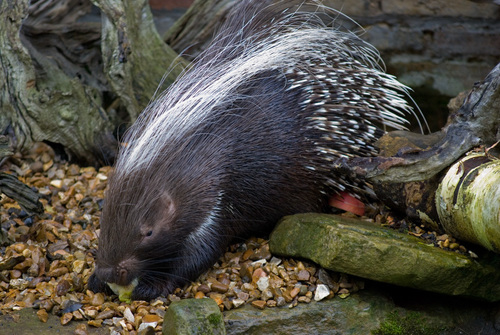
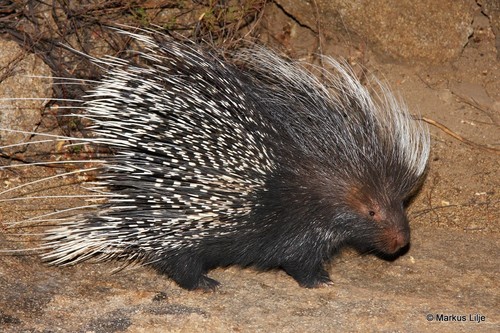
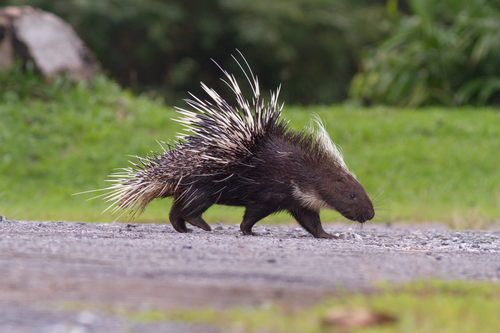
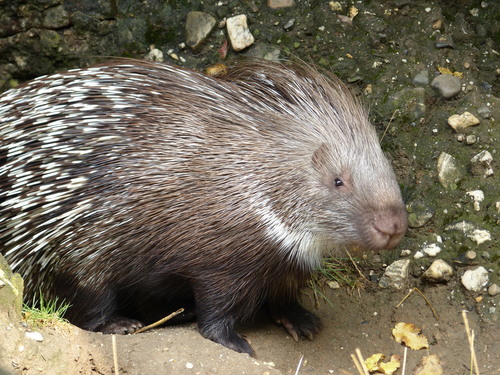
The Indian crested porcupine, scientifically named Hystrix indica Kerr, 1792, is a large rodent. Adults weigh between 11–18 kg (24–40 lb), with a body length from nose to tail base of 70 to 90 cm (28 to 35 in), and an additional 8–10 cm (3.1–3.9 in) from the tail. Their lifespan in the wild has not been documented; the oldest known captive individual was a female that lived to 27.1 years old. The species is covered in multiple layers of modified hair called quills, with longer, thinner quills lying over a layer of shorter, thicker quills. Quills are brown or black with alternating black and white bands, made of keratin, and relatively flexible. Each quill connects to a muscle at its base, allowing the porcupine to raise its quills when it feels threatened. The longest quills grow on the neck and shoulder, where they form a "skirt" around the animal. These quills can reach up to 51 cm (20 in) in length, with most measuring between 15 and 30 cm (5.9 and 11.8 in). Smaller 20 cm, more rigid quills are densely packed on the back and rump, and these smaller quills are used to stab potential threats. The base of the tail holds shorter quills that appear white, plus longer, hollow quills that the porcupine can rattle to produce a warning sound when threatened. Contrary to popular belief, Indian crested porcupines, like all porcupines, cannot shoot their quills. This porcupine has a stocky build with a low surface area to volume ratio, which helps it conserve heat. It has broad feet with long claws adapted for burrowing. Like all porcupines, it has a good sense of smell and sharp, chisel-shaped incisors. Indian crested porcupines are distributed across southwest and central Asia, found in Afghanistan, Armenia, Azerbaijan, China, Georgia, India, Iran, Iraq, Israel, Palestine, Jordan, Kazakhstan, Kyrgyzstan, Lebanon, Nepal, Pakistan, Saudi Arabia, Sri Lanka, Turkey, Turkmenistan, and Yemen. The first confirmed sighting in the United Arab Emirates' Wadi Wurayah was recorded in 2018, and one individual was spotted in the Russian republic of Dagestan in 2019. Thanks to their flexible environmental tolerances, they occupy a broad range of habitats. They prefer rocky hillsides, but are also common in tropical and temperate shrublands, grasslands, forests, plantations, and gardens. Their range is limited by seasonal forage density and the availability of suitable substrate for digging burrows. More specifically, the species' northern range limit is set by minimum summer night duration: they do not live at latitudes where minimum night duration is less than 7 hours, presumably due to the foraging time required to meet their dietary needs. Indian crested porcupines mate in February and March. Gestation lasts an average of 240 days. Females produce one brood of two to four offspring per year. Young are born with open eyes, covered in short, soft quills that harden within a few hours after birth. Young are fully weaned 13–19 weeks after birth, but stay in the den with their parents and siblings until reaching sexual maturity around 2 years of age. Indian crested porcupines are reported to be usually monogamous, and mate every night throughout their lives. This behavior is not only for reproduction, but also to maintain and strengthen the pair bond between the male and female partner. Before this observation, this pattern had only been recorded in humans, bonobos, and some dolphins.