About Hystrix cristata Linnaeus, 1758
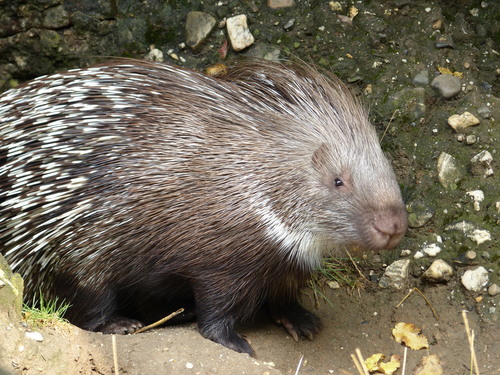
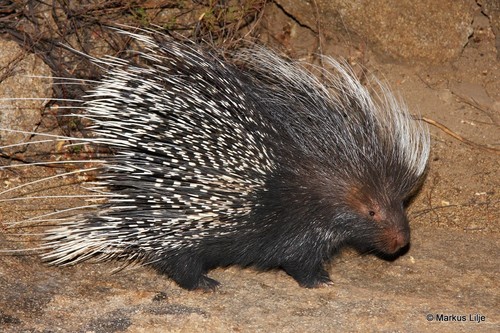
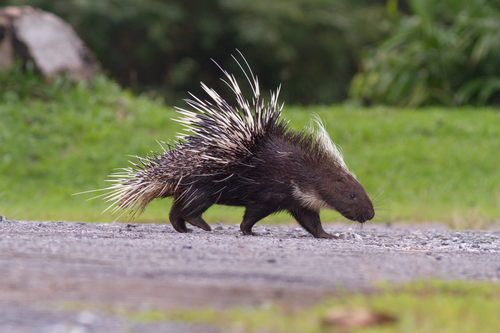
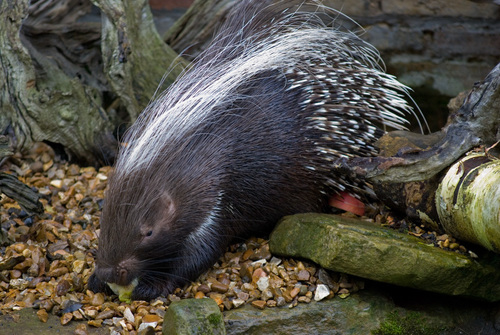
Characteristics: For adult crested porcupines (Hystrix cristata), average head-and-body length (excluding the tail) ranges from 60 to 83 cm (24 to 33 in), and body weight ranges from 13 to 27 kg (29 to 60 lb). It is one of the largest rodents in the world. Almost its entire body is covered in coarse, dark brown or black bristles. This mammal is identifiable by the quills that run along its head, nape, and back, which can be raised to form a crest, giving the species its common name. Sturdier quills, reaching roughly 35 cm (14 in) long, run along the sides and the back half of the body. These sturdier quills, which are marked with alternating light and dark bands and not firmly attached, are used primarily for defense. The crested porcupine has a short tail with rattle quills at its tip. These rattle quills broaden at their terminal end, and the broad terminal section is hollow with thin walls. When the quills vibrate, they produce a hiss-like rattle similar to the sound of a rattlesnake. The front feet have four fully developed, clawed digits, with a regressed thumb, while the rear feet have five digits. The paws have naked, padded soles, and the crested porcupine moves with a plantigrade gait. It has external ears; both the eyes and ears are very small, and long vibrissae are present on its head. Its skull has three distinct features: the infraorbital foramen is greatly enlarged, allowing portions of the masseter muscle to extend through it and attach to the frontal side surface of the snout; the angular process of the lower jaw is inflected; and the nasal cavity is enlarged. Prominent pockets create larger attachment areas for chewing muscles. Collar bones are greatly reduced, and each dental quadrant holds one incisor, one premolar, and three molars. When not erect, the male's penis points caudally, towards the rear of the body. Crested porcupines can live up to 28 years, the second-longest lifespan of any rodent; only the naked mole-rat has a longer maximum lifespan, exceeding 37 years.
Distribution and habitat: The crested porcupine occurs in Italy, North Africa, and sub-Saharan Africa. In the Mediterranean region, it is found in mainland Italy, the island of Sicily, Morocco, Algeria, and Tunisia; it has also been recorded in Ghana, Libya, and along the Egyptian coast. In Morocco's Anti-Atlas range, it has been recorded from sea level up to 2,550 m (8,370 ft) elevation. It is native to Algeria, Benin, Burkina Faso, Burundi, Cameroon, Central African Republic, Chad, Côte d'Ivoire, Democratic Republic of the Congo, Eritrea, Ethiopia, Gambia, Ghana, Djibouti, Guinea, Guinea-Bissau, Italy, Kenya, Liberia, Libya, Mali, Morocco, Nigeria, Rwanda, Senegal, Sierra Leone, Somalia, Sudan, South Sudan, Tanzania, Togo, Tunisia and Uganda. It may be locally extinct in Egypt.
Behaviour and ecology: The crested porcupine is a terrestrial mammal that very rarely climbs trees, but is capable of swimming. It is nocturnal and monogamous. It cares for its young over an extended period, and small family groups consist of an adult pair and young of various ages. When disturbed as a defense, crested porcupines raise and fan their quills to appear larger. If harassment continues, they will stamp their feet, vibrate their quills to produce a rattle, and charge backward toward the disturber to stab them with thicker, shorter quills. Such attacks have been recorded killing lions, leopards, hyenas, and even humans. Crested porcupines are known to collect thousands of bones they find while active at night. As mostly nocturnal animals, they may encounter animal skeletons, then collect and store these bones in underground chambers or caves.
Reproduction: Most current knowledge of crested porcupine reproduction comes from captive individuals. Typically, females produce one litter per year. After an average gestation period of 66 days, one or two fully developed young are born in a grass-lined chamber within a burrow. Newborns weigh roughly 1,000 g (2.2 lb), equal to about 5% of the mother's body weight. Young leave the den after one week, when their spines begin to harden. Crested porcupines reach adult weight at one to two years of age, and often become sexually mature just before reaching this weight. Breeding can occur throughout the year.