About Hystrix brachyura Linnaeus, 1758
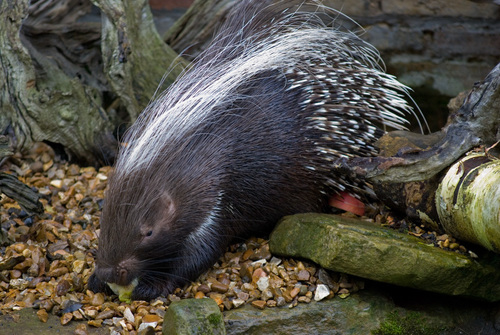
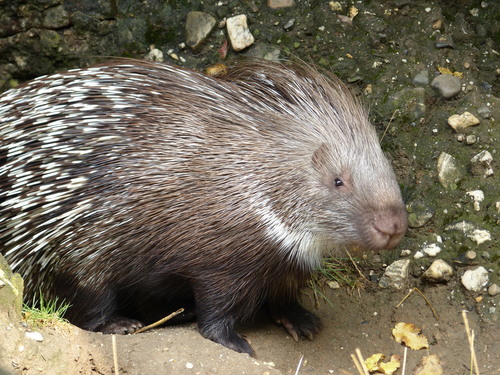
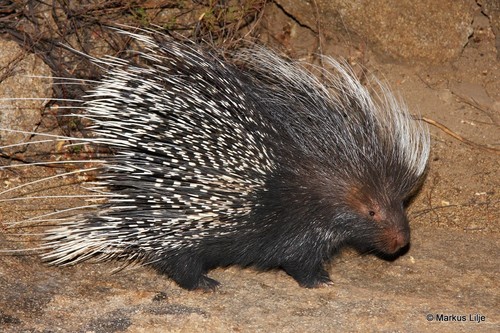
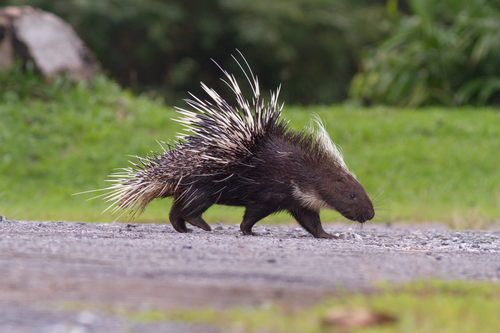
Hystrix brachyura Linnaeus, 1758, commonly called the Malayan porcupine, is a large, stout-bodied rodent covered in sharp, rigid quills that are modified hairs. Quills on the upper body are rough, black with white or yellow stripes. Young porcupines have soft quills that harden as they reach adulthood. This species has short, stocky legs covered in brown fur, with four claws on each front paw and five claws on each hind paw, and both front and hind paws have smooth soles. Head and body length ranges from 56 to 74 cm, tail length ranges from 6 to 11 cm, and adult body weight ranges from 10 to 18 kg. The Malayan porcupine's distribution extends from Nepal through northeast India (including Arunachal Pradesh, Sikkim, West Bengal, Manipur, Mizoram, Meghalaya, and Nagaland) to Bangladesh, central and southern China (including Xizang, Hainan, Yunnan, Sichuan, Chongqing, Guizhou, Hunan, Guangxi, Guangdong, Hong Kong, Fujian, Jiangxi, Zhejiang, Shanghai, Jiangsu, Anhui, Henan, Hubei, Shaanxi, and Gansu), throughout Myanmar, Thailand, Laos, Cambodia, and Vietnam, through Peninsular Malaysia to Singapore, Sumatra (Indonesia), and the entirety of Borneo (Indonesia, Malaysia, Sarawak, and Brunei). It is also found on Penang Island, Malaysia. It occurs from sea level up to at least 1,300 m above sea level, and inhabits various forest types, open areas near forests, and may stray into nearby agricultural areas. A 2020 study that sequenced partial mitochondrial 12S rRNA and cytochrome b genes from late Pleistocene porcupine fossils found in northern China suggests the Malayan porcupine may be closely related to the extinct species Hystrix subcristata. This analysis supports the hypothesis that range contraction or local extinction in northern regions allowed continued evolution of Hystrix populations in southern regions. The Malayan porcupine is terrestrial, and typically lives in small groups, though it may also live alone or in pairs. It most often occupies dens found near rocky areas, in tree holes, or in root systems, but may also dig its own burrows; networks of trails extend from these burrows into the surrounding habitat. It can be found in all forest types up to 1,500 m in altitude. It is nocturnal, foraging at night and resting during the day. It is capable of swimming and gnawing. Female porcupines usually give birth to a single pup per litter, though births of two pups have been recorded. Gestation lasts between 90 and 112 days, and the species has a maximum longevity of around 27 years.