About Hystrix africaeaustralis Peters, 1852
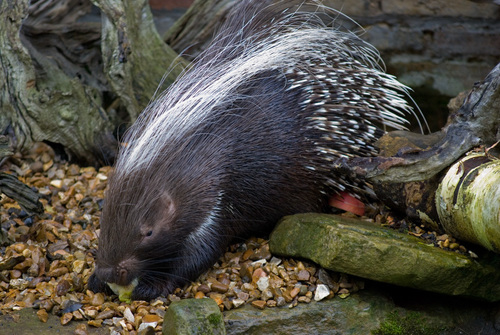
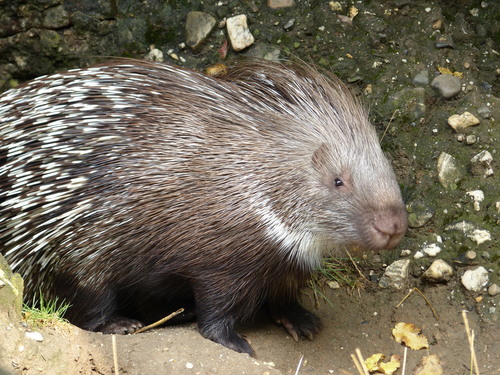
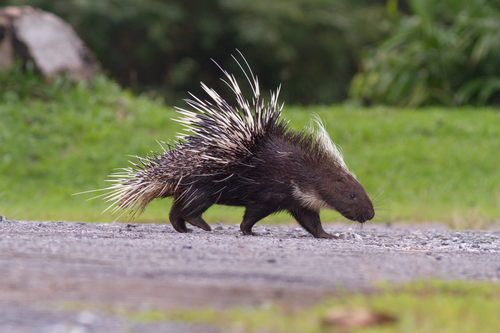
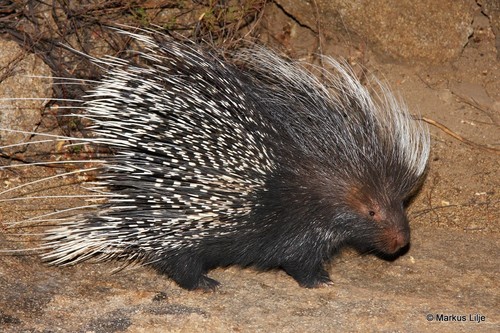
Cape porcupines (scientific name Hystrix africaeaustralis Peters, 1852) are counted among the largest rodents in Africa, and also one of the largest porcupine species in the world. Only a small number of other rodent species, including capybaras, and Eurasian and North American beavers, have a larger average body mass than Cape porcupines. They look very similar to the closely related crested porcupine, which is slightly smaller than the Cape porcupine. The easiest way to tell Cape porcupines apart from crested porcupines is the band of short white spines running along the midline of Cape porcupines' rumps. On average, Indian porcupines are roughly the same size as Cape porcupines; they are slightly heavier on average than crested porcupines, but slightly lighter than Cape porcupines. Cape porcupines measure 63 to 81 centimetres (25 to 32 inches) from the head to the base of the tail, with the tail adding an additional 11 to 20 centimetres (4.3 to 7.9 inches). They weigh between 10 and 24 kilograms (22 to 53 pounds), and exceptionally large specimens can weigh up to 30 kg (66 lb). Males and females do not have significant differences in overall size, though average weights vary between populations: in Zimbabwe, the average weight of males was 16.9 kg (37 lb) and the average weight of females was 18.4 kg (41 lb); in the Orange River valley of South Africa, males averaged 12.3 kg (27 lb) and females averaged 13 kg (29 lb). Cape porcupines are heavily built animals, with stocky bodies, short limbs, and an inconspicuous tail. Their body is covered with long spines that can grow up to 50 centimetres (20 in) in length. These long spines are interspersed with thicker, sharply pointed defensive quills that reach up to 30 centimetres (12 in) long, and the animal also has bristly blackish or brownish fur. The spines on the Cape porcupine's tail are hollow, and the animal uses them to make a rattling sound to scare off predators. An erectile crest of long, bristly hairs runs from the top of the animal's head down to its shoulders. Spines and quills cover the back and flanks of the Cape porcupine, starting around a third of the way down the body and continuing onto the tail. The quills have multiple alternating bands of black and white along their length, and grow from evenly spaced grooves across the animal's body. Each groove holds five to eight quills. All other parts of the animal, including its undersides, are covered with dark hair. Cape porcupines have relatively small eyes and ears, and short mobile whiskers. Their feet have five clawed toes, though the first toes on their forefeet are vestigial. Females have two pairs of teats. Cape porcupines are found across all of southern and central Africa, with their range reaching southern Kenya, Uganda, and Congo at its northern edge. They can live in a wide range of habitats, from sea level up to 2,000 metres (6,600 ft). They only occur in small numbers in dense forests and the driest deserts, and they are not found in swampland. No subspecies of Cape porcupine are currently recognised. Cape porcupines mate throughout the year, but births are most common during the rainy season, which falls between August and March. Unless a female's previous litter is lost, she typically only gives birth once per year. Oestrus lasts an average of nine days; during this period, a membrane across the vagina opens to allow insemination. After mating, a copulatory plug forms, and it is expelled around 48 hours later. Gestation lasts approximately 94 days, and produces a litter of up to three young. Over half of all births are just a single young. Newborn Cape porcupines weigh 300 to 440 grams (11 to 16 oz), and are born with soft quills that harden within a few hours. Newborns have their incisor teeth fully erupted at birth, but their other teeth begin to emerge at 14 days of age, and the full set of adult teeth is in place by 25 months. Young Cape porcupines are weaned at around 100 days old. They grow rapidly for their first twenty weeks, and reach full adult size and sexual maturity by the end of their first year. Compared to most other rodents, Cape porcupines are long-lived. They can survive for 10 years in the wild, and live up to 20 years in captivity.