About Hypsopygia costalis Fabricius, 1775
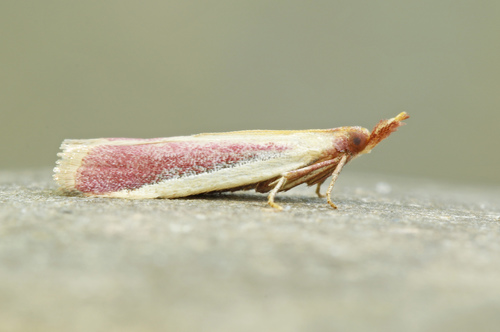
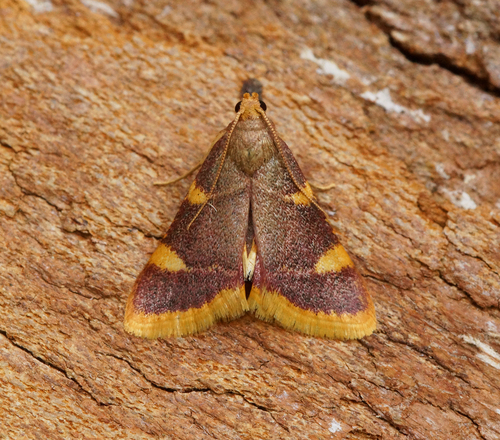
Hypsopygia costalis, commonly known as the gold triangle or clover hay moth, is a moth species belonging to the family Pyralidae. It was first described by Johan Christian Fabricius in 1775, and is found in Europe. This moth has a wingspan of 16 to 23 mm. Its forewings are purple, sometimes sprinkled with blackish spots; the median section of the costa is dotted with yellow. The wing lines are yellow, nearly straight, and form large spots on the costa. Both the terminal line and cilia are yellow. The hindwings match the forewings in base color, but their lines are positioned much closer together, are irregularly curved, and do not form spots on the costa. Adult moths fly from May to July, with timing varying based on location. The previously recognized species H. aurotaenialis is currently included within Hypsopygia costalis, pending further research to confirm its status. The caterpillars of this species feed on dry vegetable matter. They have been found living in haystacks, thatching material, and also in the nests of chickens (genus Gallus) and magpies (genus Pica). Caterpillars are known to be damaging to clover hay, and to other hay that is mixed with clover. Damage can be prevented by storing hay in a dry, well-ventilated condition, because this moth prefers to breed in moist or matted material, such as that found in the lower sections of haystacks. Affected hay becomes filled with caterpillar webbing and excrement, which makes it unfit for use as feed. To address an infestation, affected webbed material can be burned and the infested area can be thoroughly cleaned.